
 Worksheets
Inverses, Domain, Solving Radical, Exponents Review
Total questions: 236
Worksheet time: 17hrs 37mins
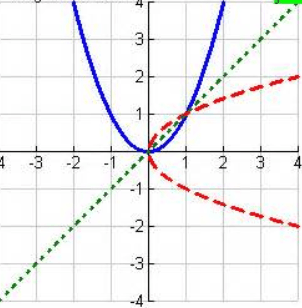
Are the blue and red graphs inverse functions?
Yes, the functions reflect over y = x
No, they do not reflect over the x - axis.
No way to tell from a graph

What does it mean to find the inverse of a function when given a table of values?
the x's and y's are switched
the x's and y's are divided by 2
the x's and y's are made negative
the x's and y's are the same
f-1(x) is written when...
The inverse is not a function
The function fails the HLT
The inverse is a function
There are two different functions

Range: (-∞, 2]
Range: (-∞, ∞)
Range: (-∞, ∞)
Range: [2, ∞)

Bacteria growing can be represented by which of the following?
Exponential Growth
Exponential Decay


Which is the inverse of the table?


Are the blue and red graphs inverse functions?
Yes, the functions reflect over y = x
No, they do not reflect over the x - axis.
No way to tell from a graph

Hint: Use a scratch graph to help you visualize things.
State if the functions are inverses.
Yes
No


Which mapping diagram is not a function?


f(x) = x
f(x) = x2 + 4x + 3
f(x) = √x
f(x) = √(x - 2)
OR f(x) = (x - 2)1/2
f(x) = √(x + 3)
OR f(x) = (x + 3)1/2
f(x) = 1 / x
f(x) = 1 / (x - 5)
OR f(x) = (x - 5)-1
f(x) = 1 / √x
OR f(x) = x-1/2

State the domain:
(-oo, 7) U (7, oo)
(-oo, -7) U (7, oo)
(7, oo)
[7, oo)

State the domain:
(-oo, -4) U (-4, oo)
[-4, oo)
(-oo, -4]
(-oo, oo)

State the domain:
(-oo, 4)
(-oo, 2]
[2, oo)
[4, oo)

State the domain:
(-oo, oo)
(-oo, -2) U (-2, 2) U (2, oo)
(-2, oo)
[-2, oo)


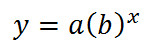
In an exponential function, what does the 'a' represent?
Slope
Rate of change
Y-intercept
Multiplier
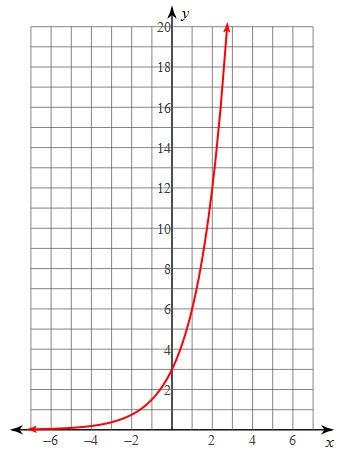
Is the graph linear, exponential, or neither?
Linear
Exponential
Neither
A=1200(.85)6
A=10(1.01)3

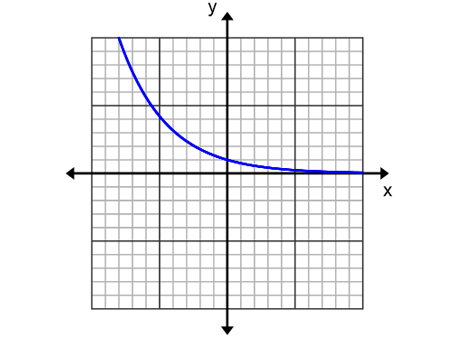
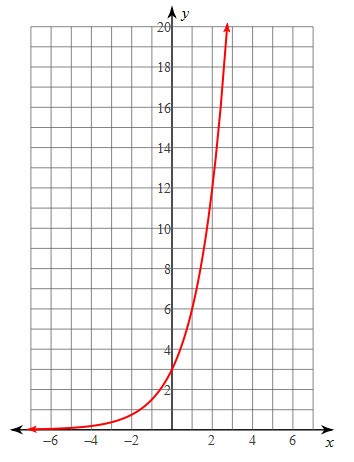
Samantha's hair was known to grow very rapidly. It began at a length of 6 in and grew at a rate of 14% a week.
Identify the initial value:
y = 6.87 (4)x
a = 4
a = 6.87
a = 3
a = 1
What type of pattern do exponential functions have?
Adds or subtracts by the same number every time
Multiplies or divides by the same number every time
Square roots all the inputs
What is the graph of the function
y=5⋅2x


Suppose the population of a species of insects doubles every year. There are 1600 insects initially. The function for the scenario would be?
f(x)=2x+1600
f(x)=1600×2
f(x)=1600⋅2x
The function
f(x)=1600⋅2x gives the number of insects after x years. How many insects were there initially?1600
2
There is not enough information to tell.
Suppose the population of a species of insects doubles every year. The function f(x)=1600(2)x gives the number of insects after x years.
How many insects will there be after 3 years?
9600
12,800
200
8000

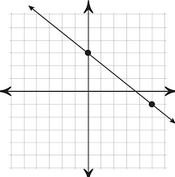
The relation in the graph is..
a function but not a one-to-one function.
a one-to-one function.
not a function

The relation in the graph is..
a function but not a one-to-one function.
a one-to-one function.
not a function

The relation in the graph is..
a function but not a one-to-one function.
a one-to-one function.
not a function

The relation in the graph is..
a function but not a one-to-one function.
a one-to-one function.
not a function

The relation in the graph is..
a function but not a one-to-one function.
a one-to-one function.
not a function

The relation in the graph is..
a function but not a one-to-one function.
a one-to-one function.
not a function

The relation in the graph is..
a function but not a one-to-one function.
a one-to-one function.
not a function

The relation in the graph is..
a function but not a one-to-one function.
a one-to-one function.
not a function

The relation in the graph is..
a function but not a one-to-one function.
a one-to-one function.
not a function.

The relation in the graph is..
a function but not a one-to-one function.
a one-to-one function.
not a function.


Which represents exponential decay?
A
B
C
D
Determine the horizontal asymptote for the function
f(x) = 3(2)x-4 + 5
x=4
y=4
x=5
y=5
Determine the range for the function
f(x) = 3(2)x-4 + 5
[5,∞)
(5,∞)
[4,∞)
(4,∞)
f(x)=3(2)x-4+5

f(x)=2x-1-3
f(x)=2x-1+3
f(x)=2x+1-3
f(x)=2x+1+3
Given the original exponential function defined by y=4x, how would the graph change if the function were:
y=2(4)x-3+1?
Vertically stretched by a factor of 2, right 3, and up 1
Vertically compressed by a factor of 1/2, left 3 and down 1
Vertically compressed by a factor of 1/2, right 3, and down 1
Vertically stretched by a factor of 2, left 3, and up 1
Which of the following is an exponential decay? (Check all that apply)
y = 5⋅(1/5)x
y = 5⋅(7/2)x
y = 5⋅8x
y = 5⋅1.5x

What is the a-value of the function?
4
3
2
1

Which of the following are TRUE about the function? (Choose all that apply)
The exponential decay has been reflected.
The exponential growth has been reflected.
The function has been shifted down 2 units.
The function has an growth rate of 2.
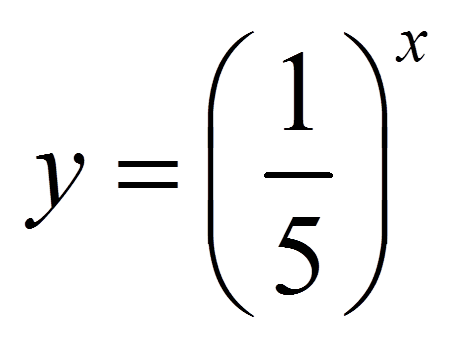

Which function represents the table of values?
f(x) = 4x
f(x) = x4
f(x) = 4x
f(x) = 4x-1
Does this table represent exponential growth or decay?
Growth
Decay


State the domain:
(-oo, oo)
(-oo, 3) U (3, oo)
(-oo, -3) U (-3, 3) U (3, oo)
[3, oo)

State the domain:
(-oo, 2]
[5, oo)
(-oo, 5/2]
[5/2, oo)

State the domain:
(-oo, 3) U (3, oo)
(-oo, 3]
(-oo, 3)
(3, oo)
State the domain:
(-oo, oo)
(-oo, -2) U (-2, 2) U (2, oo)
(-2, oo)
[-2, oo)

State the domain:
(-oo, oo)
[0, oo)
(-oo, 0)
(0, oo)

State the domain:
(-4, oo)
[-4. oo)
(-oo, -4]
(-oo, oo)

State the domain:
(-oo, 4]
[4, oo)
(-oo, -4) U (-4, oo)
[-4, oo)

State the domain:
(-oo, oo)
(-oo, 6) U (-2, oo)
(-oo, -2) U (-2, 6) U (6, oo)
(-oo, -2) U (-2, 0) U (0, 6) U (6, oo)

State the domain:
(-oo, oo)
[3, oo)
(3, oo)
(-oo, 3) U (3, oo)

State the domain:
(-oo, oo)
(-oo, 0]
[0, oo)
(-oo, 0) U (0, oo)
f( ____ ) = 10
find f(0)
Find h(-3)


√23
Write the expression in radical form.
y1/2
√y
∛y
√y2
∛y2
Check all that is true
Simplify the expression:
361/2
6
36
-6
1296
Check all that is true
Simplify the expression:
271/3
3
9
∛27
33
y¹⁄ ³

831 check at that applies
24
2
cubed root of 8
512

Check all that applies
8
4
1024
2561/4
521
5
10
25
25
231
2
cubed root of 3
6
cubed root of 2
an exponent 1/2 means
square root
cube root
fourth root
fifth root
Your exponents denominator is the (a) ?
In the following, what is my base (−2)31
-2
2
−261
What is my base
-2
2
13
6
13
1321
132
What is the 5th root of 1024?
5120
4
160
32
51231
8
22
1539
171
Bonus:
21z21212 z2
21 z2
21z
21 z

a8
a15
a35
a-2


0
1
3
31


a-3
a3
3a
1/a-3


0
1
3
31


a6
a-60
a4
a-7

a6b4
a8b
a8b4
a2b4


2x4y4
2
Simplify the rational expression
x4⋅x5⋅x3
x12
x19
x27
x60
√x⁵
23 = 8


14n−2m47n5m−2 Simplify the rational expression. Use positive exponents.
2n3m2
14mn27nm3
2m2n3
2m6n7
Simplify (x71)23 and write your answer in radical form.
21x2
14x3
x3
3x14
yx31⋅xy23
x34y25
x32y21
x31y23
x32y34
Simplify . Your answer should contain only positive exponents. (a21b21)−1
a21b211
a21b21
−a21b211
−a21b21
Simplify . Your answer should contain only positive exponents. (x0y31)23x0
y21
1
y34
0

∛x2
Simplify . Your answer should contain only positive exponents. 4v32⋅v−1
4v31
v314
4v31
4v311

16z7
16z−7
z78
z716
Simplify: 335
81
9
335
36
Simplify: 4w⋅w
w3
w3⋅4w
4w3
w⋅4w3
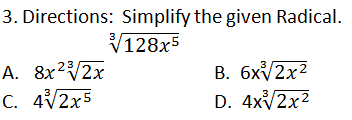
A
B
C
D
Match the radical expression with its equivalent exponential equation.
m8
m4
m81
m41
m41
Which expressions are equivalent to (3x)2 ?
Choose ALL answers that apply.
(x31)2
3x2
x321
x23
3x15
x5
x51
x12
x18

Simplify
b21/20
b43/20
b13/20
b4
Simplify the following and rewrite the answer in radical form:
b32b43
4b2
17b12
12b17
12b
Simplify and put your answer in radicals:
4x3⋅3x2
7x5
12x6
12x5
12x17


Solve the radical equation: 11=2+90−x
x = 9
x = 82
x = -9
x = -82
Solve the radical equation: x−5=23−x
x = -14
x = 14
No Solution
x = 28
Solve the radical equation: 6+6−15x=15
x = -5
x = 1/5
No Solution
x = -1
Solve the radical equation: 4+9x=5
x = 9
x = -9
x = 21
x = -21
Solve the radical equation: 10=14x+2
x = 102
x = 12
x = 98
x = 7
Solve the radical equation: 2x−7=x+2
x = 3
x = -9
x = -5/3
x = 9
Solve the radical equation: −6+6x=−3
x = 9
x = 18
x = 486
x = 54
Solve the radical equation: x−3+5=9
x = 5
x = 11
x = 19
x = 16
Solve the radical equation: x+1=4x−8
x = 3
x = -3
x = 2
x = -2
Solve the radical equation: 6x+1−8=3
x = 20
x = 11
x = 4
x = -2



