
NEW
Font size
 Worksheets
Big Idea 15 &17
Total questions: 50
Worksheet time: 55mins

Josie likes to visit the park in her neighborhood to watch hummingbirds. Based on the beak of the hummingbird, what does it most likely eat?
Fish
Nuts
Insects
Flower Nectar

The picture shows flowers with an unusual shape. Which beak shape would best allow a bird to reach the nectar inside the flower?
Long and thin
Short and thick
Short and thin
Long and thick
Bullfrogs are Florida’s largest frog. Frogs spend part of their life cycles in water and part on land. Which physical characteristic is most useful for a water environment?
Thin skin
Large eyes
Webbed feet
Long, strong legs

Water lilies live in lakes and ponds. The lilies have very long stems. The picture shows a water lily in a pond. How do long stems help water lilies live in ponds?
They absorb food for the plant.
They absorb water from the pond.
They enable the pads and flower to reach sunlight.
They prevent the plant from floating away.

Pelicans are birds that live in many water environments. They can live in large lakes, in marshy wetlands, and along beaches near the ocean. The picture shows a pelican. What does the pouch on its bill most likely help the pelican do?
Catch fish
Store water
Attack other animals
Balance when it walks
Rivers are home to many kinds of birds. Which foot is most likely the adaptation of a bird that swims in water to find food?


In the fall, a ground squirrel will store the energy from food as a thick layer of fat. What is most likely the reason for this adaptation?
It keeps the animal from being exposed to diseases in winter.
It keeps the animal from being eaten by predators that hunt during winter.
It helps the animal get exercise during winter when it is snowing.
It helps the animal survive a cold winter when there is very little food.

Tom sketched this picture of an epiphyte from a book about tropical forests. How is this plant adapted to the ecosystem in which it lives?
It has a trunk tall enough to reach above nearby trees and compete for sunlight.
It has long roots that reach deep enough into the dry soil to reach underground water.
It has roots that attach to trees so that it can reach sunlight that is scarce on the forest floor.
It has leaves that capture and digest insects, which it needs for nutrients missing from soil.
It is estimated that fewer than 100 Florida panthers are still living. Florida now has a protected habitat for the panther. How will the protected habitat affect the panthers?
The panthers will probably become extinct.
Panthers will no longer be adapted to living in Florida.
The Florida panther population will decrease in the near future.
The panther population may increase now that they are being conserved in a protected habitat.
The state reptile of Florida is the American alligator. Reptiles rely on the environment to maintain their body temperature. Which behavioral adaptation below allows the alligator to control its body temperature?
Alligators mate in April and May.
The alligator basks in the sunlight.
Alligators lay between 20 and 50 eggs at one time.
The alligator eats turtles, small mammals, and birds.
Plants have various adaptations for survival. Some adaptations protect plants by discouraging animals from eating the flowers. Which of these is an adaptation that protects a rose from animals?
Tall stems
Sharp thorns
Large leaves
Soft flower petals
Physical characteristics that help an organism survive are called:
Habitats
Extinction.
Adaptations.
Learned behaviors.

The apple snail lives in ponds, lakes, and rivers. The apple snail is the largest snail found in the freshwaters of North America. The illustration shows an apple snail. How is the structure labeled X an adaptation for the apple snail?
The apple snail uses this structure to find food.
The apple snail uses this structure to reproduce.
The apple snail uses this structure to digest its prey.
The apple snail uses this structure to protect itself from predators.
Plankton are tiny organisms that live in the ocean. Some kinds of plankton live near the surface of the ocean where there is sunlight during the day. At night, they travel deeper into the ocean where it is safer to live. Which of the following is the plankton's behavior most similar to?
Some bats hibernate in winter
Some rabbits shed their thick fur in summer
Some birds migrate during spring and summer
Some plants produce poisonous chemical substances

The picture shows a scorpion along with some facts about it. The scorpion is adapted to live in a place that is _
cold and wet
windy and dark
cloudy and cool
hot and dry

Color or pattern that helps an animal blend in with its habitat
Adaptation: Tulip-Tree Beauty Moth
a. Hibernation
b. Behavior Adaptation
c. Camouflage
d. Migration

What physical adaptation helps some organisms breathe under water?
a. lungs
b. gills
c. fins
d. heart
Baby alligators in Georgia are dark colored with light stripes across their backs. How does this coloring help them survive?
The stripes attract different kinds of prey for alligators.
The dark color makes them look larger and more dangerous.
The stripes help them blend into the swamp to hide from predators.
The dark color helps parents find them easily among the tall marsh grasses.
Rudy looks a lot like other members of his family. Which is a characteristic that Rudy probably did not inherit from his parents?
size of his feet
color of his eyes
length of his hair
shape of his ears
Plant 1 was grown in the dark and grew 5 inches with no leaves. Plant 2 was grown in light and grew to 10 inches with lots of leaves. What can you conclude about the growth and features of these plants?
The environments determine the growth and all features.
The environments play no role in the growth and features.
The environments can affect the growth and some features.
The environments determine the growth but not the features.
Which behavior is an instinctive behavior?
Riding your bike to school.
Speaking English to your partner.
Jumping out of your seat when the fire alarm sounded.
Finishing your classwork.
What most likely causes the arctic hare to change its fur color between different seasons?
A new learned behavior.
The amount of sunlight.
Changes in the environment.
The quality of the food the hare eats.
Some animals hibernate during part of the year. Which of the following explains why some animals hibernate?
the behavior is a response to changes in the environment.
animals hibernate as a defense against predators.
most animals hibernate to avoid the summer's heat.
hibernating is an inherited physical adaptation.
At a dolphin show at the Clearwater aquarium, the dolphin swims through the water, jumps into the air, and takes food out of a trainer's hand. What kind of behavior does the dolphin demonstrate at the show?
Learned only.
Hereditary only.
Both learned and hereditary.
Neither learned or inherited.
Some animals migrate during part of the year. Which of the following explains why some animals migrate?
Animals migrate as a defense against predators.
Migrating is a response to changes in the environment.
Migrating is an inherited physical adaptation.
Most animals migrate to avoid the summer’s heat.
Harry looks a lot like other members of his family. Which is a characteristic that Harry probably inherited from his parents?
The length of his hair.
The scar on his forehead.
The color of his eyes.
The clothes he wears.
Lou and her family visit a circus during a trip. They watch an elephant balance on ball, walk through a hoop, and take food out of a trainer’s hand. What kind of behavior does the elephant demonstrate at the show?
both learned and inherited
hereditary only
neither learned or inherited
learned only


Which of these behaviors were learned?
walking on a leash and barking at birds
walking on a leash and fetching the paper
swimming in the pond and running around the backyard
swimming in the pond and barking at birds
Your sister is very good at playing the piano. What is her piano playing ability an example of?
a learned behavior
an inherited trait
a dominant gene
a recessive gene
James and his father are both great athletes. Which characteristic did James most likely learn from his father?
height and weight
fast swimming stroke
large feet and hands
muscular body structure
A bird eats a brightly colored insect that tastes bad. The bird avoids preying on this type of insect again. This example is best described as:
a physical characteristic
a learned behavior
an inherited behavior
an adaptation
Which of the following statements is true about omnivores and carnivores?
Omnivores eat both plants and animals, while carnivores only eat animals, but not plants.
Omnivores only eat animals, while carnivores eat both plants and animals.
Carnivores and omnivores both break down dead plants, animals, and bacterial.
Carnivores break down dead plants, and omnivores break down dead animals.
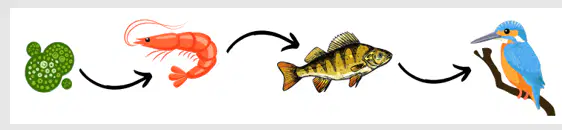
The Sun provides the energy to be used by the living things in the lagoon food chain show below.
Which of the following describes the transfer of energy from a producer to a consumer?
from perch to kingfisher
from brine shrimp to perch
from the sun to green algae
from green algae to brine shrimp
Suzanne is learning about animal behavior with a focus on the behaviors that animals have upon birth. She has collected data and information and has started to write her research paper on the topic.
Which of the following would make the best topic sentence for Susanne’s report?
Only adult animals can learn different behaviors.
Humans are the only mammals that can learn behaviors.
Animals are born with inherited behaviors called instincts.
An instinct is a behavior an animal has after a lot of practice.
In the rainforest, there is a very dense canopy of trees and heavy rainfall that make it difficult for sunlight to reach plants on the forest floor.
Which of these would not be an adaptation of a plant in a rainforest?
plants with very wide leaves
a carnivorous plant that eats insects
plants that need plenty of sunlight to make their food
plants with shallow roots to get nutrients for the rich topsoil
The American black bear lives in many parts of North America. A black bear in Colorado might hibernate for three or more months in winter, while a black bear in Florida practices a seasonal adaptation called denning. Denning bears are more active and more alert than hibernating bears.
Which statement best explains why?
Florida black bears are a different species from Colorado black bears.
Florida black bears practice denning because their climate is not as cold.
Florida black bears have less territory and cannot risk a long hibernation.
Florida black bears eat different food from bears in Colorado and need less rest.
The Western hognose snake hisses and even curls up just like a cobra snake for predators to think that it is a dangerous and venomous snake.
What form of behavioral adaptation does the Western hognose snake exhibit?
camouflage
hibernation
migration
mimicry
The bittern bird has a buff and brown colored back that allows it to blend in with the saw grass of the lakes near it. When it feels threatened, then it freezes and points its head skyward to resemble a reed. The Key deer is brown in color, lives in the forest, and freezes when threatened. Both animals live in Florida. How do these animals use similar adaptations to survive in their different environments?
Both use their small size to hide from approaching predators.
Both live in groups and huddle together with their family for protection from predators.
Both use their coloring and limited movement to avoid being seen by predators.
Both use the movement of their environment to distract predators so they can escape.
The Japanese honeysuckle is an invasive plant to Florida’s landscape. While sweet smelling and beautiful, the plant grows rapidly and stretches across landscapes, growing stronger as it ages. Why would this invasive plant need to be removed from Florida’s landscape?
Children prefer the scent of the Japanese honeysuckle to many native Florida plants.
Bees may spread the pollen to other plants and help it to grow.
The strong stems strangle other plants and takes over their water supply.
It shares nutrients with the shrubs and trees it stretches across.
Natural disasters and other human activities often cause animals to become relocated from their natural habitats. If an arctic fox with thick, white fur and a coyote with a thick, brown coat were relocated to the Alaskan tundra environment, they would both need to adapt.
Which of the two animals would have the greatest chance of adapting to overcome the new environment?
both animals because their coats of fur keep them warm
the arctic fox because its white coat would help it blend into the tundra environment
the coyote because its large ears would help it hear better
the arctic fox because it runs faster from predators
Not all individuals survive changes in their environment. If an organism is not adapted to a new environment, what might the organism do?
reproduce at a faster rate
move to a new location
develop variations to survive
change its body to match the new environment
Loggerhead sea turtles are large turtles that live in the ocean and next on the Florida coast. The female loggerhead sea turtle lays more than 100 eggs in the beach sand. How is laying so many eggs an important adaptation that helps these turtles to survive?
it provides more food for predators.
it allows the sea turtle hatchlings to protect each other.
it allows the mother sea turtle to migrate with her family.
it increases the number of hatchlings to increase the changes of more reaching the ocean alive.
The number of Burmese pythons captured in Everglades National Park has risen from 5 in 2001 to 100,000 in 2020. How has the change in the population of Burmese pythons most likely affected the native organisms in the Everglades?
it has helped native organisms.
Native organism population increases.
Native organism population decreases.
Resources have increased for the native organisms.

