
 Worksheets
Edo, Joseon, Qing
Total questions: 32
Worksheet time: 11mins
Which man completed the unification of Japan and set up a shogunate in Japan to maintain that control?
Toyotomi Hideyoshi
Ito Hirohito
Oda Nobunaga
Tokugawa Ieyasu
Confucians
Confucians
Confucians
Why is this time period called Tokugawa Japan?
Tokugawa is what Japan was called back then.
Tokugawa means Japan in Japanese.
Tokugawa was the last name of the ruler at the time.
Tokugawa was the capital at the time.
Mongols
Jurchens
Tibetans
The decline of the Qing Dynasty in China can primarily be contributed to
The arrival of the Europeans
The end of the dynastic cycle
Invasions by the Manchu
A devastating famine that wiped out all of China's crops
Which person was responsible for capturing Kyoto and gaining control in central Japan?
Hideki Matsui
Oda Nobunaga
Toyotomi Hideyoshi
Tokugawa Ieyasu
What was the main goal in education during the Joseon Dynasty?
to prepare students for government service
to prepare students to become traders
to prepare students for their ambitions
to prepare students to become teachers
How was the Joseon Dynasty created
General Yi- Seong Gye was a hereditary king
People supported General Yi -Seong Gye and he took over by force
The Goryeo leaders all died naturally and King Sejong became leader
China and Japan invaded and created a new dynasty
Why was King Sejong's leadership called the 'Golden Age'?
Stories told that he had magical powers which is gave him the ability to turn whatever he touch into gold
He made Korea extremely rich. So much so that the Joseon dynasty does not have to rely on any other country
He improved education, supported scientific progress and helped common people in natural disasters
He defended Korea from Chinese and Japanese invasions
What philosophy was the important in Joseon dynasty?
Manichaeism
Confucianism
Buddhism
Christianity
Why did the Manchu rulers enforce a strict dress code, including a particular hairstyle, on the Han Chinese?
To promote fashion trends
To foster unity and legitimacy
To make everyone appear equal
To discourage foreign influence
During the Qing Dynasty, what dress code rule did the Manchu rulers impose on the Han Chinese?
Shaved heads and braided hair
Bound feet
Wearing specific colors
No open-toed shoes
What was the banner system in the Qing military?
It was a system of flags representing different military units.
It was an administrative unit organizing agricultural activities.
It was an economic policy promoting foreign trade.
It was a social class of elite artisans.
Who ruled over Joseon Korea?
Yangban
King
Emperor
Chinese Emperor
What was traditionally the source of Emperor's legitimacy in imperial China?
Heavenly mandate
Civil service examinations
Military conquest
Support of the eunuchs
Why were eunuchs considered trustworthy?
They were castrated
They guarded the concubines
They wouldn't attempt to establish a new dynasty in their own name
They were advising the Emperor
What was the capital of Edo period Japan?
Edo
Tokyo
Kyoto
Osaka
What people traditionally constituted the lowest layer of the Chinese, Japanese and Korean societies?
Peasants and slaves
Merchants and craftsmen
Illegitimate children of the arostocrats
The despicable people
Was Hangul popular when introduced?
No, the aristocrats lobbied against it
Yes, it was easy and accessible to everyone
Yes, court ladies popularised its usage among the general population through writing letters
No, the commoners preferred Chinese characters
What was the role of Emperor during the Edo period in Japan?
He was powerful and influential
He was a spiritual leader
He was a figurehead
He was a military leader
Where did the civil service examination system emerge?
China
Japan
Korea
Great Britain
Prince Yeonsan did not go down in history as King due to:
Belonging to the wrong faction in the government
Losing the Imjin war
His peasant origin
His brutality
Where did the Departments and Ministries system originate?
China
Japan
Korea
USA
What ministries were traditionally part of the governmental system in China and Korea?
Confucianism, Civil service, Infrastructural projects, Military, Punishments, Education
Administrative, Personnel, Megaprojects, Punishments, Education, Religion
Economy, Domestic policy, Foreign policy, Infrastructure, Defence, Justice
Revenue, War, Justice, Public Works, Rites, Personnel
What were the foreigners supposed to do upon entering Japan during the sakoku period?
Step on the depiction of Mother Mary or Jesus
Conduct missionary activities
Trade with Japan
Study Chinese characters
First ever novel was written in
Japan by a court lady
China by an educated gentleman
Korea in Hangul
Europe by a scholar of Chinese language
Main features of the Yangban class in Joseon Korea included:
Growing food
Bureaucratic factionalism
Promoting education among the general public
Financing religious (e.g. Buddhist) institutions
The Imjin War was between
China and Korea
Japan and Korea
Japan and China
China, Japan and Korea
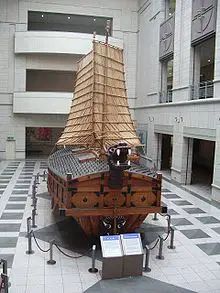
What is this?
Korean turtle ship
Japanese blind ship
Zheng He's ship
British ship during the Opium War

