
 Worksheets
MTEB
Total questions: 36
Worksheet time: 45mins
Which of the following is the best explanation for the meaning of the word “theory”?
A general, verifiable principle that explains many observations
An observation that manages to mostly explain many principles
Principles that explain many observations, verifiable or not
A general, verifiable principle that explains all observations succinctly
The main scientific theory regarding how life arose on Earth is known as:
Evolution
Abiogenesis
Panspermia
Empiricism
A strand of DNA contains 40% thymine. What percentage of guanine does it contain?
0%
10%
20%
40%
According to the central dogma, the flow of information in a cell occurs in what order?
DNA → RNA → Protein
RNA → DNA → Protein
Protein → RNA → DNA
Protein → DNA → RNA
DNA → Protein → RNA
The secondary level of protein structure is?
The main shape, formed by interactions between side chains.
Linear polypeptide chain
Involves interactions between protein sub-units
α-helix and β-pleated sheets (due to hydrogen bonding)
Which of the following is true?
Proteins store genetic information
Ribosomes are used to transcribe DNA
DNA changes are responsible for evolution
DNA is first translated, then transcribed, to produce a protein
Which of the following is NOT one of Darwin’s observations or theories?
The environment continues to expand to support the offspring produced by different species
Members of a population often vary in their inherited traits
Individuals with more beneficial inherited traits are more likely to survive and leave offspring
All life is related and has a common ancestor
Evolution is thought to...
Be goal-oriented (i.e. not random)
Be a product of mutations
Lead to higher and more complex forms
Be supported only by fossil evidence and Galapagos finch species
Evolution resulting from migration is known as:
Natural selection
Genetic drift
Gene flow
Immigratory change
Which of the following orders the key events of Life on Earth (human-centric) correctly?
First single-celled organism → Appearance of animals → Multicellularity → First eukaryotes → Oxygen revolution → Appearance of humans → Colonisation of land
First single-celled organism → First eukaryotes → Multicellularity → Appearance of animals → Oxygen revolution → Colonisation of land → Appearance of humans
First single-celled organism → Multicellularity → Oxygen revolution → First eukaryotes Appearance of animals → Colonisation of land → Appearance of humans
First single-celled organism → Oxygen revolution → First eukaryotes → Multicellularity Appearance of animals → Colonisation of land → Appearance of humans
A group of a phylogenetic tree that contains a common ancestor and some but not all of its decedents is known as:
Monophyletic
Paraphyletic
Polyphyletic
Clade
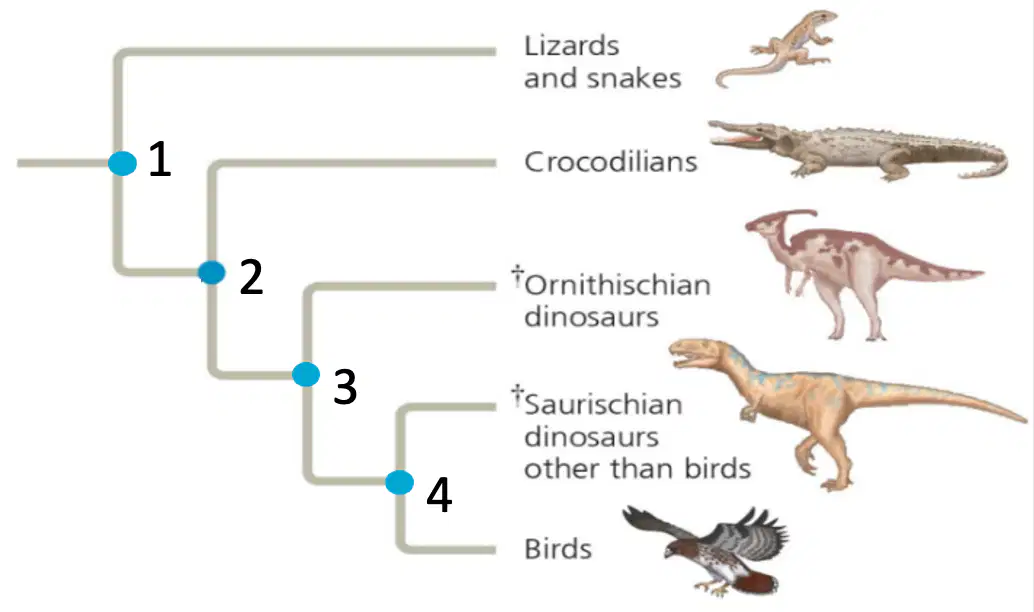
The most recent common ancestor of birds and Ornithischian dinosaurs would be:
1
2
3
4
Which of the following structures is present in a prokaryotic cell?
Mitochondria
Endoplasmic reticulum
Nucleus
Plasma membrane
The organelle that packages proteins for transport out of a cell is known as:
Ribosome
Rough endoplasmic reticulum
Smooth endoplasmic reticulum
Golgi body
Biological membranes are
Selectively permeable
Able to sense the external environment
Fluid mosaic
All of the above
Which of the following is true?
Diffusion is a spontaneous process in which particles diffuse from an area of greater concentration to an area of lower concentration
Diffusion is a spontaneous process in which particles diffuse from an area of lower concentration to an area of greater concentration
Active transport is a non-spontaneous process in which particles diffuse from an area of greater concentration to an area of lower concentration, using energy
Osmosis is a non-spontaneous process in which water diffuses to an area of greater solute concentration
Binary fission is:
The combination of 2 cells to create 1 giant cell
Cell division by meiosis
Cell division in prokaryotes, creating 2 genetically identical daughter cells
Cell division in eukaryotes, creating 2 genetically identical daughter cells
Which of the following processes occurs in meiosis?
DNA replication after Meiosis I
Sister chromatids separate in Meiosis I
At the end of Meiosis II, 2 haploid cells are created
Pairs of homologous chromosomes line up at the metaphase plate in Meiosis I
Which of the following statements defines ‘anabolic’ reactions?
Breakdown of complex molecules and compounds into simpler one
Alteration of the shape of complex molecules
Neutralising the charge of complex molecules
Synthesis of more complex compounds and molecules from simpler ones
An enzyme-catalysed reaction will:
Increase activation energy
Decrease activation energy
Will not change activation energy
Only affect enzymes
Which of the following is NOT a product of the citric acid cycle?
2 Acetyl-CoA
3 CO2
4 NADH + 4 H+ and 1 FADH2
1 ATP
The majority of the ATP in aerobic respiration is directly produced in:
Glycolysis
Pyruvate oxidation
Citric Acid Cycle
Oxidative phosphorylation
Energy produced by the partial breakdown of sugars and other organic fuels is known as:
Aerobic respiration
Anaerobic respiration
Fermentation
All of the above
With regards to the Calvin cycle:
Light energy is used to synthesise ATP
ATP is required
Water is reduced to oxygen
It occurs in the thylakoid stacks of the chloroplast
A science student isolates a novel strain of the bacterial E. coli. Which of the following features could not apply to this organism?
Absence of internal organelles
Multicellular
Rod-shaped (bacillus)
Cell wall
The endospore is:
Formed when a prokaryote faces harsh conditions
Formed when a prokaryote wishes to replicate
Produced as a food source when food is scarce
Allows prokaryotes to “stick” to substrate
A public health researcher visits a very ill community, presenting with diarrhea, greasy stools and dehydration. They discover that this community visits one particular creek to obtain drinking water as well as to shower and toilet. The most likely infective organism is __________. The protist clade it belongs to is ___________.
Brown algae; SAR
Red algae; Archaeplastida
Slime moulds; Unikonta
Giardia; Excavata
S. aureus is a bacterium which lives on the skin of humans. If the skin is intact the human does not develop any diseases from this bacterium. This is an example of:
Mutualism
Commensalism
Parasitism
Predation
The cell wall in fungi is made of:
Peptidoglycan
Starch
Chitin
Cellulose
The fungal phylum distinguished by arbuscular mycorrhizae formed with plants is:
Chytridiomycota
Zygomycota
Glomeromycota
Ascomycota
SAQ1. Discuss the similarities and differences between DNA and RNA. You may provide your answer in table format or dot points (paragraph structure is not necessary).
SAQ2. Name and describe two examples of evidence that supports the theory of evolution.

SAQ3. Label the Diagram:
SAQ4. Explain when and why photorespiration occurs and describe 2 types of adaptations that allow plants to survive in arid and hot climates.
SAQ5. What are some mutualistic relationships between plants and organisms living in soil?
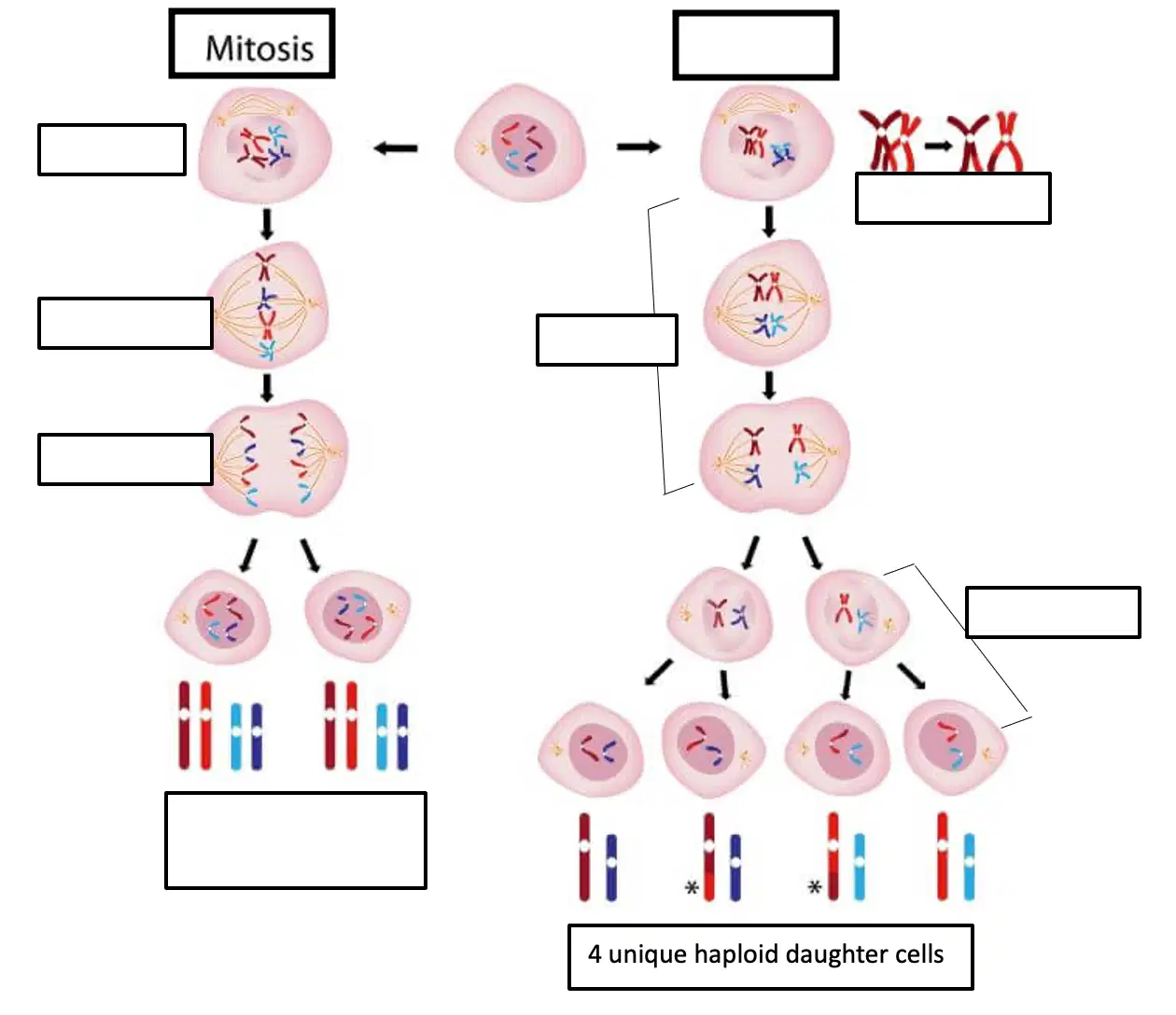
Bonus question: Eukaryotes perform two types of cell division. Below is a diagram illustrating both processes. Fill in the blanks:

