
Font size
 Worksheets
Higher - SQA Lingo
Total questions: 59
Worksheet time: 35mins
In which software development methodology is the client heavily involved in both the initial analysis stage and at the end of development?
Agile
Iterative
Waterfall
Spiral
What is emphasized in Agile methodology to ensure the software evolves throughout the project?
Detailed project specifications
Independent work by teams
Constant feedback and quick adaptation
Large documents that are never updated
How do teams operate in Agile software development compared to Iterative?
Teams work in isolation
Teams communicate and collaborate
Teams require significant time on design
Teams focus on creating detailed test plans
What is the approach to documentation in Agile software development?
Creating detailed project specifications at the beginning
Spending significant time on program commentary and test plans
Reducing documentation and focusing on small cycles of coding and adapting to change
Maintaining large documents that are updated upon project completion
How does an iterative approach to project management measure progress?
By the time it takes to produce prototypes or working components of the software.
By following a strict plan and measuring progress against timescales set at the beginning of the project.
By adapting quickly to changing realities and project needs.
By ensuring only the most valuable changes are considered through a change control board.
What is a key characteristic of an adaptive project management methodology?
It relies on effective early phase analysis and planning for the future in detail.
It breaks a project down into a series of short development goals called "sprints".
It focuses on delivering software as quickly as possible.
It focuses on adapting quickly to changing realities and when the needs of a project change, an adaptive team changes as well.
When do predictive teams typically carry out testing in a project?
Throughout the project in conjunction with programming.
When the implementation phase of the project is complete.
There is no recognised testing phase.
After each short development goal or "sprint".
What is a distinctive feature of the Agile methodology regarding testing?
Testing is carried out when the implementation phase of the project is complete.
Testing is carried out in conjunction with programming.
There is a separate and distinct testing phase after development.
Testing is only done by a change control board.
Which of the following is NOT a deliverable in the scope of the development described in the exemplar?
Detailed design of the program structure
Test plan with completed test data table
This development work must be completed within 4 hours.
Evaluation report
The program can only accept inputs as strings
What should each process in a program be implemented as?
A separate procedure or function that is called from the main program
A single function that handles all processes
Inline code within the main program
Multiple main programs
When using pseudocode to design efficient solutions to a modular problem, which of the following must be included?
Only the top level design
Data flow and refinements only
Top level design, data flow, and refinements
The final output of the program
What is the purpose of the top level design in pseudocode?
To show the final output of the program
To display the name of the pupil with the highest percentage
To outline the major steps of the design
To calculate the percentage from marks
What is the purpose of a top-level design in a structure diagram?
To show the detailed steps of the design
To show the minor steps of the design
To show the major steps of the design
To show the specific algorithms used in each step
What does the data flow in a structure diagram indicate?
The direction of the user interface flow
The information that must flow in or out from the sub-programs
The programming languages used in the sub-programs
The final output of the program
What does "Fitness for purpose" in software evaluation refer to?
The software's ability to be maintained over time
The software's user interface and help screens
The software's ability to meet the tasks required by its specification
The efficiency of the code written by the software writers
Which of the following is NOT a factor that the "Efficient use of coding constructs" section suggests should be considered when writing efficient code?
The use of nested selection
The use of multimedia elements like audio and video
The use of arrays
The use of procedures or functions with parameter passing
What should the "Usability" section of a software evaluation include?
The amount of modularity in the code
The general user interface and user prompts
The efficiency of the code constructs
The readability of the code
Which of the following is NOT listed as a factor affecting the "Maintainability" of software?
The use of meaningful variable names and comments
The screen layout and user prompts
The amount of modularity using functions and procedures
The readability of the code using indentation and whitespace
What does robustness in software reflect?
The user interface design of the software
How well the software copes with errors during execution
The speed of the software's performance
The number of features the software contains
In floating-point representation, what does the exponent represent?
The number of decimal places the point has moved
The size of the mantissa
The base of the number system
The sign of the number
How is the sign bit of the mantissa represented in binary?
0 for positive and 1 for negative
1 for positive and 0 for negative
2's complement
10's complement
What does the number of digits in the mantissa indicate in terms of a number's representation?
The range of numbers that can be stored
The precision of the number
The total bits used
The exponent's value
What is the consequence of increasing the mantissa while keeping the total number of bits constant?
Increased precision, increased range
Decreased precision, increased range
Increased precision, decreased range
Decreased precision, decreased range
If the exponent is increased and the total number of bits remains the same, what is the effect on the precision and range?
Increased precision, increased range
Decreased precision, increased range
Increased precision, decreased range
Decreased precision, decreased range
What is the first step in the fetch-execute cycle?
The processor activates the read line on the control bus.
The processor sets up the address bus with the required address.
An instruction is fetched from the memory location.
The instruction in the instruction register is interpreted by the decoder.
How does increasing the number of processors (cores) in a computer affect its performance?
It decreases the system performance due to increased complexity.
It has no impact on the system performance.
It improves system performance by allowing more instructions to be processed at the same time.
It reduces efficiency by always sharing tasks equally between cores.
What is the effect of increasing the width of the data bus from 32 wires to 64 wires?
It decreases the amount of information that can be transferred at one time.
It has no impact on the system performance of the computer.
It increases the system performance by allowing twice as much information to be transferred at one time.
It reduces the speed of the computer because of the additional wires.
What happens when the processor encounters a 'cache hit'?
The processor slows down due to a slower main memory access.
The processor must check the next fastest cache (level 2) for the data or instruction.
The processor proceeds at high speed because it found the data or instruction in the cache.
The processor deactivates the read line on the control bus.
What is the role of cache memory in a computer system?
To store permanent data for long-term access.
To provide a small amount of fast accessible memory on the same chip as the processor.
To connect the processor with memory and other hardware devices.
To set up the address bus with the required address.
What is the function of clock speed in an electronic unit?
It measures the size of the electronic unit.
It synchronises related components by generating pulses at a constant rate.
It reduces the power consumption of the computer.
It increases the storage capacity of the computer.
What is the relationship between clock rate and the speed at which a computer completes a series of instructions?
The lower the clock rate, the faster the computer completes instructions.
The clock rate has no impact on the speed of completing instructions.
The higher the clock rate, the faster the computer may complete instructions.
The clock rate only affects the computer's ability to play videos.
Why is it not always possible to directly compare clock rates between different processor manufacturers?
Because all processors have the same clock rate.
Because clock rate is irrelevant to processor performance.
Because different manufacturers measure the clock rate in different ways.
Because clock rate comparisons are prohibited by law.
What do intelligent transport systems use to reduce harmful emissions?
Satellite communication and traffic flow analysis
Manual traffic control by traffic police
Traditional traffic lights without sensors
Increased number of vehicles on the road
How do start-stop systems in cars help the environment?
What is the function of engine control units in car management systems?
Who are considered the end users in the context of database development?
The developer team analyzing the database
The people who are going to be using the database
The staff providing comments on the database features
The entities stored within the database
What are functional requirements in database development?
The design specifications of the database
The tasks end users expect to perform with the database
The processes and activities the system has to perform
The feedback from the staff on the database features
What is the purpose of identifying requirements during the analysis stage of database development?
To determine the cost of the database
To clarify the design of the database and identify features to be implemented
To choose the programming language for database development
To finalize the user interface design of the database
What is the purpose of using a simple sort in the database according to the functional requirements?
To delete query results
To update the query results
To order the query results
To filter the query results
What is an entity in the context of entity-relationship modeling?
A relationship between tables in a database
A person, place, thing, event or concept of interest to the business or organization about which data is to be stored
A type of database management system
A graphical representation of database entities
What is an entity occurrence?
A unique identifier for an entity
A relationship between entities
A specific example of an entity
A rule that defines how entities interact
Which of the following best describes an attribute in entity-relationship modeling?
A connection between two entities
A characteristic of the entity
A diagram showing entities and relationships
A unique identifier for an entity occurrence
What is a primary key?
A key that opens the main database
An attribute that must be unique for each entity occurrence
A combination of attributes that describes a relationship
A diagram that outlines the main entities in a database
What is a foreign key in the context of a database?
An attribute that uniquely identifies a row within the same table.
An attribute in one table that uniquely identifies a row of another table.
A primary key that consists of two or more attributes.
A relationship between two entities in a database.
What is a compound key?
A key that is composed of multiple foreign keys.
A key that is used to speed up database queries.
A primary key that comprises two or more attributes.
An attribute that is unique across multiple tables.
What does the cardinality of a relationship in a database indicate?
The strength of the relationship between two entities.
The number of attributes shared between two entities.
The number of participants in the relationship.
The number of tables involved in the relationship.
Which of the following best describes a one-to-one relationship in a database?
A relationship where one entity occurrence is associated with multiple occurrences in a related entity.
A relationship where each entity occurrence in an entity is associated with one, and only one, entity occurrence in a related entity.
A relationship where one entity occurrence in an entity is associated with many occurrences in a related entity.
A relationship where many entity occurrences in an entity are associated with many occurrences in a related entity.
What is a one-to-many relationship in a database?
A relationship where one entity occurrence is associated with one and only one occurrence in a related entity.
A relationship where each entity occurrence in an entity is associated with multiple occurrences in a related entity.
A relationship where each entity occurrence in an entity is associated with one occurrence in a related entity.
A relationship where multiple entity occurrences in an entity are associated with one occurrence in a related entity.
Why are many-to-many relationships resolved into two one-to-many relationships in a relational database system?
Because many-to-many relationships are too complex to manage.
Because relational database systems cannot implement direct many-to-many relationships.
Because it is more efficient in terms of database performance.
Because it allows for easier data redundancy.
What does an entity-occurrence diagram illustrate?
The physical layout of a database
The relationships between the entity occurrences of one entity and the entity occurrences within a related entity
The sequence of operations in a program
The hierarchical structure of an organization
How is each entity occurrence represented in an entity-occurrence diagram?
By a unique color
By the value of its identifier
By a specific shape
By its position in the diagram
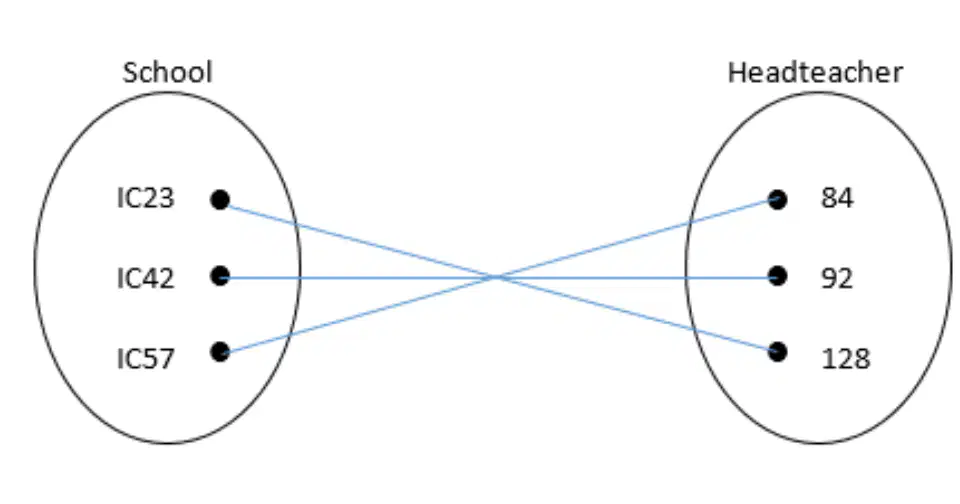
What type of relationship is depicted in the provided entity-occurrence diagram example?
One-to-many relationship
Many-to-many relationship
One-to-one relationship
Many-to-one relationship
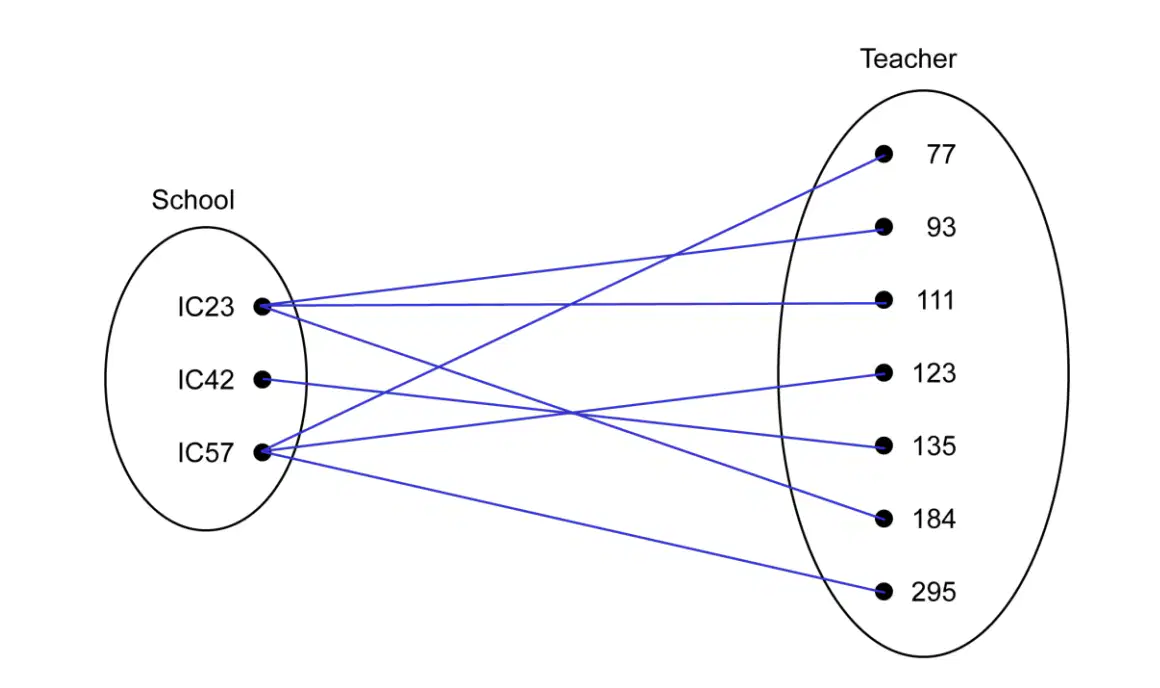
What type of relationship is depicted between the School and Teacher entities in the entity-occurrence diagram?
One-to-one
Many-to-many
One-to-many
Many-to-one
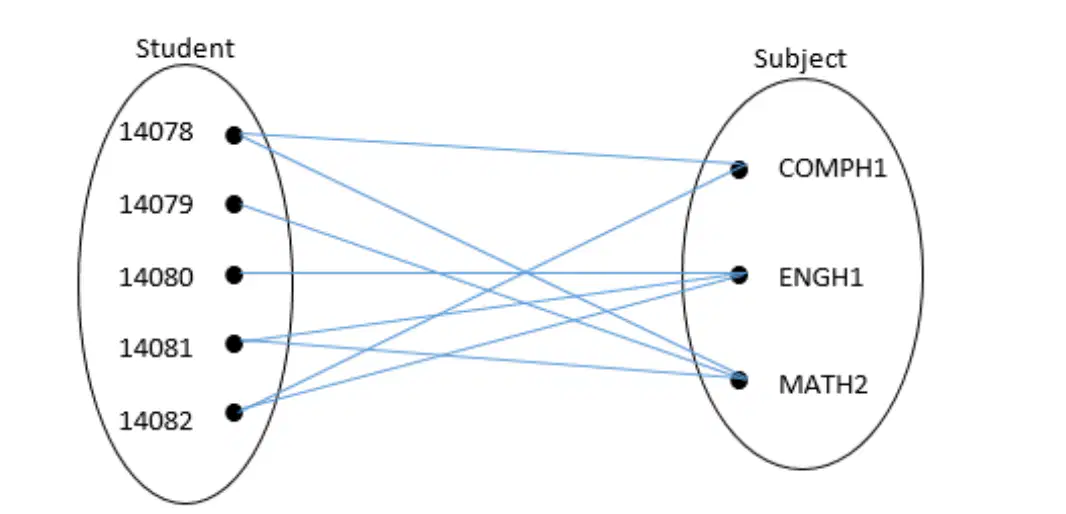
What type of relationship is depicted in the entity-occurrence diagram ?
One-to-one relationship
One-to-many relationship
Many-to-one relationship
Many-to-many relationship
How are entities represented in an entity-relationship diagram?
Labelled rectangles
Labelled circles
Labelled arrows
Labelled triangles
What notation is used in the entity-relationship diagrams to indicate the 'many' sides of a relationship?
Arrow notation
Dot notation
Crow's feet notation
Plus sign notation
What can be shown if required, besides the name of each entity and the relationship between entities in an entity-relationship diagram?
The attributes of each entity
The functions of each entity
The location of each entity
The owners of each entity

What type of relationship is depicted in entity-relationship diagram example 1?
One-to-one relationship
One-to-many relationship
Many-to-many relationship
Many-to-one relationship

According to entity-relationship diagram example 2, how many schools can a teacher be employed by?
One
Two
Many
Zero

