wayground logo

Free Printable Worksheets

Font size

S
M
L
XL
Worksheets

Tectonics Test Review

Total questions: 127

Worksheet time: 2hrs 45mins
Name
Class
Date
1.
As the waves travel through shallow water toward the land they get
a)
bigger
b)
smaller
c)
faster
d)
slower
2.
The most destructive type of wave is a
a)
P-wave
b)
S-wave
c)
Surface wave
d)
transverse wave
3.
What type of Seismic waves are compressional waves?
a)
P-wave
b)
S-wave
c)
Surface wave
d)
transverse wave
4.
What type of Seismic waves are transverse waves?
a)
P-wave
b)
S-wave
c)
Surface wave
d)
longitudinal waves
5.
What type of Seismic waves can only travel through solids?
a)
P-wave
b)
S-wave
c)
Surface wave
d)
longitudinal waves
6.
Where is the point at which the first movement occurs during an earthquake?
a)
Epicenter
b)
Focus
c)
Fault
d)
Plate
7.
Where is the point at which the first surface waves occur?
a)
Epicenter
b)
Focus
c)
Fault
d)
Plate
8.
What geologic feature/event would you most likely to find at a divergent boundary between two pieces of continental crust?
a)
Mid-Ocean Ridge
b)
Mountain
c)
Rift Valley
d)
Island Arc
9.
What results as the two oceanic plates converge?
a)
formation of a deep sea trench and island volcanoes
b)
earthquake activity and appearance of a transform fault
c)
volcanic eruption along both oceanic plate edges
d)
formation of a continental mountain range
10.
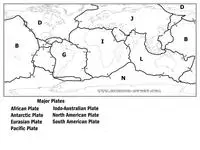
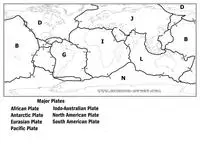
What plate is labeled D in the diagram?
a)
Indo-Australian Plate
b)
North American Plate
c)
Eurasian Plate
d)
Pacific Plate
11.
What plate is labeled L in the diagram?
a)
Indo-Australian Plate
b)
North American Plate
c)
Eurasian Plate
d)
Pacific Plate
12.
Around what plate boundary do most volcanoes and earthquakes occur?
a)
Indo-Australian Plate
b)
North American Plate
c)
Pacific Plate
d)
Eurasian Plate
13.
Reverse faults have __________________ and folding that formed the Alps and Himalayas.
a)
tension
b)
compression
c)
stress
14.
1. Molten material adds new crust to the ocean floor, pushing continents apart, in a process called
a)
a. sea floor spreading
b)
b. continental crust
c)
c. original horizontality
d)
d. continent spreading
15.
2. The best evidence that 2 land areas were once connected is the discovery that both land masses
a)
a. currently have the same climate
b)
b. are on the same ocean
c)
c. exist along the same line of longitude
d)
d. have similar types of rocks and fossils
16.
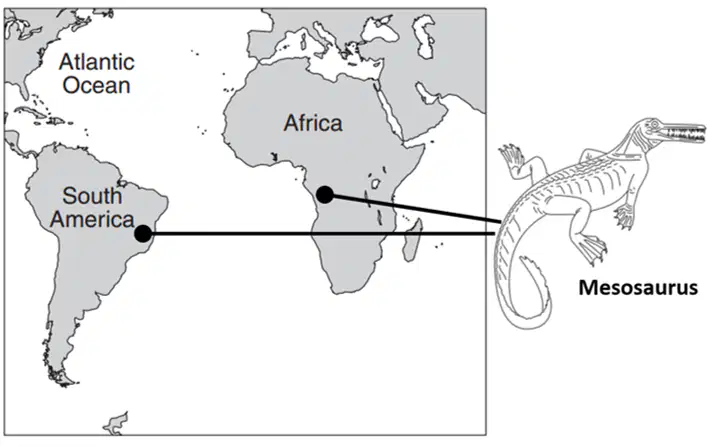
3. The diagram below shows two locations where fossils of Mesosaurus have been found. Mesosaurus was a freshwater reptile that existed on Earth about 250 million years ago. Which statement best explains why these freshwater Mesosaurus fossils are found today in some rock layers in both South America and Africa?
a)
a. Mesosaurus swam across the ocean between the continents.
b)
b. The continents were once connected as a single landmass.
c)
c. Global warming has been raising the sea level in the Atlantic Ocean.
d)
d. The remains of Mesosaurus were carried across the ocean by predators.
17.
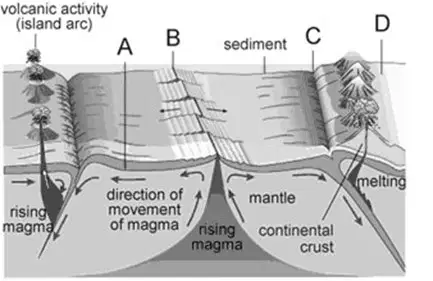
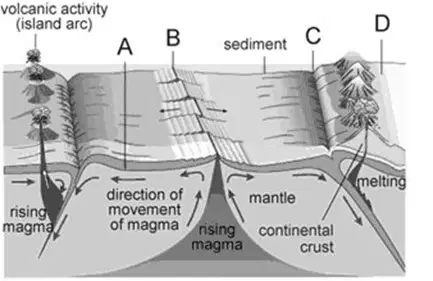
4. Which point on the diagram represents where new crust is formed?
a)
a. Point A
b)
b. Point B
c)
c. Point C
d)
d. Point D
18.
5. Which point on the diagram represents the mid-ocean ridge?
a)
a. Point A
b)
b. Point B
c)
c. Point C
d)
d. Point D
19.
6. Which of the following is NOT evidence of continental drift?
a)
a. the shape of the continents appear to fit together
b)
b. the same patterns of rock and mineral deposits exist on entirely different continents
c)
c. the fossils of the same animals and plants exist on entirely different continents
d)
d. different continents appear to have similar weather patterns
20.
7. What does finding tropical, warm-living plants on a cold continent like Antarctica prove?
a)
a. The tropical plants were once adapted to cold areas.
b)
b. Antarctica once had mineral deposits that could support tropical plants.
c)
c. The continent of Antarctica was once in an area of Earth that had a warmer climate.
d)
d. Tropical plant fossils were carried by ocean currents to Antarctica.
21.
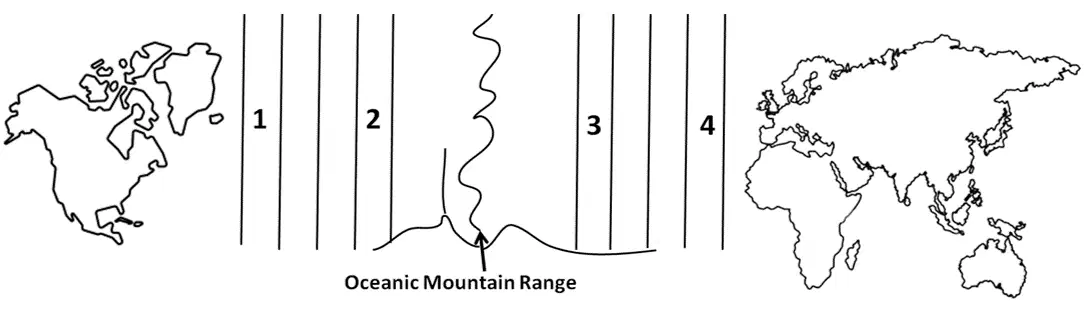
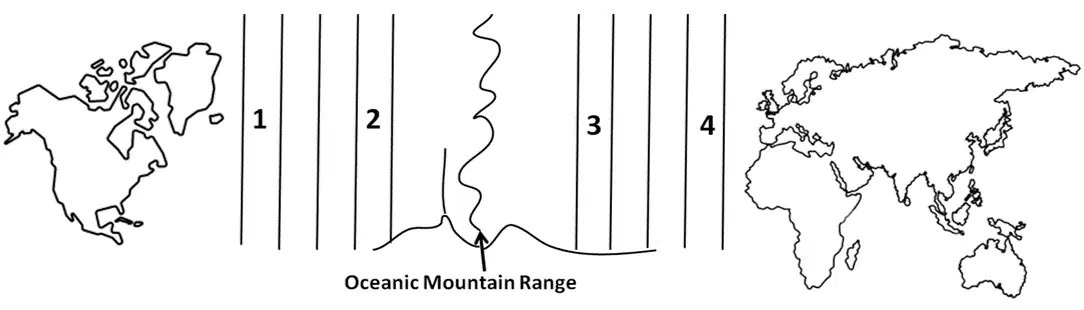
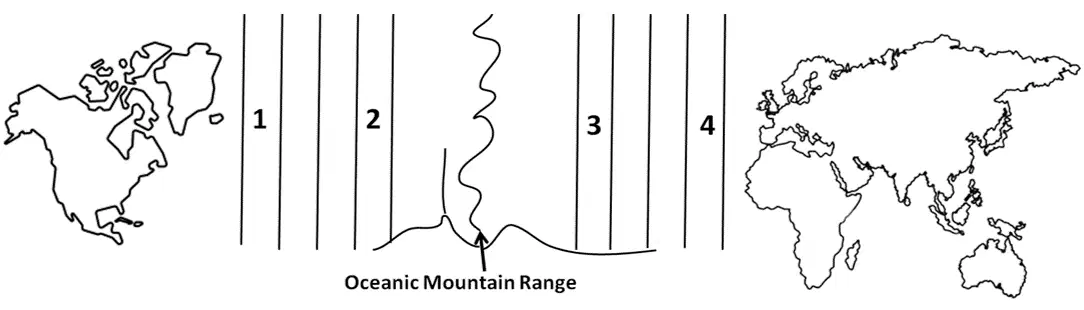
8. Which areas of rock would be the oldest?
a)
a. 1 and 2
b)
b. 1 and 4
c)
c. 2 and 3
d)
d. 3 and 4
22.
9. Which areas of rock would be the youngest?
a)
a. 1 and 2
b)
b. 1 and 4
c)
c. 2 and 3
d)
d. 3 and 4
23.
10. What is happening at the oceanic mountain range in the middle?
a)
a. The plates are pulling away from each other so magma is able to rise up, creating new crust.
b)
b. The plates are moving towards each other, creating pressure so magma is able to rise up, creating new crust.
c)
c. The plates are pulling away from each other so magma is able to rise up, destroying old crust.
d)
d. The plates are moving towards each other, creating pressure so magma is able to rise up, destroying old crust.
24.
________________ pulls on crust which results in a normal fault.
a)
tension
b)
compression
c)
stress
25.
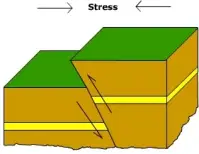
Which type of force is involved with this type of fault?
a)
tension
b)
compression
c)
stress
26.
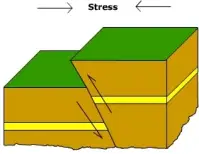
Which type of fault is this (stress pushing in on both sides)?
a)
Normal
b)
Reverse
c)
Strike-Slip
27.
Which type of fault is this (stress pushing in on both sides)?
a)
Normal
b)
Reverse
c)
Strike-Slip
28.
Which type of fault is this (stress pushing in on both sides)?
a)
Normal
b)
Reverse
c)
Strike-Slip
29.
What type of feature forms at divergent boundaries where continental crust is being pulled apart?
a)
mid-ocean ridge
b)
horst and graben
c)
mountains
30.
The method that geologists use to place rocks in chronological order.
a)
superposition
b)
correlation
c)
relative dating
d)
horizontality
31.
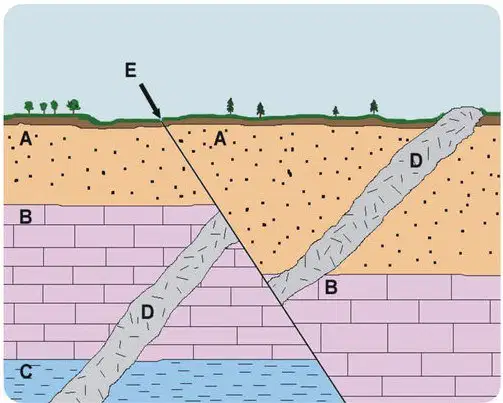
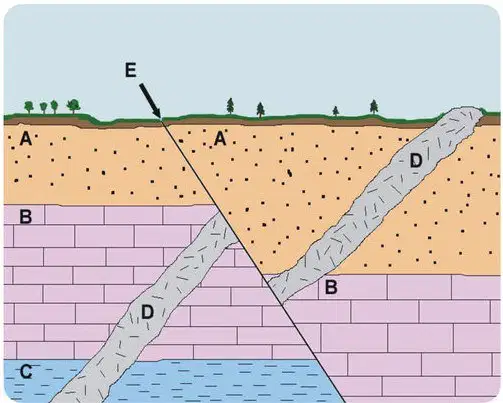
Which Rock layer is the oldest?
a)
A
b)
B
c)
C
d)
D
32.
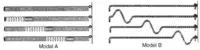
Base your answer on the diagram, which shows models of two types of earthquake waves. Model A best represents the motion of earthquake waves called:
a)
P-waves (compressional waves) that travel faster than S-waves (shear waves) shown in model B
b)
P-waves (compressional waves) that travel slower than S-waves (shear waves) shown in model B
c)
S-waves (shear waves) that travel faster than P-waves (compressional waves) shown in model B
d)
S-waves (shear waves) that travel slower than P-waves (compressional waves) shown in model B
33.
Which Rock layer is the newest?
a)
A
b)
B
c)
C
d)
D
34.

What is this minor plate?

a)

Caribbean

b)

Cocos

c)

Arabian

35.

What is this major plate?

a)

African

b)

South American

c)

Eurasian

36.

What is this major plate?

a)

North American

b)

Indo-Australian

c)

Eurasian

37.

What is this major plate?

a)

Indo-Australian

b)

Pacific

c)

Eurasian

38.

The circular arrows inside the Earth's Mantle represent what type of motion, that drives ALL plate movement?

a)

Convergent Boundary

b)

Ocean Currents

c)

Convection Currents

d)

Transform Boundary

39.

How does heat from the core cause molten rock in these convection currents to move?

a)

Sinks when hot, and rises when cool

b)

Rises when hot, and sinks when cool

c)

Heat from inside the Earth does not cause rocks to move.

40.

Convection currents beneath the Earth's surface push and pull tectonic plates. Follow the direction of the arrows in the image shown. Imagine the continuous motion of these currents. What type of plate boundary would occur at the surface?

a)

Convergent

b)

Divergent

c)

Transform

41.

Who first proposed the idea of Continental Drift?

a)

Harry Hess

b)

Alfred Wegener

c)

Albert Einstein

d)

Galileo Galilee

42.

India, Australia, South America, and Africa all have deep grooves or scratches in rocks which is climate evidence of ....

a)

erosion

b)

dinosaurs

c)

glaciers

d)

aliens

43.

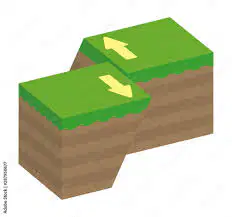
What type of fault is this?

a)

Normal

b)

Reverse

c)

Strike-slip

44.

What type of fault is this?

a)

Normal

b)

Reverse

c)

Strike-slip

45.

What type of fault is this?

a)

Normal

b)

Reverse

c)

Strike-slip

46.

What kind of force is required to create this fault?

a)

Compression

b)

Tension

c)

Shear

47.

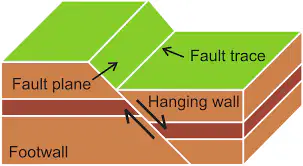
What type of wall is 'A"?

a)

Hanging wall

b)

Foot wall

48.

What type of wall is "B"?

a)

Hanging wall

b)

Foot wall

49.
What type of fault is the San Andreas?
a)
Convergent
b)
Transform
c)
Optimus Prime
d)
Divergent
50.

What type of fault is this?

a)

normal fault

b)

reverse fault

c)

strike-slip fault

51.
What fault has little up or down motion?
a)
strike-slip
b)
normal
c)
reverse
52.
Which of these boundaries/stresses/faults all correctly go together?  Choose all that apply.
a)
normal, divergent, tension
b)
reverse, convergent, shearing
c)
strike-slip, transform, compression
53.

The three types of stress that leads to faults include:

a)

tension, compression, and normal stress

b)

tension, compression, and shearing stress

c)

deformation, tension, and shearing stress

54.

What is the instrument used to measure earthquakes?

a)

Seismograph

b)

Seismologist

c)

Scale

d)

Seismogram

55.

Which city is closest to the epicenter?

a)

A

b)

B

c)

C

56.

Which seismogram represents a city that is far from the epicenter of an earthquake?

a)

New York, NY

b)

Nome, Alaska

c)

Guadalajara, Mexico

57.

This is created by earthquakes that occur on the ocean floor.

a)

longshore current

b)

gulf stream

c)

tsunamis

d)

high tide

58.

What scale determines the amount of damage an earthquake causes?

a)

Richter scale

b)

Mercalli scale

c)

Moment magnitude scale

d)

seismographic scale

59.

S-waves can move through which of the following?

a)

Gas

b)

Liquid

c)

Solid

d)

All of these

60.
An area where no direct seismic waves from a particular earthquake can be detected is called
a)
an inactive fault zone
b)
the mesosphere
c)
a shadow zone
d)
the atmosphere
61.

Measures the magnitude or size, of an Earthquake

a)

epicenter

b)

focus

c)

Richter scale

d)

Mercalli Scale

62.

What is the measure of the amount of energy released in an earthquake?

a)

Intensity

b)

Epicenter

c)

Magnitude

d)

Seismogram

63.

How do scientists know that the outer core is a liquid?

a)

P waves do not travel through the outer core but S waves do.

b)

S waves do not travel through the outer core but P waves do.

c)

P waves and S waves do not travel through the outer core.

d)

P waves and S waves travel through the outer core.

64.

What does the Japanese word "tsunami" mean in English?

a)

Boat Smasher

b)

Harbor Wave

c)

Waves of Death

d)

Tall Water

65.

What should you do if you hear a Tsunami alert for your area?

a)

Head for higher ground

b)

Get into a boat

c)

Get into your car and drive away

d)

Run towards the beach to watch

66.

Most Tsunamis occur in the

a)

Amazon River

b)

Atlantic Ocean

c)

Indian Ocean

d)

Pacific Ocean

67.

Most waves get their energy (size/speed/shape) from __________ but tsunamis get their energy from ___________ ___________.

a)

Rain

Lightning Strikes

b)

Fire

Thunderstorms

c)

Wind

Tornado Winds

d)

Wind

Underwater Forces

68.

A Tsunami wave can move at over _______ miles per hour.

a)

10

b)

50

c)

500

d)

1000

69.
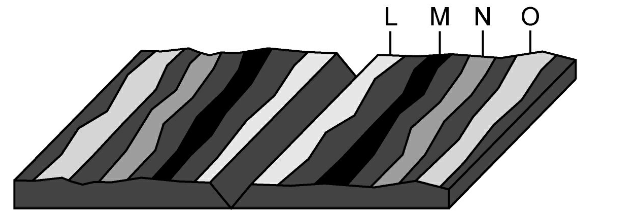
Where would the oldest rock be found?
a)
L
b)
M
c)
N
d)
O
70.

How is it possible for new crust to be formed without increasing the surface area of the Earth?

a)

Crust is recycled in subduction zones at the same time it is created at mid-ocean ridges

b)

New crust is underwater where it sinks

c)

New crust breaks more easily than old crust

d)

The oldest crust just breaks apart as the plates move

71.

The average density of continental crust is 2.8 g/cm3 and the average density of oceanic crusts is 3.2 g/cm3. If these two plates came together, what would happen?

a)

The two plates would push apart and form a rift zone.

b)

The oceanic plate would rise up over the continental plate.

c)

The oceanic plate would sink under the continental plate.

d)

The two plates would meet head on and rise up to form mountains.

72.
Which of the following objects best represents the movement that occurs during sea-floor spreading?
a)
Elevator
b)
Conveyor belt
c)
Rollercoaster
d)
Hot air balloon
73.

Scientists use ______ to map the ocean floor

a)

radar

b)

pulsar

c)

lidar

d)

sonar

74.

The OLDEST seafloor is located

a)

closest to the mid-ocean ridge.

b)

farthest from the mid-ocean ridge.

c)

east of Hawaii

d)

west of California

75.

Which of the following supports the theory of seafloor spreading?

a)

Correlation of rock layers

b)

Crustal slab pull

c)

Magnetic reversals recorded in rocks

d)

Continuous mountain chains

76.

Rock at the mid ocean ridges...

a)

is the oldest rock on the earth.

b)

is older than continental rock.

c)

is younger than continental rock.

77.

What type of plate activity is creating the Himalayas?

a)

divergence of the Indian Ocean and Asia

b)

convergence of India and Asia

c)

strike slip faulting

d)

subduction

78.
What geologic feature/event would you most likely to find at a convergent boundary between two pieces of continental crust?
a)
Volcano
b)
Mountain
c)
Rift
d)
Island Arc
79.
When an oceanic plate and a continental plate collide, which one will subduct?
a)
oceanic
b)
continental
c)
neither
80.
What would you be most likely to find at a convergent boundary between a continental and oceanic plate?
a)
Mountains
b)
Volcanoes
c)
Mid-Ocean Ridge
d)
Rift
81.

1. Subduction does not occur at which convergent plate boundary?

a)

Oceanic - Oceanic

b)

Continental - Continental

c)

Oceanic - Continental

82.
The area where two or more plates meet is called a __________________.
a)
fault
b)
plate boundary
c)
plate edge
d)
ring of fire
83.
What is molten rock that has formed deep within the Earth?
a)
Hot Spot
b)
Magma
c)
Lava
d)
Volcano
84.
As magma rises towards the surface it collects in a 'room' called a _____ _____ . 
a)
magma chamber
b)
side vent
c)
main vent
d)
lava chamber
85.
Where are most volcanoes found?
a)
Southern Hemisphere
b)
Ring of Fire
c)
Mid-Atlantic Ridge
d)
Hot Spots
86.
What is / are sign(s) that a volcano may erupt soon?
a)
Earthquake activity in the area
b)
Changes in the shape of the volcano
c)
Different amounts of gas being produced
d)
All of these are signs
87.
What is the definition of dormant?
a)
sleeping
b)
extinct
c)
active
d)
invisible
88.
What are scientists that study volcanoes called?
a)
doctor
b)
vet
c)
volcanologist
d)
volcano scientist
89.
The volcanoes on the Hawaiian Islands form due to which of the following?
a)
Divergent Boundary
b)
Hot Spot
c)
Subduction Boundary
d)
Transform Boundary
90.

Based on the map chose the answer that best describes the age of the hawaiian islands.

a)

The big island of hawaii is further from the hotspot and the youngest island.

b)

Oahu is further from the hotspot and the oldest island.

c)

The big island of hawaii is closest to the hotspot and the oldest island.

d)

Oahu is closest to the the hotspot and the oldest island.

91.

What part of a Volcano is Number 1?

a)

Crater

b)

Vent

c)

Side vent

d)

Pipe

e)

Magma Chamber

92.

What part of a volcano is number 4?

a)

Vent

b)

Magma chamber

c)

crater

d)

Pipe

e)

Side vent

93.

A composite volcano _____

a)

is built from layers of lava and volcanic ash.

b)

consists primarily of cinders and volcanic rock.

c)

composed almost entirely of thin lava.

94.

A shield volcano _____

a)

is built from layers of lava and volcanic ash.

b)

consists primarily of cinders and volcanic rock.

c)

composed almost entirely of thin lava.

95.

A volcanic eruption can be either _____.

a)

explosive or gentle

b)

explosive or violent

c)

explosive or smooth

d)

explosive or a geyser

96.

All are the factors of viscosity of lava, except

a)

Silica (SiO2) content of lava

b)

Temperature of lava relative to solidification point

c)

Gas dissolved in Magma

d)

Density of Magma

97.

Low silica, low sticky, low viscosity, and magma flows slowly for many kilometers.

a)

pyroclastic flow

b)

quiet eruption

c)

explosive eruption

d)

crater

98.
What is the principal ingredient to all types of magma?
a)
Iron
b)
Magnesium
c)
Silica
d)
Water
99.
The composition of magma determines its _____.
a)
viscosity
b)
darkness
c)
color
d)
none of the above
100.

In general, the more silica in magma, the ______________ its viscosity.

a)

lower

b)

greater

101.

What type of mountains are produced by ocean-ocean convergence?

a)

parallel belts of folded mountains and volcanic mountains

b)

mainly volcanic mountains

c)

a continental volcanic arc

d)

parallel belts of uplifted mountains and volcanic mountains

102.

What type of mountains are produced by ocean-continental convergence?

a)

folded mountains and volcanic mountains

b)

folded mountains only

c)

mainly volcanic mountains

d)

fault-block mountains and volcanic mountains

103.

At a continental-continental convergent boundary...

a)

...fault-block mountains are formed.

b)

...both continental plates are subducted.

c)

...folded mountains result.

104.

Which of the following mountain ranges was formed by a continental-continental convergent boundary?

a)

the Andes Mountains

b)

the Black Hills

c)

the Himalayas

d)

the Sierra Nevada

105.

These raised plateau areas are produced where fault block mountains are being formed.

a)

Horst

b)

Rift

c)

Graben

d)

Plunging

106.

What are two main types of folding?

a)

Horizontal and Vertical

b)

Synclines and Anticlines

c)

Up and down

d)

Bottom and Top

107.

Mountains where normal faulting occurs caused by tensional forces.

a)

Uplifted Mountain

b)

Volcanic Mountain

c)

Fault-block Mountain

d)

Island Arc

108.

The tectonic processes and landforms of mountain building.

a)

orogeny

b)

depositional mountain

c)

topography

d)

orogenics

109.

By far the oldest major mountain range in the United States are these...

a)

Rockies

b)

Cascades

c)

Sierras

d)

Appalachians

110.
What type of stress is happening to these layers of crust?
a)
Compression
b)
Seperation
c)
Faulting
d)
Tension
111.

These types of faults occur due to tensional stress....

a)

Normal

b)

Reverse

c)

Thrust

d)

Strike-slip

112.

What type of fault is this?

a)

Transform

b)

Normal

c)

Reverse

113.

Smallest volcano and only erupts once.

a)

Shield

b)

Composite

c)

Cone

114.

What theory did Wegener propose?

a)

Plate tectonics

b)

Mountain formation

c)

Seafloor spreading

d)

Continental drift

115.

What is seafloor spreading?

a)

The theory that explains plate tectonics

b)

The process of new oceanic crust forming at divergent boundaries

c)

The formation of mountains at convergent boundaries

d)

The movement of Earth's plates against each other

116.

How does seafloor spreading support the theory of plate tectonics?

a)

It explains the formation of mountains

b)

It demonstrates the movement of Earth's plates

c)

It supports the theory of continental drift

d)

It shows the process of new crust formation

117.

Where do mountains usually form?

a)

At divergent boundaries

b)

At subduction zones

c)

At transform boundaries

d)

At convergent boundaries

118.

What causes earthquakes?

a)

The formation of mountains

b)

The movement of Earth's plates

c)

The process of seafloor spreading

d)

The eruption of volcanoes

119.

Which type of fault is the San Andreas fault?

a)

Thrust-slip fault

b)

Strike-slip fault

c)

Normal fault

d)

Reverse fault

120.

What are P-waves?

a)

Waves that only travel across Earth's surface

b)

Waves that cause buildings to move side to side

c)

Waves that travel only through solids

d)

Waves that travel through solids, liquids, and gases

121.

What type of magma does a composite volcano have?

a)

Medium viscosity magma

b)

Low viscosity magma

c)

High viscosity magma

d)

No magma

122.

Which volcano has low viscosity magma and is the biggest? Mauna Loa is an example.

a)

Shield

b)

Composite

c)

Cone

123.

Which volcano has layers of ash and lava and is the most dangerously explosive?

a)

Shield

b)

Cone

c)

Composite

124.

Smallest volcano and only erupts once.

a)

Shield

b)

Composite

c)

Cone

125.

This is an example of what type of fault?

a)

Transform

b)

Normal

c)

Reverse

126.

What type of fault is this?

a)

Transform

b)

Normal

c)

Reverse

127.

What type of fault is this?

a)

Transform

b)

Normal

c)

Reverse