
 Worksheets
Psych Unit 2 test
Total questions: 20
Worksheet time: 10mins
The cochlea is to the _______as the _______is to the eye for transduction.
eye; retina
ear; rods and cones
eye; eardrum
ear; retina
Herbie was in a terrible car accident and sustained head injuries. He is able to speak but nothing he hears makes any sense to him. He can see people talking but it is all jumbled. Which of these structures was probably injured in his accident?
Broca's area
Wernicke's area
the hippocampus
the hypothalamus
During REM, we experience paradoxical sleep. Which of the statements below best describes what is happening
Our brains are active but our bodies cannot move.
Our brains and bodies show increased activity.
We are in restorative sleep.
Our brains and bodies show a decreased level of activity.
The synapse is crossed because of the presence of
neurotransmitters
myelin
axons
dendrites
Looking at a restaurant sign that has some light bulbs burnt out and yet still being able to read the whole word "OPEN" even though not all parts of the letters are visible is an example of which Gestalt law?
proximity
good figure
closure
figure-ground
Staring at a flag that is green, yellow and blue and then looking at a white wall and seeing the flag as an after-image in red, white and blue supports which theory of color?
rod and cone firing theory
opponent - process theory
all-or-nothing theory
trichromatic theory
Split-brain patients have had their ______________ surgically cut.
cerebral lobes
limbic system
corpus callosum
sensory systems
The right hemisphere of the brain is superior to the left hemisphere in:
solving math problems
recognizing people's faces
understanding simple verbal requests
reading a book to a child
EEG is to CT as:
x-ray photographs is to recordings of brain waves
recordings of brain waves is to x-ray photographs
radioactive emmissions is to recordings of brain waves
recordings of brain waves is to radioactive emissions
The external part of the ear that helps catch sound is the:
cochlea
tympanic membrane
pinna
ossicles
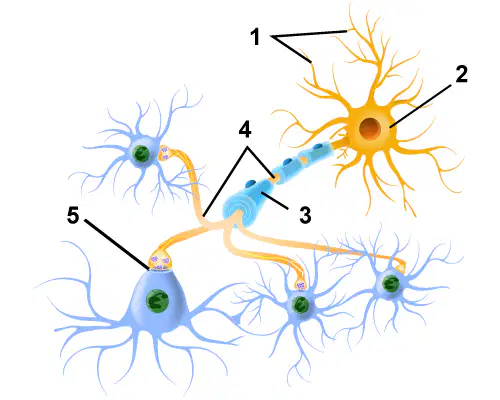
Using the image of the neuron, Identify #1
dendrite
soma
Myelin
axon
Using the image of the neuron, Identify #2
dendrite
soma
Myelin
axon
Using the image of the neuron, Identify #4
dendrite
soma
Myelin
axon
Using the image of the neuron, Identify #5
synapse
soma
Myelin
axon
Using the image of the neuron, Identify #3
synapse
soma
Myelin
axon
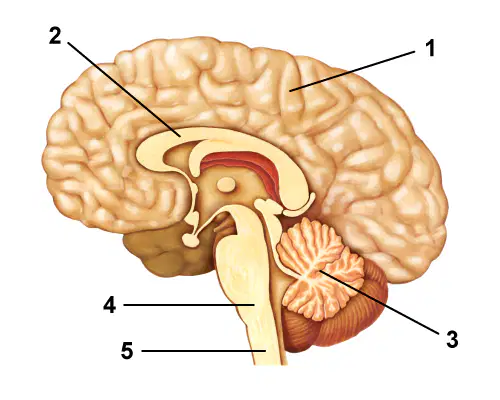
Identify the part labeled #1 of the central nervous system.
cerebrum
Spinal Cord
corpus callosum
cerebellum
Identify the part labeled #2 of the central nervous system.
cerebrum
Spinal Cord
corpus callosum
cerebellum
Identify the part labeled #3 of the central nervous system.
cerebrum
Spinal Cord
corpus callosum
cerebellum
Identify the part labeled #4 of the central nervous system.
cerebrum
Spinal Cord
medulla
cerebellum
Identify the part labeled #5 of the central nervous system.
cerebrum
Spinal Cord
medulla
cerebellum

