
 Worksheets
Q3 REVIEW Quiz
Total questions: 44
Worksheet time: 25mins
Earth revolves around the sun. How long does it take for Earth to complete one revolution?
one day
one week
one month
one year
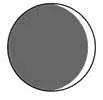
The picture below shows a phase of the moon. Which phase does the picture show?
waxing crescent
new moon
third quarter
waning crescent
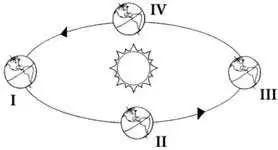
Look at the diagram below. It shows Earth at four positions in its orbit around the sun. At which position does the Northern Hemisphere receive the least amount of sunlight each day?
Position I
Position II
Position III
Position IV
The moon goes through a cycle of phases each month. Which phase takes place when the moon is directly between Earth and the sun?
full moon
new moon
quarter moon
crescent moon
The sun is at the center of our solar system. What are the largest objects that revolve around the sun?
moons
comets
planets
asteroids
A thick atmosphere surrounds this planet. As a result, the temperature at its rocky surface is the hottest in the solar system. Which planet is it?
Jupiter
Neptune
Saturn
Venus
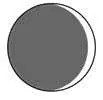
The picture below shows one of the phases of the moon. What will the next phase be?
new moon
third quarter
first quarter
full moon
Kashvi likes to look out the window at the moon. She observes that it seems to change every week. Which sentence best explains why this happens?
The moon moves between Earth and the sun.
The moon rotates only once in about a month.
The same side of the moon always faces Earth.
The amount of the lighted part of the moon that faces Earth changes.
Earth rotates on its axis once every 24 hours. What is the result of Earth’s rotation?
the seasons
night and day
the moon’s phases
the length of the year
The same side of the moon always faces Earth. Why is this?
Half the moon faces the sun.
The moon does not rotate as Earth does.
The moon’s rotation and orbit around Earth take the same amount of time.
Earth blocks part of the sunlight that would shine on the moon’s surface.
What would happen to the moon’s phases if the moon still revolved but Earth did not?
Phases would not occur.
The cycle of phases would be faster.
The cycle of phases would be slower.
Phases would occur the same as they do now.
Inner planets and outer planets have different structures. Which characteristic do all inner planets share?
small solid core
large solid core
surface of frozen gases
surface of mostly liquid water
On the moon, craters are formed when (a) hit the surface.
Kelly looks up at the moon at night. The moon appears to change shape every few nights. Why do the moon's surface features always look the same?
All features on the moon look the same.
The moon’s rotation distorts its features.
Features on the moon’s surface never change.
The same side of the moon always faces Earth.

Look at the table below. It shows the characteristics of four planets. Based on the data, which one is an inner planet?
Planet A
Planet B
Planet C
Planet D
. Examples of Constellations are …………………………………. And ………………………………….
(a)
Earth is a planet in the solar system. A planet can have one or more moons. What is another word that means the same as moon?
asteroid
satellite
comet
star

The picture below shows one of the phases of the moon. Which phase does the picture show?
crescent
first quarter
new moon
third quarter
Earth is tilted on its axis. Which of these would not exist if Earth had no tilt?
gravity
seasons
lunar phases
Earth’s rotation
Why is it useful to make a model of the sun and planets?
It shows the actual size of these objects.
It helps us quickly compare a physical property of these objects.
It clearly shows the composition of each object.
It helps us determine the distance between each object.
Carla sees a small object streak across the night sky. It trails a bright stream of light behind it. Which of the solar system’s objects does Carla see?
a moon
an asteroid
a comet
a dwarf planet
Daniel wants to make a cross-section model of an inner planet. Which characteristic should it have?
a large, solid core
a small, liquid core
a surface covered by liquid
a ball with a very large diameter
What does a solar system contain?
a group of stars
a star and the planets near it
the planets, moons, and asteroids around a star
a star and all the bodies that revolve around it
Which of these is responsible for changes from day to night on Earth?
Earth’s tilt
Earth orbiting the sun
the moon orbiting Earth
Earth rotating around its axis
Earth is one of the inner planets. Jupiter is one of the outer planets. How does each planet compare to the other planets in its group?
Both are the largest planets in their group.
Both are the smallest planets in their group.
Both are the closest planets to the sun in their group.
Both are the farthest planets from the sun in their group.
The planets of the solar system are very different in size. Which list orders the planets correctly from smallest to largest?
Jupiter – Venus – Saturn
Neptune – Uranus – Jupiter
Venus – Saturn – Jupiter
Earth – Mars – Jupiter
Luce made a scale model of the solar system. What did he notice about the inner planets—Mercury, Venus, Earth, and Mars?
They are all the same size.
They are all larger than the sun.
They are all larger than the outer planets.
They are all smaller than the outer planets.
………………………………….is a sphere of hot gas that gives off light and heat.
(a)
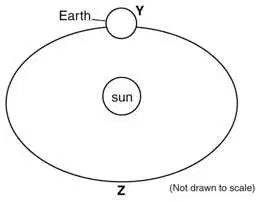
The diagram below shows the path of Earth’s movement. About how long does it take for Earth to move from point Y—its current location— to point Z?
12 hr
6 months
24 hr
1 yr
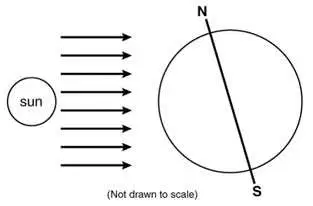
The diagram below shows the positions of Earth and the sun. Which of these statements is correct?
In the Northern Hemisphere it is fall, and in the Southern Hemisphere it is spring.
In the Northern Hemisphere it is winter, and in the Southern Hemisphere it is spring.
In the Northern Hemisphere it is spring, and in the Southern Hemisphere it is summer.
In the Northern Hemisphere it is summer, and in the Southern Hemisphere it is winter.
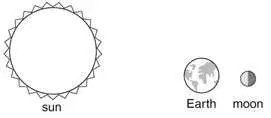
The picture below shows the sun, the moon, and Earth. Which moon phase would someone on Earth see?
full moon
last quarter
new moon
first quarter
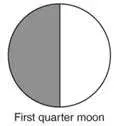
Emily saw the moon one night. It looked like the picture below. One week later, why did the moon look larger?
The moon became larger.
The moon became brighter.
Earth and the moon moved closer together.
Emily could see more of the side of the moon that was lighted.
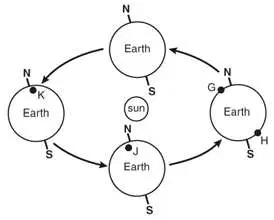
The diagram below shows planet Earth in different positions relative to the sun. Labels G, H, J, and K are different locations on Earth’s surface. According to the diagram, which of the following correctly states the season for the given location?
It is spring at Location G
It is winter at Location H.
It is fall at Location J.
It is summer at Location K.
What is an orbit?
the turning of a planet on its axis
the distance of a planet from the sun
the speed at which a planet moves around the sun
the path one object takes around another object in space
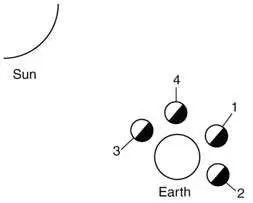
The picture below shows the moon in several positions around Earth. Which position would let a person on Earth see a new moon?
1
3
2
4
8.The equator is an imaginary line that divides Earth into two ………………………….
(a)
………………….. are the regular rise and fall of water along the shore?
(a)
1. Meteor is a rock that strikes Earth’s surface.
True
False
1. Water level rises where the bulge is while the level lowers where there is no bulge.
True
False
1. An Equinox happen in March and December. (-)
True
False
The sun is a medium-sized star, but it
appears much larger than other stars. Why
does the sun appear to be so large?
The sun is hotter than other stars.
The sun produces more light than
other stars.
The sun is much closer to Earth than
other stars are.
The sun is affected by Earth’s gravity
more than other stars are.
While looking at the sky one night, Bevan
saw a streak of light. Bevan’s father told
him that the light was produced by a small
chunk of rock passing through Earth’s
atmosphere. Which of these terms best
describes what Bevan saw?
asteroid
meteor
comet
meteorite
A meteoroid is a chunk of rock traveling
through the solar system. How is a
meteorite related to a meteoroid?
A meteorite is a meteoroid that enters
Earth’s atmosphere.
A meteorite is a meteoroid that has
broken into smaller pieces.
A meteorite is a meteoroid that is
larger than an asteroid.
A meteorite is a meteoroid that
reaches the surface of Earth.
Planets are classified as either inner
planets or outer planets based on their
distance from the sun. What is found
between the inner planets and the outer
planets?
(a)

