
 Worksheets
[AOP220] Splints Acting on the Shoulder & Elbow
Total questions: 72
Worksheet time: 40mins
Shoulder arm sling is the most basic provision for shoulder orthosis. It is also known as Northern Ring Sling.
FIRST statement is TRUE, SECOND statement is FALSE
FIRST statement is FALSE, SECOND statement is TRUE
BOTH are FALSE
BOTH are TRUE
Conditions that Require an Elbow Immobilization Splint:
Elbow Fracture
Elbow Arthroplasty
Elbow Instability
Biceps/Triceps Repair
Cubital Tunnel Syndrome
It is used for short-term/temporary cases, to prevent overstretching of the glenohumeral musculature or ligaments.
Shoulder Arm Sling
Humeral Fracture Brace
Arm Abduction Orthosis
NOTA
Functions to decrease shoulder pain related to arm distraction and shoulder-hand syndrome or (CRPS) complex regional pain syndrome.
Shoulder Arm Sling
Humeral Fracture Brace
Arm Abduction Orthosis
NOTA
Shoulder arm sling functions to help keep the hand and forearm elevated to reduce edema. Elevation of the hand permits gravity to assist with the drainage of edema from the proximal limb to the distal.
FIRST statement is TRUE, SECOND statement is FALSE
FIRST statement is FALSE, SECOND statement is TRUE
BOTH are FALSE
BOTH are TRUE
The provision of a shoulder arm sling will immobilize the shoulder. However, it will not improve subluxation (it will not reduce shoulder subluxation), this facilitates protection ONLY in acute stroke patients with subluxation.
FIRST statement is TRUE, SECOND statement is FALSE
FIRST statement is FALSE, SECOND statement is TRUE
BOTH are FALSE
BOTH are TRUE
A humeral fracture brace is used to protect healing fractures as in the case of a humeral fracture. This non-articular fracture orthosis is mostly for colossal fractures that require reduction and fixation procedures because the healing process takes longer compared to hairline fractures or minuscule fractures that do not need any of the aforementioned procedures.
FIRST statement is TRUE, SECOND statement is FALSE
FIRST statement is FALSE, SECOND statement is TRUE
BOTH are FALSE
BOTH are TRUE
These are indicated for clients who have stiffness at the shoulder and adhesive capsulitis or frozen shoulder.
Torque Transmission Splints
Immobilization Splints
Non-articular Fracture Orthosis
NOTA
Elbow fracture and arthroplasty has the same wearing schedule. The only difference is that for elbow fracture, the immobilization splint is removed for exercises and hygiene if permitted meanwhile for arthroplasty, it is removed for protected range of motion exercises until the joint is stable.
FIRST statement is TRUE, SECOND statement is FALSE
FIRST statement is FALSE, SECOND statement is TRUE
BOTH are FALSE
BOTH are TRUE
Mobilization of a passively supple shoulder requires a (a) sufficient to abduct, extend, flex, or rotate the proximal upper extremity joint that is both complex in structure and large in size.
If bony tuberances cannot be avoided, then we have to decrease the splint pressure over the protrusions or areas of the bony prominences. Use of padding is not be beneficial to the splint fabrication, padding can induce more pressure to the area, leading to redness and pressure ischemia.
BOTH are TRUE
FIRST statement is FALSE, SECOND statement is TRUE
BOTH are FALSE
FIRST statement is TRUE, SECOND statement is FALSE
It is a common consequence of trauma which is seen in patients with osteoarthritis.
Elbow Stiffness
Elbow Fracture
Biceps/Triceps Repair
NOTA
Mobilization splints maintain or increase the shoulder's passive range of motion by applying heavy-load prolonged tension on associated tissues. This splint requires the incorporation of more secondary joints that allow improved purchase, stabilization, and torque to be applied to achieve specific shoulder positions.
FIRST statement is TRUE, SECOND statement is FALSE
FIRST statement is FALSE, SECOND statement is TRUE
BOTH are FALSE
BOTH are TRUE
Pressure sensitive areas on the elbow, EXCEPT:
Olecranon process
Lateral epicondyle
Medial epicondyle
Radial/Torsion Gutter of Radial Nerve
NOTA
Pressure sensitive areas on the hand which are distally located, EXCEPT:
Olecranon process
Lateral epicondyle
Medial epicondyle
Radial/Torsion Gutter of Radial Nerve
NOTA
Arm abduction orthosis is an example of an immobilization splint. The majority of these splints incorporate, elbow, forearm, and wrists as secondary joints to improve splint mechanics.
BOTH are TRUE
FIRST statement is FALSE, SECOND statement is TRUE
BOTH are FALSE
FIRST statement is TRUE, SECOND statement is FALSE
Biceps/Triceps Repair and Cubital Tunnel Syndrome have the same type and position of splint which says that "Posterior elbow splint immobilized at a prescribed angle based on structures requiring protection. The splint is usually adjusted to increase the angle of immobilization by 10 to 15 degrees per week at 3 weeks postoperatively. Volar splint elbow immobilized in 30 to 45 degrees extension or reverse elbow pad"
TRUE
FALSE
This may occur with or without fractures which highlights that dislocation on the elbow are common. The mechanism of injury is the posterior or posterolateral force directed to the elbow.
(a)
The (a) articulation consists of the trochlear notch of the proximal ulna and the trochlea of the distal humerus.
Repetitive pronation is attributed to the rupture of biceps tendon as this is inserted on the radius as proximal radioulnar joint space is occupied by the biceps tendon when the forearm is pronated. It contributes to the pathophysiology of the distal biceps rupture to the mechanical shearing and hypovascularization. Mechanical shearing is the repetitive stress and hypovascularization is the lack of adequate blood supply to the ligament and to the tendon.
TRUE
FALSE
Pressure-tolerant and sensitive areas are also included in our splint fabrication, these are the bony prominences that have minimum subcutaneous soft tissue that leads to vulnerability to external pressure. To check if the pressure-sensitive areas have reacted to the pressure in the splint, it is best to check within 5 minutes.
FIRST statement is FALSE, SECOND statement is TRUE
FIRST statement is TRUE, SECOND statement is FALSE
BOTH are FALSE
BOTH are TRUE
It is a temporary immobilization splint; as it recovers, another orthosis can be provided. It is also known as Airplane Splint as its common name.
Arm Abduction Orthosis
Shoulder Arm Sling
Humeral Fracture Brace
NOTA
These are the indications of Arm Abduction Orthosis:
Post Operative Shoulder Fusion
Post Operative Scar Release
Shoulder Dislocation
Burns (Humeral)
Tendon Transfer
This condition requires the position of the splint in posterior at 90° of flexion, in Bledsoe brace, or Mayo elbow brace
Elbow Arthroplasty
Biceps/Triceps Repair
Elbow Fracture
Elbow Instability
After the removal of the postoperative dressing, a posterior elbow immobilization splint with 120 degrees of flexion is provided. Therapist-supervised protected range-of-motion exercises are performed until the joint becomes more stable. The client is not permitted to remove the splint unsupervised.
Elbow Arthroplasty
Biceps/Triceps Repair
Elbow Fracture
Elbow Instability
Functional range of motion -30-0° of extension, 0-130° of flexion is the functional ROM of the elbow. While the movement of the elbow consists of Flexion (0-150°); Extension (150-0°), and Supination (75-90°); Pronation (75-90°).
BOTH are TRUE
FIRST statement is FALSE, SECOND statement is TRUE
BOTH are FALSE
FIRST statement is TRUE, SECOND statement is FALSE
Arthroplasty, acromioplasty, rotator cuff repair, and tendon transfer are examples of post-operative indications to protect healing tissues under arm abduction orthosis, and in general, these are considered clinical indications for shoulder splint.
TRUE
FALSE
In shoulder splints, the shoulder position is dependent on the specific repair and surgeon's preference. For burns in the axillary area, anti-deformity position is acquired at 90 to 100° to avoid contracture and difficulty to perform abduction.
FIRST statement is TRUE, SECOND statement is FALSE
FIRST statement is FALSE, SECOND statement is TRUE
BOTH are FALSE
BOTH are TRUE
(a) have minimum subcutaneous soft tissue that leads to vulnerability to external pressure.
For biceps rupture, conservative management is often indicated for partial tears using elbow braces or immobilization orthoses, which are placed in 90° of flexion and neutral in pronation. This may also include postoperative bracing or orthotic provision for full tears with the forearm in supination.
FIRST statement is TRUE, SECOND statement is FALSE
FIRST statement is FALSE, SECOND statement is TRUE
BOTH are FALSE
BOTH are TRUE

A. This is a result of bending force.
Transverse Fracture
Spiral Fracture
Oblique Fracture
NOTA
B. This is a result of the combination of bending and torsion force, with or without butterfly fragment.
Transverse Fracture
Spiral Fracture
Oblique Fracture
NOTA
C. This is a result of torsion force.
Transverse Fracture
Spiral Fracture
Oblique Fracture
NOTA
This is the most common cause of anterior shoulder pain shoulder instability and muscled weakness of supraspinatus, rhomboids, teres major. Compared to rotator cuff impingement where you have the acromion process and greater tuberosity, ______________ is more of the subacromial which is under the acromion process.
Humeral Fracture
Impingement Syndrome
Acromioplasty
Frozen Shoulder
It is caused by repetitive microtrauma and outlet impingement between the acromion and greater tuberosity of the humerus.
Rotator Cuff Impingement
Impingement Syndrome
Acromioplasty
Humeral Fractures
Rotator cuff tears are more common in the dominant arm as it is used more frequently. If the individual has a rotator cuff tear on one laterality, it will most likely occur on the other side.
BOTH are TRUE
FIRST statement is FALSE, SECOND statement is TRUE
FIRST statement is TRUE, SECOND statement is FALSE
BOTH are FALSE
Functional range of motion for the elbow:
-30° to 130°
30° to 130°
0° to 130°
NOTA
With Hypovascularization, the body’s natural ability to repair tendon damage becomes less effective. These may also be caused by bone overgrowth, which often develops in the underside of the greater tuberosity which impinges the tendon and causes tear.
BOTH are TRUE
FIRST statement is FALSE, SECOND statement is TRUE
BOTH are FALSE
FIRST statement is TRUE, SECOND statement is FALSE
Clinical indications of elbow splints are Elbow fractures, Elbow arthroplasty, Elbow instability, Tendinitis and strain (biceps and triceps repair), Cubital tunnel syndrome, Olecranon Bursitis, Medial epicondylitis, and Lateral epicondylitis. Medial epicondylitis is also called tennis elbow, lateral epicondylitis is also known as golfer's elbow.
BOTH are FALSE
BOTH are TRUE
FIRST statement is TRUE, SECOND statement is FALSE
FIRST statement is FALSE, SECOND statement is TRUE
This can occur when an individual is at the gym performing bicep curls and then the client has to sustain more eccentric loading far beyond the capabilities of their biceps.
Cubital Tunnel Syndrome
Biceps Rupture
Rotator Cuff Impingement
Impingement Syndrome
Swimming, baseball, weightlifting, and overhead activities put repeated stress on the supraspinatus, infraspinatus, teres major, and subscapularis.
TRUE
FALSE
Pressure sensitive areas on the shoulder, EXCEPT:
Glenohumeral Joint
Clavicle
Spine of the Scapula
Coronoid Fossa
NOTA
True joints of the shoulder, EXCEPT:
Glenohumeral Joint
Acromioclavicular Joint
Sternoclavicular Joint
Scapulothoracic Joint
The shoulder area is more challenging to splint due to its complexity and size. This spans the axial skeleton, like the elbow; there are no isolated regions, for the shoulder, it is the connection of the appendicular and axial.
FIRST statement is TRUE, SECOND statement is FALSE
BOTH are FALSE
FIRST statement is FALSE, SECOND statement is TRUE
BOTH are TRUE
Shoulder Joint
Enarthrodial
Trochoginglymoid
These splints are designed to transfer movement to joints external to the splints themselves. They do this by transferring moment longitudinally through controlling secondary joints.
Torque Transmission Splints
Restriction Splints
Mobilization Splint
Immobilization Splints
Neophrine splint is a single-purpose torque transmission splint that has a minimum of 1 secondary joint level. They are used to maintain or increase motion in conjunction with upper extremity use.
FIRST statement is TRUE, SECOND statement is FALSE
FIRST statement is FALSE, SECOND statement is TRUE
BOTH are FALSE
BOTH are FALSE
These splints limit the elbow's normal arc of motion to promote healing or to decrease pain. These splints cater to wide variety of elbow problems; are diagnostic specific.
RESTRICTION SPLINTS
TORQUE TRANSMISSION SPLINTS
EXCERCISE SPLINTS
ELBOW FLEXION SPLINT
Cubital tunnel syndrome's mechanism of injury includes trauma and prolonged/sustained motion that compresses the nerve. Symptoms may present as pain and paresthesia on the fourth and fifth digits, in advanced stage, it presents as weakness and atrophy of the thenar and thumb abductor.
BOTH are TRUE
BOTH are FALSE
FIRST statement is FALSE, SECOND statement is TRUE
FIRST statement is TRUE, SECOND statement is FALSE
Restriction splint allows protected movement with a safe range of motion determined by the therapist. This is worn when sleeping to prevent elbow extension.
FIRST statement is TRUE, SECOND statement is FALSE
FIRST statement is FALSE, SECOND statement is TRUE
BOTH are FALSE
BOTH are TRUE
The PRUJ, along with the distal radioulnar joint at the wrist, form a singular longitudinal axis that affords pronation and supination of the forearm.
TRUE
FALSE
The mechanism of injury is fall on outstretched hand, posterior force is directed at the flexed elbow. These are often complicated by concomitant injury to surroundings of tissues, blood vessels, or nerves.
ELBOW FRACTURES
BICEPS RUPTURE
ELBOW DISLOCATIONS
NOTA
The elbow joint is composed of the humeroradial joint which is a hinge joint, humeroulnar joint which is an axial joint as well as the proximal radioulnar joint.
TRUE
FALSE
Biceps rupture is commonly seen in the long head of the biceps within the shoulder, while distal biceps tendon is uncommon. The mechanism of injury is the eccentric loading of the biceps while the elbow is flexed.
FIRST statement is TRUE, SECOND statement is FALSE
FIRST statement is FALSE, SECOND statement is TRUE
BOTH are FALSE
BOTH are TRUE
During the day, an elbow pad is worn to protect the posterior elbow in addition to elbow restriction splints that allow precise restriction of motion through adjustable elbow hinges. These splints may affect motion in only one plane.
FIRST statement is TRUE, SECOND statement is FALSE
FIRST statement is FALSE, SECOND statement is TRUE
BOTH are FALSE
BOTH are TRUE
In restriction splints, Type 0 is more of a neophrine splint (cloth-like) that only includes the primary joint, this is not as sturdy as a thermoplastic splint. Type 1 incorporates the forearm as a secondary joint while restricting elbow flexion.
FIRST statement is TRUE, SECOND statement is FALSE
FIRST statement is FALSE, SECOND statement is TRUE
BOTH are FALSE
BOTH are TRUE
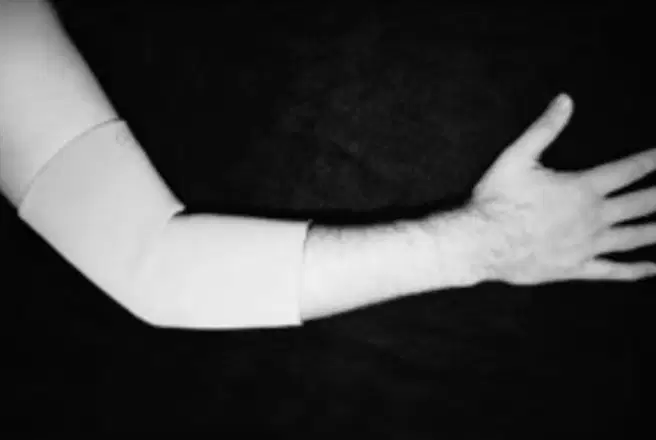
This splint falls under:
RESTRICTION SPLINTS (Type 0)
MOBILIZATION SPLINTS (Type 0)
IMMOBILIZATION SPLINTS (Type 0)

The picture shows 1 primary + 1 secondary joint. This splint falls under.
RESTRICTION SPLINTS (Type 1)
MOBILIZATION SPLINTS (Type 1)
IMMOBILIZATION SPLINTS (Type 2)
Static progressive orthosis is considered a mobilization splint. In the elbow, the _____________ is considered to be a secondary joint. This is done to obtain sufficient splint mechanical advantage on the elbow joint as the elbow is considered the pivot/fulcrum and the _____________ acts as the lever arm.
(a)
In elbow mobilization splint, the secondary joint is hindered from pronation and supination which can reach near total immobilization. The elbow mobilization splint applies static progressive concept on the movement of flexion and extension.
FIRST statement is TRUE, SECOND statement is FALSE
FIRST statement is FALSE, SECOND statement is TRUE
BOTH are FALSE
BOTH are TRUE
These are indicated for elbow contractures that may be manifested in thickening and shortening of the anterior and posterior capsules of the elbow with increasing contracture of the collateral ligaments and muscles surrounding the elbow as time progresses.
Mobilization Splints
Immobilization Splints
AOTA
NOTA
These splints promote tissue healing, control post-operative motion, and rest joints that are debilitated. These splints may be applied to the anterior, and posterior, lateral, or medial aspect of the elbow depending on the instructions or location of the injury or trauma.
Mobilization Splints
Immobilization Splints
AOTA
NOTA
Conditions commonly require immobilization of the elbow include:
Arthritis
Cubital tunnel syndrome
Carpal tunnel syndrome
Rotator cuff impingement
Ligamentus Injuries
For Type 1 immobilization splint, anterior elbow orthosis is indicated in situations where there is a posterior wound that cannot tolerate posterior pressure or contact. Anterior elbow orthosis is used to prevent or correct extension contractures, when it follows an anterior design it becomes effective in blocking elbow flexion such as for people with ulnar nerve compression neuropathies.
FIRST statement is TRUE, SECOND statement is FALSE
FIRST statement is FALSE, SECOND statement is TRUE
BOTH are FALSE
BOTH are TRUE
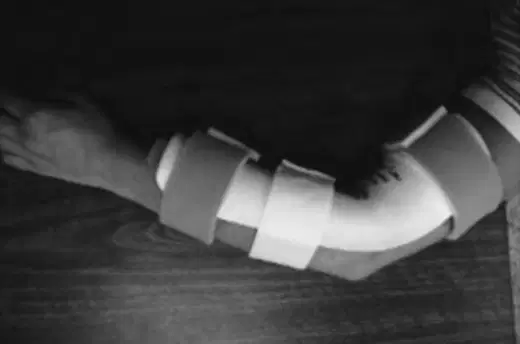
This splint falls under:
RESTRICTION SPLINTS (Type 1)
MOBILIZATION SPLINTS (Type 2)
IMMOBILIZATION SPLINTS (Type 1)
NOTA
In elbow immobilization splint, the elbow area can be isolated which is why there is a presence of Type 0 splint that only includes the primary joint. In immobilization splint Type 2, 2 secondary joints are used both of which are always situated distal to the primary elbow joint which increases splint stabilization and improves elbow immobilization by stabilizing the forearm and wrist.
FIRST statement is TRUE, SECOND statement is FALSE
FIRST statement is FALSE, SECOND statement is TRUE
BOTH are FALSE
BOTH are TRUE
For the posterior elbow orthosis, is a common orthotic choice for many acute post-traumatic and post-surgical elbow conditions. The orthosis is easy to wear and offers rest and protection to painful and healing structures
FIRST statement is TRUE, SECOND statement is FALSE
FIRST statement is FALSE, SECOND statement is TRUE
BOTH are FALSE
BOTH are TRUE
Cubital tunnel syndrome is the first common site of nerve compression in Upper Extremity (UE), carpal tunnel syndrome comes after. Ulnar nerve is affected in cubital tunnel syndrome as it is located at the medial epicondyle this can be elicited by Tinel's sign.
FIRST statement is TRUE, SECOND statement is FALSE
FIRST statement is FALSE, SECOND statement is TRUE
BOTH are FALSE
BOTH are TRUE
Conservative management avoids posture that aggravates the symptoms where clients are instructed to avoid repetitive and sustained elbow flexion. A nighttime posterior orthosis or a belly gutter at the posteromedial is fabricated with the elbow position to 30 - 45 degrees of extension. If the exposed cubital tunnel region remains irritated, an anterior elbow extension orthosis at the aspect of the elbow may be an option.
FIRST statement is TRUE, SECOND statement is FALSE
FIRST statement is FALSE, SECOND statement is TRUE
BOTH are FALSE
BOTH are TRUE
Nearly all elbow dislocations simple and complex have elbow instability. In summary, when there is a posterior or posterolateral force directed at the elbow, it may be followed by instability because of the humeroulnar joint dislocation, injury to the varus and valgus stabilizers (i.e. lateral and medial collateral ligament, and the radial head), and coronoid avulsion (coronoid fossa).
BOTH are TRUE
FIRST statement is TRUE, SECOND statement is FALSE
FIRST statement is FALSE, SECOND statement is TRUE
BOTH are FALSE
Elbow joint is a Trochoginglymoid Joint with 2 articulations but has 3 joints (1 hinge joint, 2 axial rotation joints). There are 2 degrees of freedom which is flexion and extension, supination and pronation.
BOTH are TRUE
FIRST statement is FALSE, SECOND statement is TRUE
BOTH are FALSE
FIRST statement is TRUE, SECOND statement is FALSE
The (a) articulation is formed by the fovea of the proximal radius and the capitulum of the distal humerus.

