
NEW
Font size
 Worksheets
Y12 Global Shift Quiz
Total questions: 22
Worksheet time: 11mins
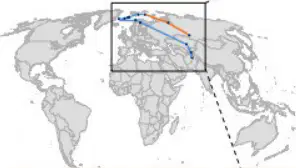
What does the map provided by the McKinsey Global Institute illustrate?
The population distribution from AD 1 to 2025
The shift of the world's economic center of gravity over time
The climate change impact on the world economy
The political power shift from the 20th to the 21st century
Which regions have experienced a shift of manufacturing jobs?
From Asia to Europe and North America
From Europe and North America to Africa
From Europe, Japan, and North America to China
From China to Europe and North America
What has been the trend in service and administration jobs?
They have shifted from India to Europe and North America
They have remained stable in Europe and North America
They have shifted from Europe and North America to India, especially Bangalore
They have shifted from China to Europe and North America
Over how many years has the global economic center of gravity been relocating to Asia from Europe and North America?
Over the last 20 years
Over the last 30 years
Over the last 40 years
Over the last 50 years
When did the shift of economic activity towards Japan begin, marked by the relocation of cheap mass-produced goods like toys and textiles?
1913
1950s
1980s
2025
Which regions quickly followed Japan in the economic shift during the 1960s and 70s?
European countries
Asian Tiger Economies
South American countries
The communist bloc
What is the expected time lag between the removal of trade barriers and large FDI flows according to the text?
5-10 years
10-15 years
20-25 years
30-35 years
By 2025, what does McKinsey predict about the global economy?
It will be centered near the United States.
It will be balanced around the middle of Eurasia.
It will shift entirely to Asian countries.
It will revert back to the Industrial Revolution era.
Who are the key players in the global shift?
International governments only
Global organisations only
Multi-national and trans-national corporations
Local businesses
What has contributed to accelerating globalisation?
The decline of technology and transport
The growth and improvement of technology and transport
The decrease in economic power of large companies
The disintegration of trade blocs
What role do trade blocs and international governments play in globalisation?
They have no impact on globalisation
They have led to a deceleration of globalisation
They have led to accelerating globalisation
They only affect local markets
What is one positive effect of cheaper imports of labor-intensive products for HICs?
Increase in the cost of living
Decrease in the retailing sector
Increase in unemployment rates
Decrease in the cost of living
How might growth in LICs affect HICs' exports?
Decrease demand for exports from HICs
No impact on exports from HICs
Increase demand for exports from HICs
Only affect the domestic market of LICs
What is a potential environmental benefit of the loss of industries in HICs?
Worsening environmental quality
No change in environmental quality
Improved environmental quality
Increased industrial waste
What is one of the negative effects of rising job exports in HICs?
Increase in skilled labor demand
Inevitable job losses
Decrease in technology changes
Balanced wage differences between skilled and unskilled workers
Who are most likely to experience job losses due to competition-driven changes in technology in HICs?
Skilled workers
Government employees
Unskilled workers
Industry CEOs
What can the concentration of job losses in certain areas and industries lead to in HICs?
Increased investment in new industries
Decreased wage demands
Deindustrialisation and structural unemployment
Balanced economic growth
What is one of the positive effects of factory work in LIC/NEE compared to subsistence farming?
Factory work leads to a decrease in regular wages.
Factory work provides a reliable regular wage.
Factory work increases reliance on subsistence farming.
Factory work reduces the number of available jobs.
How many people have been lifted out of extreme poverty due to the global shift?
1 million people
1 billion people
600 million people
11,000 people
What can lead to over-dependence on one industry in NEEs/LICs?
Diversification of the economy.
Investment in multiple industries.
Over-rapid industrialisation.
Over-dependence on one industry leaving an unstable economy.
What is a negative impact of the creation of jobs in cities in NEEs/LICs?
Decrease in rural-urban migration.
Development of well-planned settlements.
Development of unplanned settlements as new job opportunities create rural-urban migration.
Improvement in public services.
Which environmental issue is associated with over-rapid industrialisation in NEEs/LICs?
Decreased air and water pollution.
Environmental regulation keeping pace with growth.
Air and water pollution due to growth outpacing environmental regulation.
Improved natural resource management.

