
Font size
 Worksheets
Unit 5-7 Mastery
Total questions: 20
Worksheet time: 10mins
Imagine Rohan and Avery are planning a fun day at the beach. Besides enjoying delicious seafood and surfing the waves, in what other cool ways do humans rely on the vast oceans? Let's dive in with Jackson to explore!
Oxygen production from phytoplankton
Weather regulation due to coastal water temperature
Transportation
Relief from hurricanes and tornadoes
Imagine diving into the vibrant world of coral reefs with Elijah, Abigail, and Henry. Recently, they've noticed a worrying decline in the bustling life that usually thrives here. Scientists are scratching their heads, but a popular theory points to global warming. It seems the rising temperatures are too hot to handle for some of the reef's tiniest inhabitants, causing a domino effect that threatens everyone in this underwater community. Now, our trio is on a mission to find out which action WON'T help save the day for the coral reefs.
create artificial coral reefs in cooler waters
limit fishing around the reefs
ban the placing of anchors in the reefs
ban cities from discarding sewage into coral reef areas

Imagine Kai, David, and Avery are on an adventure and they come across an erupting volcano! Kai wonders, how did this magnificent volcano come to be? It could have formed and erupted when —
less dense oceanic crust was forced under denser continental crust, causing the oceanic crust to heat up, melt, and flow upward to relieve pressure.
denser oceanic crust was forced under less dense continental crust, causing the continental crust to heat up, melt, and flow upward to relieve pressure.
two equally dense tectonic plates collided and both pushed upward, causing friction that heated up minerals between the two rising plates.
two equally dense tectonic plates separated and allowed hot minerals from Earth's crust to flow upward and out of the opening that formed between the two plates.
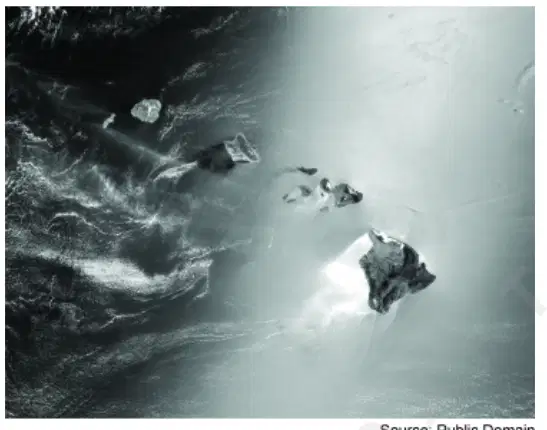
Imagine David, Benjamin, and Daniel are on an adventure in Hawaii. They're curious about how these beautiful islands came into existence. The Hawaiian islands were formed in this geological hotspot because —
tectonic plates shifted over time, allowing lava to reach Earth's surface and produce volcanoes. It's like the Earth playing a slow game of building blocks!
tectonic plates shifted over time, creating ocean basins that lava filled until it created volcanoes. Think of it as the Earth's way of filling up a giant bathtub!
a divergent plate boundary, known for frequent volcanic activity, provided the magma needed to form new crust material. It's as if the Earth is constantly renovating its surface!
a subduction plate boundary, known for frequent volcanic activity, provided the magma needed to form new crust material. Imagine the Earth gobbling up one plate under another and then burping out a volcano!
Imagine Benjamin and Arjun are on a thrilling underwater adventure, exploring the vast and mysterious sea floor. Suddenly, they stumble upon the formation of an ocean basin right before their eyes! What incredible process are they witnessing that forms an ocean basin?
Two crustal plates moving apart
Two crustal plates freezing
Two crustal plates melting
Two crustal plates colliding
Alright, super sleuths William, Maya, and Benjamin! It's time for a two-part detective mission. First up, Part A: Uncover the last piece of evidence that supported the plate tectonic theory. Ready, set, investigate!
The continents fit together like a puzzle
Mountain ranges lined up across oceans
Fossils were discovered that connected continents together
The ocean floor was spreading and new crust was filling in the spaces
Imagine you're on a thrilling adventure back in the early twentieth century with Oliver, David, and Elijah. As budding geologists and meteorologists, you're piecing together the groundbreaking theory of plate tectonics. Amidst your discoveries, which piece of evidence made you scratch your head, realizing it didn't quite fit the puzzle that Earth's crust plates were on the move?
Stumbling upon similar fossils in completely different regions of the world
Finding matching rock and mountain formations that seemed to tell a story of unity
Observing land features shaped by sand and erosion, which seemed out of place
Noticing land features created by glaciers on each continent, hinting at a chilly past
Imagine Anika, Maya, and Rohan are on a thrilling adventure, diving deep into Earth's mysteries after the scientific community embraced Alfred Wegener's theory of continental drift. Their quest leads them to uncover secrets that propel the development of the theory of plate tectonics. They become super sleuths in understanding how Earth's plates dance by –
unraveling the mystery that there are different types of boundaries where plates meet.
believing that all plates are born from volcanoes and meet their end in earthquakes.
discovering that Earth is home to only three giant plates.
concluding that plate boundaries are just a myth.
Imagine Anika and Rohan are in a science museum, staring at a fascinating exhibit. The exhibit shows tiny particles arranged in a beautiful geometric pattern, all of them dancing in place. What phase is this mesmerizing substance in?
gas phase.
solid phase.
liquid phase.
plasma phase.
Imagine Emma, Abigail, and Benjamin are observing a snowflake under a microscope in their science class. They're curious about the behavior of H₂O molecules in this solid phase. Which statement best describes these molecules?
They move slowly in straight lines.
They move rapidly in straight lines.
They are arranged in a regular geometric pattern.
They are arranged in a random nongeometric pattern.
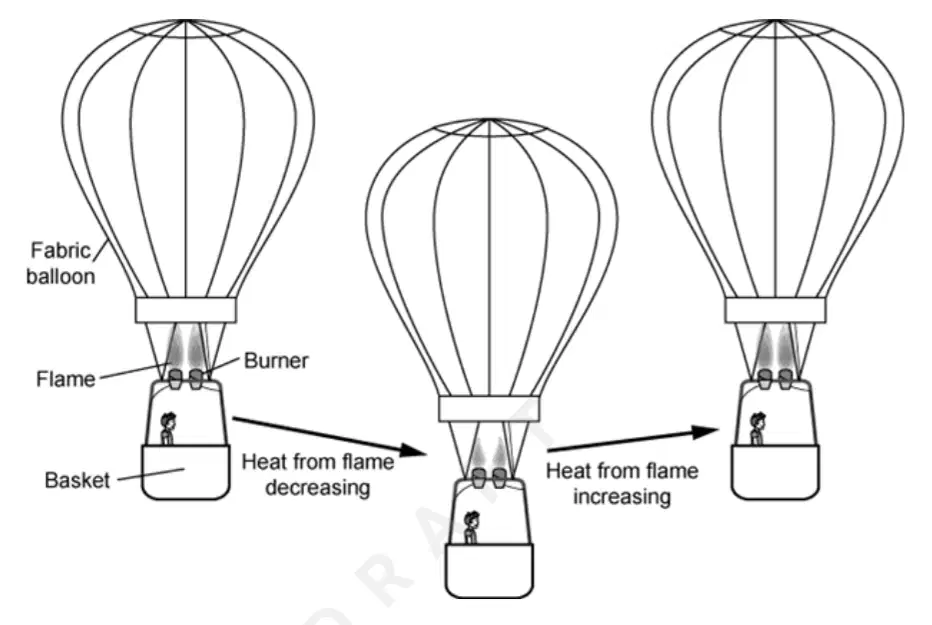
Imagine Michael, Aria, and Nora are on an adventure, soaring through the sky in a hot air balloon. As they adjust the flame to change their altitude, which type of heat transfer is primarily responsible for their thrilling ride up and down?
Convection, because as the heat from the flame is increased, less dense air fills and lifts the balloon, making their adventure even more exciting
Conduction, because as the heat from the flame is increased, heat moves into the balloon without traveling through particles, but is this really how their balloon soars?
Condensation, because as the heat from the flame is decreased, water droplets form on the sides of the balloon, making it heavier. Could this be the secret to their adventurous descent?
Radiation, because as the heat from the flame is decreased, the flow of energy is able to pull the balloon down. Is this the mysterious force guiding their journey?
Imagine Priya and Elijah are on a chilly winter adventure. Priya decides to wear a cozy coat. This smart move prevents —
conduction, the transfer of heat from Priya's body to the atoms in the cold air.
convection, the transfer of heat through empty space, leaving Priya shivering.
radiation, the transfer of heat to fluids, like the water vapor swirling around them.
radiation, the transfer of heat in circular a pattern from Priya's body to the chilly air.
Imagine Anika and Nora are at the beach, feeling the warm sun on their skin. Suddenly, Priya explains that when the Sun heats one region in an ocean, the water starts moving and spreading the heat around. What's this cool process called?
Radiation
Conduction
Convection
Absorption
Imagine Aria, Noah, and Oliver are on a space adventure! They're curious about how things heat up differently in space. Which of the following statements is true of radiation but not of convection or conduction, something they might experience beyond Earth's atmosphere?
It can cause a liquid to get warmer.
It can occur beneath Earth's surface.
It can cause a solid to get warmer.
It can occur beyond Earth's atmosphere.

Imagine Grace and Mason are having a tea party in their cool classroom. Looking at the data table, can you help Abigail explain how the thermal energy is moving around, especially considering the temperature of the tea and the surrounding air?
The thermal energy of the tea moved from inside the cup to the surrounding air, just like when Grace noticed her tea getting cooler.
The thermal energy of the cool classroom moved from the room into the tea, making Mason's tea surprisingly warm.
Condensed water vapor from the air formed around the rim of the cup, which then transferred thermal energy into the tea, a mystery that Abigail pondered.
Evaporation of the tea resulted in less tea in the cup, which decreased the amount of thermal energy in the cup, a fact that surprised both Grace and Mason.
Imagine Ethan and Luna are conducting a cool science experiment. They have a glass jar filled with 100 mL of water at a toasty 75°C (167°F). Curious Luna places a metal spoon, which was resting at a cool 23°C (73°F), into the water. What do you think will happen after the spoon and water have been mingling for five minutes?
The temperature of the spoon will decrease as thermal energy flows into the water, making it even cooler.
The temperature of the water will decrease as thermal energy flows into the spoon, warming it up.
The temperature of the water and spoon will remain the same as no thermal energy is transferred, like they're giving each other the silent treatment.
The temperature of the water and spoon will both increase as thermal energy transfers between them, like they're sharing warmth in a cozy hug.
Imagine Kai and Mia are on a cool science adventure, exploring the mysteries of heat transfer! They decide to conduct a fun experiment by placing an ice cube in warm water. Kai carefully measures the temperature of the water before the ice cube dives in, and Mia checks it again after the ice cube has completely melted. During this chilly encounter, heat zips and zooms between the water and the ice cube. Let's help them fill in the blanks to describe this exciting journey of heat.
Heat moves from the ________ into the ________ until the ice cube melts in the water and both reach the same cozy temperature.
(a)
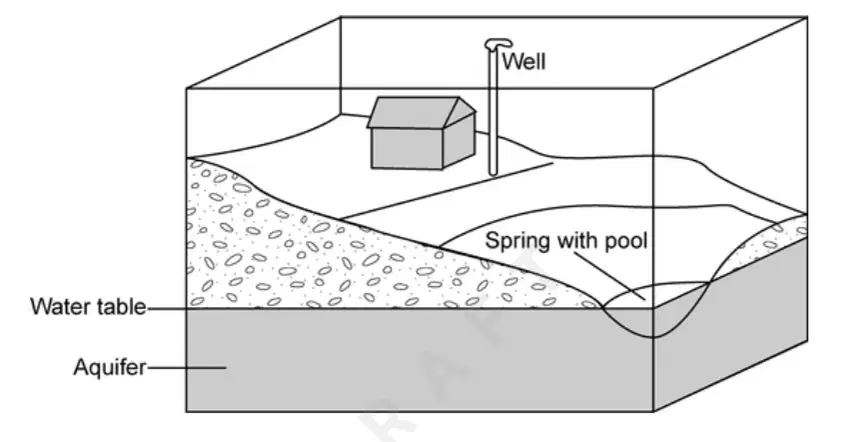
Imagine Nora, Liam, and Abigail are on a quest in a land suffering from a severe drought. They discover that the locals have been excessively pumping groundwater out of their ancient aquifers to survive. Our trio learns about the consequences of this action, but they are puzzled about one thing that doesn't happen as a result. Can you help them figure out which of the following is NOT an effect of excessive groundwater pumping?
groundwater depleting.
the water table rising.
soil collapsing.
water quality decreasing.
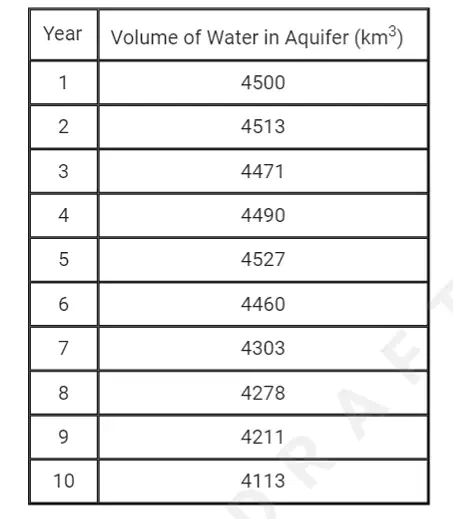
Imagine you're a water detective like Harper, Anika, and Benjamin, investigating the mysterious case of the disappearing water! The table you've found shows the amount of water in the secret groundwater aquifer, known as Aquifer X, over the last ten years. After a new human community popped up nearby, the water levels started to change. Your mission: Determine in which year this sneaky community most likely settled down near Aquifer X.
Year 3
Year 5
Year 7
Year 9
Imagine Elijah's backyard, a lush green paradise thanks to his diligent yard maintenance and generous use of fertilizers. But when rain comes, those same fertilizers journey from Elijah's yard to the local pond, where they throw a massive feast for algae. What do you think happens next in this aquatic drama?
The pond becomes a sunlit haven, with more light reaching the deep-dwelling creatures below.
The pond turns into a bustling metropolis of diverse aquatic life, thanks to the new arrivals.
A shadow falls over the pond's inhabitants as the algal blooms block the sunlight from reaching below.
The pond's bottom gets a clean sweep, leaving less soil and sediment behind.

