
 Worksheets
Test Corrections - Biomes, Energy Flow, & Eco Succession
Total questions: 20
Worksheet time: 20mins
In what way is a decomposing log in a forest a microhabitat?
It supports a distinct population of organisms, but the forest houses the log itself.
It provides camouflage for particular organisms to protect them from predators.
It decomposes into organic matter that enriches the soil.
It is a large community of organisms that occupy a major habitat.
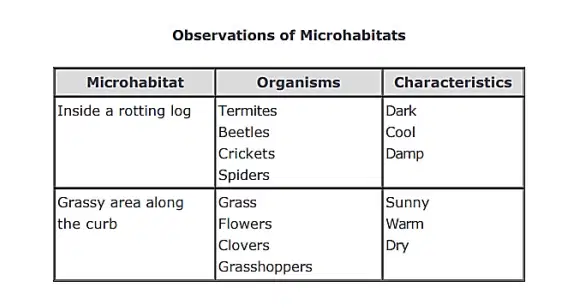
Based on the information in the chart, what is the best explanation for the different variety of organisms in the two microhabitats?
The rotting log and grassy area are in different biomes.
Conditions for survival are different in each location.
The rotting log has predators while the grassy area does not.
There is more space in the rotting log than in the grassy area.
Which statement best describes the comparison of lake and ocean environments?
The lake and ocean environments support the same organisms because they are both water and are made up of the same elements.
The lake and ocean environments support different organisms because most freshwater organisms cannot live in saltwater.
The lake and ocean environments support the same organisms, but they will look different because of the type of water.
The lake and ocean environments support different organisms because ocean organisms are blocked by land from getting into lakes.
A good adaptation for living in a grassland would be —
the ability to hibernate.
the ability of plants to grow very high to reach the sunlight.
thick, insulating fur.
the ability of plants to regrow after prairie fires.
Some desert animals are most active at dusk and dawn. This adaptation is MOST helpful for —
preying on plant species.
finding new water sources.
avoiding high temperatures.
hiding from hungry animals.
High biodiversity improves the sustainability of an ecosystem, because —
It makes the food web simpler and ensures there are very few predators.
Many organisms will undergo beneficial mutations and improve their traits.
The ecosystem will continue to function even if some populations decrease.
It allows organisms from different species to mate and create new species.

The food webs below model relationships among the organisms in two ecosystems. Which ecosystem would be more likely to survive if a disease killed the grasses?
The forest ecosystem, because most of the animals can eat other organisms
The grassland ecosystem, because several predators compete for food
The forest ecosystem, because it has three top predators
The grassland ecosystem, because it has many herbivores

Students in a science class visited four local ecosystems. The students observed the species present in each ecosystem and recorded their observations in the table. Based on the observations of four local ecosystems recorded in the table, which ecosystem is likely to be the least sustainable and why?
Ecosystem 1 - it has the fewest species
Ecosystem 2 - it supports many animals
Ecosystem 3 - it has few predators
Ecosystem 4 - it includes both aquatic and terrestrial species
Two of the greatest threats to biodiversity and the sustainability of ecosystems are - [Select TWO choices]
Changing of natural habitat for farming, mining, and urban development
Diseases that spread from humans to animals
Lack of recycling programs and excess food waste
Catching fish or hunting animals at a rate that doesn't allow populations to rebuild
An ecosystem that is not sustainable can break down when a natural disaster occurs. This can lead to organisms in the ecosystem either leaving the area or dying off. Increased biodiversity results in a more sustainable ecosystem because —
a greater number of plant species means that there is less barren land
a greater variety of species present allows more organisms to adapt after changes occur
the transition area between two ecosystems is narrower
there are fewer species to be affected by environmental stresses
Which question is most relevant to an ecosystem beginning primary succession?
Why is there no soil, grass, or shrubs present in the ecosystem?
Why are there so many kinds of animals living in the ecosystem?
What types of hardwood trees are growing in the ecosystem?
What caused the forest fire that destroyed the previous ecosystem?
Some students take care of a vegetable garden. When it is time to plant in the spring, the students leave part of the garden empty in order to observe ecological succession. Which of these will most likely occur first?
Development of topsoil
Growth of weeds and grasses
Growth of trees and shrubs
Development of a stream
Primary succession occurs when pioneer species move into an area that has no plants. Which organisms are common pioneer species?
Conifer trees and tall grasses with roots that loosen the soil
Mosses and lichens that can grow on rocky surfaces
Grasses and weeds that arrive as seeds carried by the wind and then germinate in rich soil
Vines and shrubs that help prevent the erosion of shallow soil
Which of the following sequences most likely represents ecological succession on a recently abandoned wheat field?
grasses → flowering plants → shrubs → native trees
native trees → shrubs → flowering plants → grasses
shrubs → grasses → native trees → flowering plants
flowering plants → native trees → shrubs → grasses
A volcanic eruption covers a wide area of forest with ash, lava, and volcanic rock. Which of these describes the first stage of ecological succession that will begin to return biotic factors to the forest community and return it to a state of equilibrium?
The volcano stops erupting.
The lava cools to form rock.
Lichens grow on the rocks.
The rocks melt back into lava

An energy pyramid is shown. Which sentence best describes how energy flows through this pyramid?
Energy is transferred down each level of the energy pyramid.
The energy lost at each level is consumed by organisms in the top level.
Energy is transferred from organisms in one level to those in the level above.
The organisms at the bottom level provide energy directly to organisms in all the other levels.
What do the arrows represent in the diagram of a food chain?
The order of size of organisms in the ecosystem
The importance of organisms in the chain
The direction of energy flow through organisms
The energy increases as you move from left to right
When energy is passing through a food web, some of the energy is lost as heat. Approximately how much of the energy is passed from one level to the next?
1%
10%
50%
90%

The chart lists organisms in five different categories living near the Texas Gulf Coast. Based on the chart, which food chain best models a flow of energy in this ecosystem?
Sun → Mosquitoes → Shrimp → Coyotes
Sun → Algae → Shrimp → Red drum
Sun → Pygmy sunfish → Shrimp → Wood ducks
Sun → Willow oaks → Algae → River otters
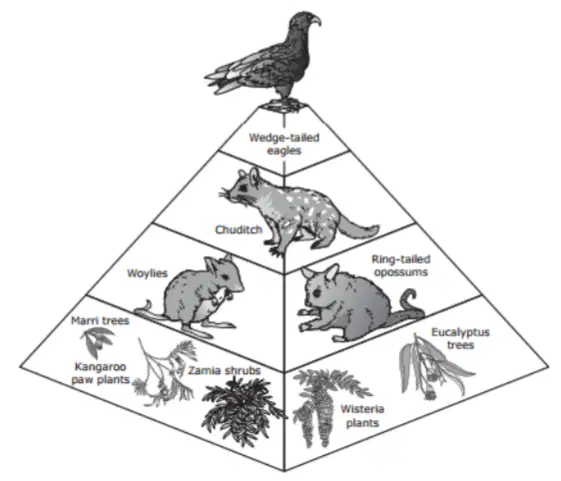
Based on the model, which consumers would receive the greatest amount of energy captured by the producers in their food chains?
Wedge-tailed eagles
Chuditch
Ring-tailed opossums
Eucalyptus trees

