
 Worksheets
Evolution post exam
Total questions: 22
Worksheet time: 11mins
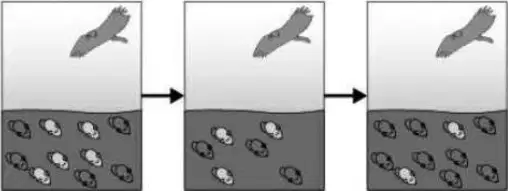
The diagram below shows a population of mice over time. Which of the following statements is supported by the information in the diagram?
The light mice are poorly adapted to survive in any environment. Because of this, fewer light mice were able to pass on their genes.
The dark mice all have identical genes. Because of this, the dark mice were more likely to have a beneficial mutation and pass on their genes.
The dark mice are hard to be seen against the dark rocks. Because of this, the dark mice lived to reproduction age and produced more dark mice.
There are more light mice to begin with, making it hard for them to compete for resources. Because of this, there were fewer light mice in the next generation.
Which of the following best explains why the population of brown beetles grew more than the green beetles? (5 Points)
The green beetles' genes were not dominant, so they did not get passed onto as many offspring.
The brown beetles' offspring had more mutations, which made their genes express the brown color.
The green beetles produced more offspring with their traits than the environment could support.
The brown beetles were better able to survive to reproductive age and pass on their traits.
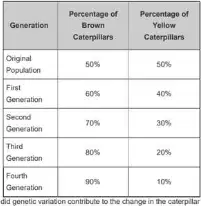
Some of the caterpillars are brown and some are yellow. The table illustrates the change in the population over generations. How did genetic variation contribute to the change in the caterpillar population? (5 Points)
The yellow caterpillars had more desirable traits.
The brown caterpillars were better able to find food.
The yellow caterpillars had fewer resources available.
The brown caterpillars were better able to avoid predators.
A scientist studying fossils in undisturbed layers of rock identified a species that appeared to have changed little over the years. Which observation would have most likely led him to this conclusion? (2 Points)
The simplest fossil organisms appeared only in the newest rocks.
The same kind of fossil organisms appeared in old and new rocks.
According to Darwin's theory of natural selection, the individuals that tend to survive are those that have the (2 Points)
greatest number of offspring, variations best suited to environmental conditions.
characteristics that plant and animal breeders value
characteristics their parents acquired by use and disuse

If the lack of rain continued for another three years, which of the following graphs would most likely be correct?
Option 1
Option 2
Option 3
Many of the animals that live in the northernmost regions of the Northern Hemisphere have white fur. How does having white fur make these animals more likely to survive in an arctic environment?
White fur repels insects and parasites that live in the Arctic
White fur absorbs more sunlight to help them keep warm
White fur provides less water resistance to make them swim faster
White fur helps them blend in with their surroundings
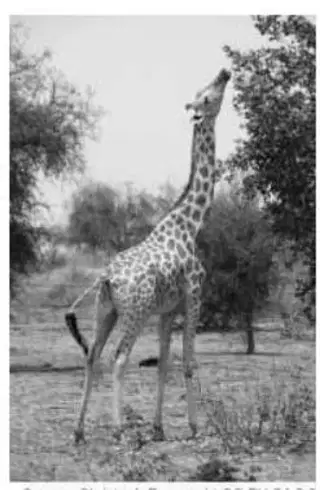
Which of the following variations would best help individuals in a population of giraffes outlive the other giraffes?
having the longest necks to reach food at higher levels than the others
having the brightest fur to blend into the environment, avoiding predators
When lions prey on a herd of antelopes, they often go after the weakest of the herd. Some antelopes are killed and others survive. Which statement best describes the future generations of these antelopes? (5 Points)
The number of weak antelopes will increase in future generations.
The weakest antelopes will inherit traits from the strongest antelopes in future generations.
The strongest antelopes will inherit traits from the weakest antelopes in future generations.
The number of strong antelopes will increase in future generations.
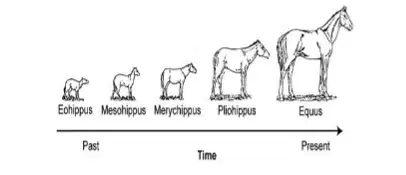
What is a genetic change that has occurred in the horse over time? (5 Points)
The horse has developed four legs.
The horse has lost its tail.
The horse has increased in size.
The horse has become less muscled.
Ms. Tucker is using an empty bookcase with four shelves to model layers of fossils. On which shelf should she put the newest fossils? (5 Points)
top shelf
second shelf
third shelf
bottom shelf
What have paleontologists discovered through the fossil record? (5 Points)
Changes occur in animals over long periods of time.
None of the animals that exist today were alive millions of years ago.
Animals that become extinct often reappear at a later time in history.
Animals have more dominant genes in the modern age.
A scientist studying fossils in undisturbed layers of rock identified a species that appeared to have changed little over the years. Which observation would have most likely led him to this conclusion? (5 Points)
The simplest fossil organisms appeared only in the newest rocks.
The simplest fossil organisms appeared only in the oldest rocks.
The same kind of fossil organisms appeared in old and new rocks.
The simplest fossil organisms appeared only in the oldest rocks.
What does the fossil record tell us about this change?
All reptiles once possessed the ability to fly.
It occurred immediately after a meteor struck Earth.
It has reversed itself many times throughout history.
It happened slowly over a long period of time.
Evidence that life on Earth has changed over time is buried within the Earth. What is this evidence? (5 Points)
embryology
fossils
sedimentary rock
magma
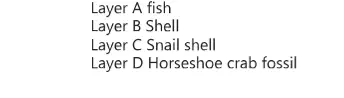
The diagram below shows undisturbed sedimentary rock strata. In which layer will the most complex organisms be found? (5 Points)
Layer A
Layer B
Layer C
Layer D
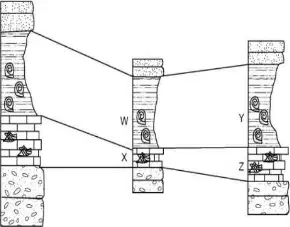
The picture illustrates three cross sections of rock layers from three different areas. What can be determined about the relative ages of the fossils? (5 Points)
Fossils U, V, W, and X were formed more recently than Y and Z.
Fossils U, V, and W were formed further in the past than V, X and Z.
Fossils U, W and Y were formed around the same time period as V, X and Z.
Fossils U, W and Y were formed more recently than V, X and Z.
What is the process by which humans have intentionally selected desirable traits in plants or animals to breed for those traits? (5 Points)
Natural selection
Variation
Mutation
Selective breeding
Which term refers to the gradual process by which biological traits become either more or less common in a population based on the advantages they provide for survival and reproduction? (5 Points)
Extinction
Adaptation
Mutation
Natural selection
Which of the following is a source of genetic variation that can lead to evolution? (5 Points)
Selective breeding
Mutation
Adaptation
Extinction
What is the process by which new species develop from existing species over time? (5 Points)
Selective breeding
Natural selection
Extinction
Speciation
Which term describes the process by which species gradually die out and no longer exist? (4 Points)
Mutation
Adaptation
Extinction
Variation

