
 Worksheets
Airplanes/FMC Test
Total questions: 120
Worksheet time: 3hrs 0mins
What city is the airport HNL in?
New York
Honolulu
San francico
hnl
what city is SFO in?
San Francisco
San Francco
Helena
Denver
what city is DFW in?
dallas
Dallas/Fort Worth
New York
Dallas
What city is JFK in?
New York
El Paso
Lemming
New York City
what city is LAX in?
Los Angeeslxander
Las Angeles
Los Angeles
lax
The airport in Honolulu is...
HNNL
ogg
egg
HNL
The airport in d
Denver is...
den
Denver Airport
DEN
DEEN
What is the natural force that allows planes to fly
wings
levitation
lift
gravity

what airline is this
sw
aa
delta
emirates

what airline is this
delta
sw
aa
hawaiian

what airline is this
emirates
delta
aa
sw

what airline is this
alaska
delta
alaskan
aa

what airline is this
southwest
aa
emirates
delta
Standard traffic pattern turns are to the?
Right
Left
Pilot's choice

What is the VASI lighting system indicating on the picture above?
Too low
Too high
On glidepath

What type of runway is depicted in the picture above?
Temporarily closed runway
Permanently closed runway
Active runway

What can you do in the area depicted by arrows leading to the runway numbers?
Take-off, no taxi, no landing
No take-off, no taxi, no landing
Take-off, landing, no landing
What is the purpose of runway markings?
Help pilots navigate to their next destination
Prevent runway incursions and mishaps around the airport environment
Solely used by ground maintenance personnel in order to prevent vehicles from colliding with aircraft
Which is not a leg of an airport traffic pattern?
Quarterwind
Downwind
Crosswind
If an airport had two runway 25s, how would the runways be marked?
25 L and 25 C
25 C and 25 R
25 L and 25 R

In what taxiway are we currently located at?
Alpha
Charlie
Delta
In order to properly enter an airport traffic pattern, a pilot must enter on the downwind at a?
60 degree angle
30 degree angle
45 degree angle

Using the sign above, how many feet of runway is left before aircraft reaches the end of the runway?
40
400
4000

True or False: Runway number above coincides with a magnetic heading of 031?
True
False
The base leg is flown
after the downwind leg
prior to turning downwind
with the wind pushing the airplane to the right
before turning final
A right hand traffic pattern allows a pilot to
fly a 'straight in' approach and skip the base leg.
avoid flying over populated areas.
avoid flying near a significant hill or mountain.
avoid a crosswind landing.
The crosswind leg of the traffic pattern is normally
flown following the downwind leg of a right hand traffic pattern.
flown with the aircraft flying directly into the wind.
not flown unless a pilot chooses to remain in the traffic pattern following a takeoff.
used only for emergency purposes.
The recommended entry position for manned aircraft to enter an airport traffic pattern is
45° to the base leg just below the traffic pattern altitude
to enter 45° at the midpoint of the downwind leg at the traffic pattern altitude
to cross directly over the airport at the traffic pattern altitude and join the downwind leg
just above the final approach leg for the runway planes are landing on
What is the normal manned aircraft traffic pattern around an airport in the U.S.?
Making all right turns along the traffic pattern
Enter on the upwind leg and land on the downwind leg
Turn right after the crosswind leg to enter the base leg
Making all left turns along the traffic pattern
The first leg of the manned aircraft traffic pattern is called
the Crosswind Leg
the Upwind Leg
the Base Leg
the Downwind Leg
The second leg of the manned aircraft traffic pattern is called
the Crosswind Leg
the Base Leg
the Upwind Leg
the Downwind Leg
In the Manned aircraft traffic pattern, "final" occurs after which leg?
the Downwind Leg
the Crosswind Leg
the Upwind Leg
the Base Leg
What is the runway number for a runway when the landing aircraft is facing East?
36
18
27
09
What is the runway number when the aircraft taking off is facing West?
36
27
18
09
If an airport has two runways facing the same direction, how does a manned aircraft pilot know which to land on?
It doesn't matter. He can take his pick
Always land on the one to your right
The tower will specify the Left or Right runway
Always land on the one to your left
When a manned aircraft is entering the traffic pattern, the pilot must make sure that
his aircraft is descending as it enters the traffic pattern
his aircraft is ascending as it enters the traffic pattern
his aircraft is already at the altitude of the traffic pattern
his aircraft enters the traffic pattern from the left
An aircraft approaching an airport announces that they are "midfield left downwind to Runway 18". Where would the aircraft be relative to the runway?
East of the runway, heading North
West of the runway, heading South
North of the runway, heading West
South of the runway, heading East
The phonetic code for the letter "C" is
Carol
Candy
Charlie
Cancer
The phonetic code for the letter "G" is
Gary
George
Grandad
Golf
The phonetic code for the letter "H" is
Harry
Hotel
Henry
Handy
In the phonetic alphabet, what word comes after Papa?
Mama
Grandad
Oscar
Quebec
An aircraft announces that they are "on short final for runway 9". Where will the aircraft be in relation to the airport?
North
East
South
West
What does the standard aviation phraseology "WILCO" mean?
Let me know that you have received my message.
I have received your message , understand it, and will comply with it.
Request confirmation of information
Stay in place where you are currently located
In standard aviation phraseology, what does "Final" mean?
the aircraft is on final approach and aligned with the landing area
the aircraft is about to crash and this is its last transmission
the aircraft is holding short of the runway while another plane lands
It is an answer to the tower's question "Advise intentions".
In the phonetic alphabet, what is the word for the number 9?
Niner
Nothing
Nunya
Nuggie
What does ILS stand for?
Instrumental Landing System
Instrumental Landing Signal
Instrument Landing Signal
Instrument Landing System
What is the main function of the ILS?
To guide the pilot horizontally and vertically towards the airport
To provide weather forecasts for the pilot
To control the air traffic in the vicinity of the airport
To communicate with the ground control for landing clearance
What is the purpose of the bar on the ILS instrument display?
To show the direction of the nearest airport
To display the current altitude of the aircraft
To indicate the distance to the runway
To guide the pilot on the horizontal alignment with the runway
What is the function of the Outer Marker (OM) in the ILS system?
To indicate the position of the aircraft in relation to the runway
To provide the final approach path guidance to the pilot
To signal the proximity to the minimums for landing
To mark the outer boundary of the airport airspace
What is the potential future of ILS in aviation?
It will be phased out completely due to technological advancements
It will continue to be the most popular approach aid, especially in airports with complex terrain
It will be replaced by RNAV for all types of approaches
It will only be used for visual approaches in the future

What is the name of this?
Displaced Threshold
Blast Pad
Helipad
Jet Pad

This stands for?
Important Landing Software
Important Landing System
Instrument Landing System
Immediate Landing System

Indicates what?
800 feet of runway remaining
80 feet of runway remaining
8 feet of runway remaining
8000 feet of runway remaining

Which of the following is true with regards to a displaced threshold?
You can land on it
The runway needed to be extended
You can begin your take off there
You can taxi on it

These lights are found...
on the sides of taxiways
on the sides of runways
on the sides of aprons (parking bays)

If you were approaching this runway from the other end, what would be your heading?
270 degrees
090 degrees
09 degrees
27 degrees

If you see this sign, it indicates that....
You are on taxiway charlie
You are approaching taxiway charlie
You are on taxiway C
You are approaching taxiway C

When must you stop?
When approaching this from the dashed side
When approaching from the double-lined side
Only if there is traffic
When approaching from either side
The centre line of a taxiway is...
a double yellow line
a dashed white line
a dashed yellow line
a solid yellow line
ATIS stands for
Automated Tower Information Service
Automated Terminal Information Service
Automated Terminal Information System
Which of the following words indicates the least amount of cloud cover (as described on an ATIS)?
Overcast
Broken
Few
Scattered
If the wind at an airport was described as 120/21G33, what would this mean?
Wind at 120 knots, from 21 degrees with 33 knot gusts
Wind from 120 degrees, at 21 knots, gusting to 33 knots
Wind from 120 degrees, at 33 knots, gusting to 21 knots

What is this?
Airspeed Indicator
Attitude Indicator
Altimeter
Turn and Slip Indicator
Vertical Speed Indicator

What is this?
Airspeed Indicator
Attitude Indicator
Altimeter
Turn and Slip Indicator
Vertical Speed Indicator

What is this?
Airspeed Indicator
Altitude Indicator
Altimeter
Turn and Slip Indicator
Vertical Speed Indicator

What is this?
Airspeed Indicator
Attitude Indicator
Altimeter
Turn and Slip Indicator
Magnetic Compass

What is this?
Airspeed Indicator
Altitude Indicator
Altimeter
Turn and Slip Indicator
Magnetic Compass

What is this?
Airspeed Indicator
Attitude Indicator
Altimeter
Vertical Speed Indicator
Magnetic Compass
Pulling the yoke towards the pilot helps the plane..
climb.
go down.
fly stable.
set autopilot.
Pushing the yoke towards the dashboard helps the plane..
climb.
go down.
fly stable.
set autopilot.
The airspeed indicator displays...
the airspeed of the aircraft in knots.
the airspeed of the aircraft in mph.
air pressure to tell us how high we are relative to sea level.
the rate of turn and slip of a turn.
the position in roll, pitch, and yaw in relation to the horizon and flight path.
The altimeter indicator displays...
the airspeed of the aircraft in knots.
the airspeed of the aircraft in mph.
air pressure to tell us how high we are relative to sea level.
the rate of turn and slip of a turn.
the position in roll, pitch, and yaw in relation to the horizon and flight path.
The turn and slip indicator displays...
the airspeed of the aircraft in knots.
the airspeed of the aircraft in mph.
air pressure to tell us how high we are relative to sea level.
how fast the airplane is turning.
the position in roll, pitch, and yaw in relation to the horizon and flight path.
The magnetic compass displays...
the airspeed of the aircraft in knots.
the direction the aircraft is pointing, 0 being north and 180 being south.
air pressure to tell us how high we are relative to sea level.
how fast the airplane is turning.
the position in roll, pitch, and yaw in relation to the horizon and flight path.
The vertical speed indicator displays...
the airspeed of the aircraft in knots.
the direction the aircraft is pointing, 0 being north and 180 being south.
air pressure to tell us how high we are relative to sea level.
rate of climb or decent.
the position in roll, pitch, and yaw in relation to the horizon and flight path.
What doe VOR stand for?
Very High Frequency Omni-Directional Range
Vertical Orientation Radar
Very Omni-Directional Radar
Vertical Overwatch Radar
What does ILS stand for?
Indiana Landing System
Instrument License System
Indy League Signal
Instrument Landing System
ILS
(a)
DME
(a)
DA
(a)
DH
(a)
MDA
(a)
OCH
(a)
MAP
(a)
PA
(a)
What is lift?
twisting of a plane around a vertical axis
raise to a higher position
pull something forcefully
turning over and over on an axis
What is yaw?
twisting of a plane around a vertical axis
raise to a higher position
pull something forcefully
move or cause to move in a particular direction by turning over and over on an axis
What is drag?
twisting of a plane around a vertical axis
raise to a higher position
pull something forcefully
turning over and over on an axis
What is weight?
twisting of a plane around a vertical axis
raise to a higher position
pull something forcefully
the heaviness of a person or thing
What is engineering?
using math and science to solve problems or create something
make the best of something
pull something forcefully
the heaviness of a person or thing
What is roll?
motion of an aircraft rocking back and forth
make the best of something
pull something forcefully
the heaviness of a person or thing
What is pitch?
motion of an aircraft rocking back and forth
rotation of an aircraft around a side-to-side axis or the up and down movement
pull something forcefully
the heaviness of a person or thing
What is horizontal?
motion of an aircraft rocking back and forth
rotation of an aircraft around a side-to-side axis or the up and down movement
a way to make a design the most effective it can be
parallel to the horizon
What is a wing?
motion of an aircraft rocking back and forth
rotation of an aircraft around a side-to-side axis or the up and down movement
a horizontal structure on either side of a plane that provides support for an aircraft
parallel to the horizon
What is a stabilizer?
a fixed wing section that keeps a plane flying straight
rotation of an aircraft around a side-to-side axis or the up and down movement
a horizontal structure on either side of a plane that provides support for an aircraft
parallel to the horizon
What is the nose of an airplane?
a fixed wing section that keeps a plane flying straight
the very front section of the plane
a horizontal structure on either side of a plane that provides support for an aircraft
parallel to the horizon
What is aviation?
a fixed wing section that provides stability for the aircraft, to keep it flying straight
the very front section of the plane
a horizontal structure on either side of a plane that provides support for an aircraft
the flying or operating of an aircraft
What is thrust?
the force that moves an aircraft
the very front section of the plane
a horizontal structure on either side of a plane that provides support for an aircraft
the flying or operating of an aircraft
The first successful airplane was built by?
The Smith Brothers
The Wright Brothers
Neil Armstrong
The Wrong Brothers
The Wright brothers tested their plane at...
Virginia Beach , VA
Dayton, OH
Kitty Hawk, NC
Charlotte, NC
The speed of sound is...
260 mph
460 mph
760 mph
100,600 mph
The body of the plane...
fuselage
wings
fin/rudder
stabilizer
Controls pitch
fuselage
wings
fin/rudder
stabilizer
Controls yaw (left, right)
fuselage
wings
fin/rudder
stabilizer
Generates Lift and controls Roll.
fuselage
wings
fin/rudder
stabilizer
Rotation around the vertical axis (left, right)
pitch
yaw
roll
lift
Rotation around the front to back axis.
pitch
yaw
roll
lift
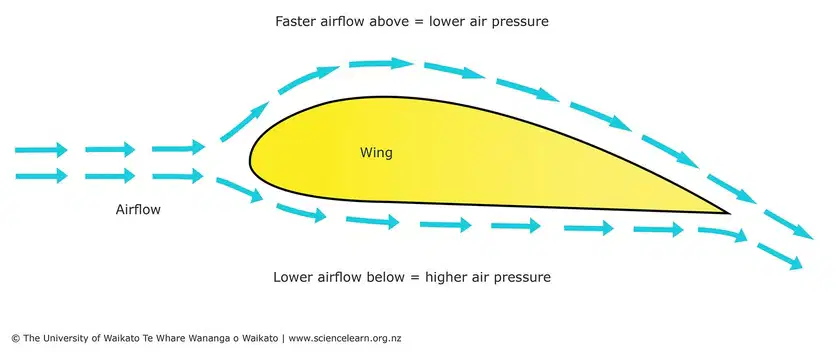
air moves faster over the top of the wing creating....
lift
drag
gravity
thrust
Resistance due to friction with the air. Increases with speed. Reduced by streamlining or aerodynamics.
lift
drag
gravity
thrust
Is the force of the engine pushing or pulling the craft forward.
lift
drag
gravity
thrust
Force pulling the aircraft down
lift
drag
gravity
thrust
The center of gravity should prevent
nose heaviness
tail heaviness
diving and stalling
all of the above
Average Pilot's salary in the U.S.
$75,000
$150,000
$1,000,000
$2,000,000
The principle which states that fast moving fluid (gas or liquid) over a surface creates low pressure.
Da Vinci's Principle
Buonarotti's Principle
Principal Childs
Bernoulli's Principle
What is the world's busiest Commercial Airport in the U.S.?
Atlanta International Airport ATL
O'Hare International Airport ORD
John F. Kennedy International Airport JFK
Los Angeles International Airport LAX
Which aircraft has the most parts?
Memphis Belle
Curtis NC-4
The Boeing 747
Vin Fiz Flyer

An elite team of black female mathematicians at NASA help win the space race and advance the quest for equality.
Name the 3 NASA engineers.
Janel Monee, Taraji P. Henson, Octavia Spencer
Patricia Kotero, Brenda Bennett, Susan Moonsie
Mary Jackson, Katherine Johnson, and Sidney Vaughn
Michelle Williams, Kelly Rowland, Farrah Franklin
The main 2 types of engines are reciprocal (piston) and ____________
Turbine
Lawn Mower
Rocket
Electric
Engines provide ______ which moves the aircraft forward.
Lift
Drag
Thrust
Heat
Wings produce ______ which is what makes flight possible
Drag
Lift
Thrust
Gravity

