
 Worksheets
STAAR Review
Total questions: 62
Worksheet time: 58mins

The factors listed above contributed most to the —
creation of alliances between British settlers and American Indians
election of British colonists to Parliament
growth of representative government in the British colonies
expansion of British trade in the Americas

Which characteristic is correctly matched with a number in the table?
1: Indigo
2: Moderate
3: Rocky soil
4: Ships

Which factor most contributed to the creation of the documents in this list?
The opportunity for trade with American Indians
The distance of the colonies from Great Britain
The doctrine of the Church of England
The economic system of mercantilism
Which best describes an important effect of the First Great Awakening?
Followers put suspected witches on trial.
Slavery was abolished in the colonies.
New teachings taught believers to challenge authority.
Puritans in England immigrated to the New World.

Which factor most encouraged the growth of this trade?
The invention of the steam engine
The profitability of cash-crop agriculture in the Plantation system
The development of the factory system
The establishment of protective tariffs
The Proclamation Line of 1763 led to disagreement between the colonists and the British government because it—
banned colonial trading with the American Indians
surrendered control of the Great Lakes region to Canada
offered all lands west of the Appalachian Mountains to British nobles
prohibited the colonists from settling west of the Appalachian Mountains

The Continental Congress issued this commission to —
Benedict Arnold
Alexander Hamilton
John Hancock
George Washington

These acts contributed to the start of the Revolutionary War by —
restricting colonial trade with American Indians
imposing regulations on colonial agriculture
angering colonists who believed that their civil liberties had been violated
punishing colonists for resisting the authority of Parliament

The excerpt above reflects the dissatisfaction of American colonists with the —
political debates that took place at the Albany Convention
interference of Great Britain in the slave trade
economic consequences of the Great Awakening
economic policies imposed by Great Britain following the French and Indian War

This excerpt refers to rights that people —
earn by demonstrating loyalty to their government
receive by becoming citizens of a country
have as a result of being human
are granted after enlistment in the military

Look at this excerpt from a STAAR question; the most likely matching keywords are...
Appalachian Mountains
pay off debt after the French and Indian War
representative self-government
trade with foreign countries

Which cause of the American Revolution is described in this excerpt?
Boston Massacre
Boston Tea Party
French and Indian War
Proclamation of 1763

Which phrase would best help you answer a question from this excerpt?
"Four score and seven years ago..."
No taxation without representation in Parliament

Look at these keywords from a STAAR question; the most likely matching keywords are...
Appalachian Mountains
pay off debt after the French and Indian War
representative self-government
trade with foreign countries
Women's rights movement leader who was instrumental in the proposal and ratification of the 19th Amendment
Dorthea Dix
Susan B Anthony
Harriet Tubman
Harriet Beecher Stowe
Women's rights movement leader who organized the Seneca Falls Convention
Harriet Beecher Stowe
Dorthea Dix
Harriet Tubman
Elizabeth Cady Stanton
The right to vote
Abolitionist
Suffrage
Temperance
2nd Great Awakening
Someone opposed to slavery
Suffragette
Transcendentalist
Prohibitionist
Abolitionist
Transcendentalist artists who painted American landscapes
Elizabeth Cady Stanton
Henry David Thoreau
Hudson River School
William Lloyd Garrison
Movement that taught that man could get closer to God through nature
Transcendentalism
2nd Great Awakening
Temperance
Abolitionism
Leader in education reform; Wanted to make school available for everyone
Dorthea Dix
Horace Mann
Ralph Waldo Emerson
William Lloyd Garrison
Religious movement that led to social reforms
Temperance
2nd Great Awakening
Suffrage
Transcendentalism

A
B
C
D

F
G
H
J

F
G
H
J

A
B
C
D


Which number represents the Adams-Onis Treaty (Florida Cession)?
1
2
3
4

Which number represents the Oregon Territory?
5
6
7
8
Which number represents the Mexican Cession? Hint: After the Treaty of Guadalupe Hidalgo
5
6
7
8
Why was "The Great Compromise" so important?
It created the Senate and the House of Representatives.
Smaller states seceded.
Larger states had all the power in the government.
People never argued again.

A
B
C
D

A
B
C
D
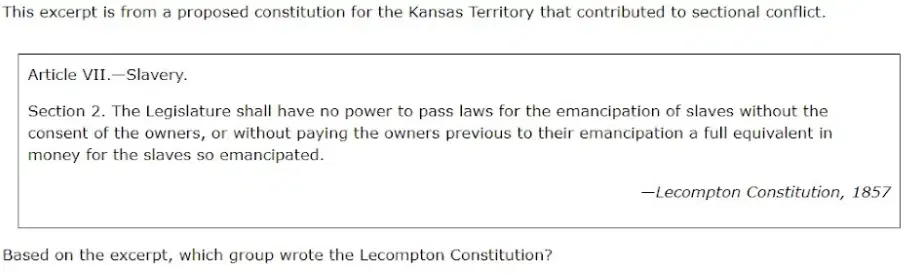
Based on the excerpt, which group wrote the Lecompton Constitution?
Opponents of westward expansion
Supporters of abolitionism
Anti-slavery northerners
Pro-Slavery Southerners
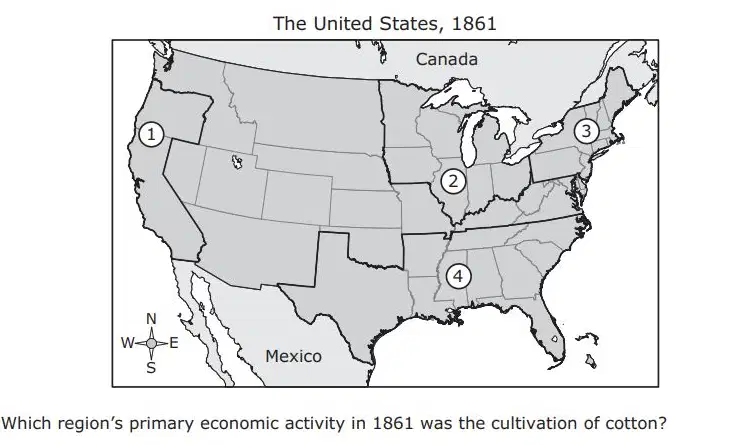
Which region primary economic activity in 1861 was the cultivation of cotton?
1
2
3
4


A
B
C
D

F
G
H
J

A
B
C
D

A
B
C
D

A
B
C
D

A
B
C
D

F
G
H
J

A
B
C
D

F
G
H
J

F
G
H
J

A
B
C
D

A
B
C
D

A
B
C
D

F
G
H
J

What was one effect of these events on the 1828 presidential election?
Votes were cast by secret ballot
Property qualifications for voting were strengthened
Poll taxes were reduced
Voter participation increased

What led to the conflict referred to in this excerpt?
The passage of the Dawes Act
The Louisiana Purchase
The adoption of Indian removal policies
The Battle of Tippecanoe
What was the issue in Worcester v. Georgia?
The taxation of Cherokee lands
The use of subsistence farming by the Cherokee people
The sovereignty of the Cherokee nation
The abandonment of the Cherokee culture by its people
Which shaded state was the main destination of American Indians forced to relocate as part of the Trail of Tears?


The proclamation excerpted above was issued during which of these historical events?
Shay's Rebellion
The War of 1812
The Nullification Crisis
The Civil War


What was the primary question surrounding the 1832 Nullification Crisis?
Can the federal government regulate interstate commerce.
Can a state regulate a federal agency.
Can a state overturn a federal law.
Can the federal government levy taxes on states.

