
 Worksheets
Unit 10 Electricity Review
Total questions: 25
Worksheet time: 25mins
A material through which charges do not flow well.
insulator
switch
current
short circuit
A device that can be used to easily stop and start the flow of electricity in a circuit.
insulator
switch
current
electric field
The actual flow of electric charges through a circuit.
electric field
insulator
short circuit
current
An accidental extra path for electricity to flow that can lead to a fire.
short circuit
electric field
current
insulator
The area around a charged object where other nearby objects can “sense” the charge and begin to respond to it.
electric field
current
short circuit
insulator
The process of acquiring (gaining) a charge on an object, usually as a result of friction, is called:
static electricity
discharge
current
induction
_______ is the rearrangement that occurs within a neutral object when it is placed near a charged object.
induction
static electricity
potential difference
short circuit
In the lightning process, the actual bolt that travels from the cloud down to the ground is an example of:
discharge
induction
static electricity
insulation
Which object is the best conductor of electricity?
plastic
metal
wood
rubber
This scientific instrument is used to detect if an object has an electrical charge_______.
electroscope
voltmeter
chargometer
ohmmeter
Thin wires have a ____________ resistance to electron flow than thicker wires.
higher
lower
equal
neutral
How easily an object is able to rearrange its electrons when it's near a charged object is called its:
conductivity
resistance
potential difference
induction
A galvanometer is a type of ammeter. It is used to measure ____________.
voltage
electric current
magnetism
light
Copper is used for the wiring in houses because:
it has low resistance
all of these answers are correct
it doesn’t lose much electrical energy
it has high conductivity
The function of an electric motor is to:
change electrical energy to mechanical energy.
change electrical energy to chemical energy.
change chemical energy to electrical energy.
change mechanical energy to electrical energy.
Which of the following are safety devices used in electrical circuits?
all of these
none of these
ground fault circuit interrupter (GFCI)
fuse
circuit breaker
Which of the following does NOT affect the amount of resistance in a circuit?
changing the amount of voltage
changing the type of metal used for the wire
changing the diameter of the wire
changing the length of the wire

This circuit is wired in-series circuit because:
it uses a single pathway for the current
it is shaped like a square
it has two light bulbs
it uses a single battery
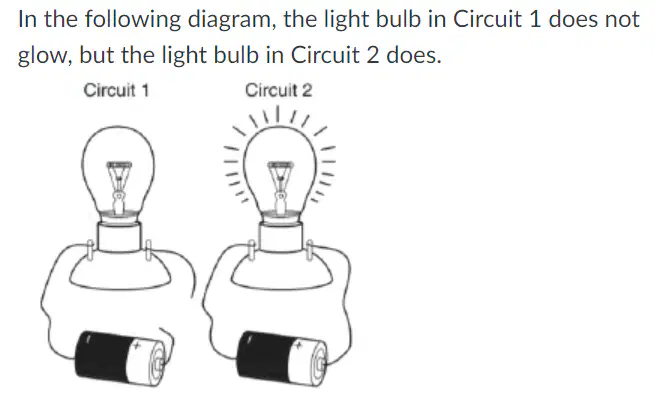
Which statement best explains why the light bulb of Circuit 1 does not glow?
The negative terminal of Circuit 1 is connected to the battery
Circuit 1 is a closed circuit
The positive terminal of Circuit 1 is connected to the battery.
Circuit 1 is an open circuit
What is one way to increase the resistance in a circuit?
use a shorter wire
use a metal that has higher conductivity
use a thinner wire
decrease the temperature in the room
If a switch is “closed,” it will:
allow the flow of current.
stop the flow of current.
increase the flow of current.
decrease the flow of current.
Houses are wired:
in-parallel using circuit breakers.
in-series using circuit breakers.
in-series using fuses.
in-parallel using fuses.
Like charges _______, while unlike charges ________:
repel, attract
attract, repel
repel, repel
attract, attract

Assume that Circuit II is a flashlight. What would it mean if the voltage was actually supplied by two D cell batteries instead of two AA batteries?
The flashlight would have less total energy, so it would shine dimmer.
The flashlight would have more total energy, so it would shine brighter.
The flashlight would have the same total energy and brightness, but it would only last half as long.
The flashlight would have the same total energy and brightness, but it would last twice as long.

There will be a series of questions regarding this diagram. Make sure you can label it and understand its functionality.
I can tell you anything and everything you want to know about either circuit!!
I never filled out my notes
I have no idea what is going on in this class
We never talked about this in class

