
NEW
Font size
 Worksheets
Properties of Soil
Total questions: 49
Worksheet time: 25mins
What are the properties of soil that need to be examined according to the learning material?
Color, texture, and temperature
Capacity to retain water, ability to support the growth of plants, and density
Color, texture, capacity to retain water, and ability to support the growth of plants
Color, texture, and smell
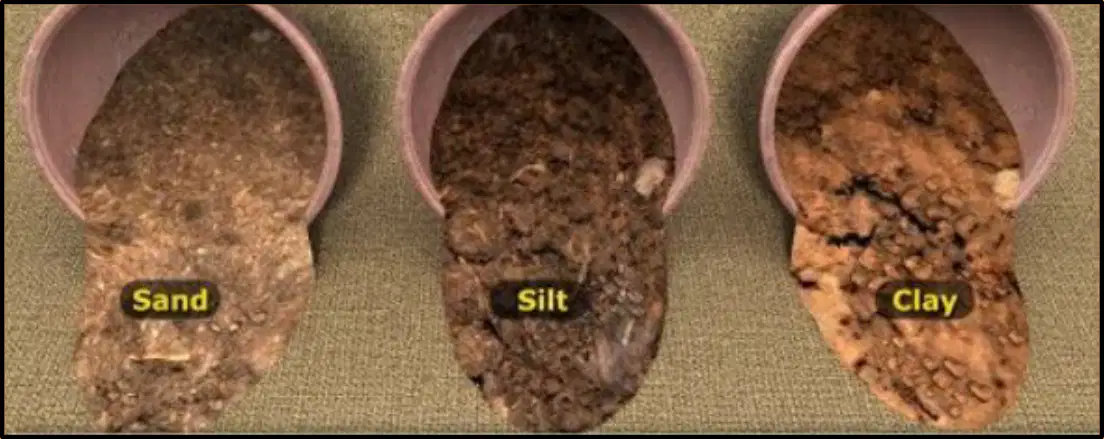
Which of the following is NOT shown as a type of soil in the image?
Sand
Silt
Peat
Clay
What is soil primarily made up of?
Water
Air
Tiny pieces of broken rock and other minerals
Leaves
What else is mixed into soil besides rock and minerals?
Plastic
Decaying plant and animal matter
Fresh fruit
Paper
Soil is sometimes referred to as what?
Sand
Mud
Dirt
Clay
Do different types of soil have the same color and texture?
Yes, they are all the same
No, they have different colors and textures
They have different colors but the same texture
They have the same color but different textures
What is a characteristic of soil layers in the Earth?
Each layer has the same look and feel
Each layer has a different look and feel
All places have the same type of soil
Soil is not layered in the Earth
Which of the following is true about soil in different places?
Different places have the same type of soil
Different places have different types of animals
Different places have different types of soil
Different places have the same climate
From the soil chart, which layer of soil is the finest?
Coarse sand
Fine sand
Silt
Clay
According to the soil chart, which layer of soil is likely to have the largest particles?
Silt
Fine sand
Clay
Coarse sand
What can the color of soil indicate about its composition?
The amount of sunlight it receives
The amount of water it can hold
The type of crops it can support
The amount of organic matter it contains
What does the texture of soil refer to?
The color and appearance of the soil
How the soil feels to the touch
The nutrient content of the soil
The age of the soil
Which soil texture might feel gritty?
Clay
Silt
Sand
Loam
Which type of soil is typically darker and better for plant growth?
Sand
Silt
Loam
Clay
What does the texture of soil depend on?
The color of the soil
The age of the soil
The particle size
The amount of sunlight
Why is the size of soil particles important?
It determines the color of the soil.
It affects the soil's ability to hold water.
It changes the taste of the plants.
It influences the soil's temperature.
Which type of soil particle size holds more water?
Larger particle size
Smaller particle size
All particle sizes hold water equally
Soil particle size does not affect water retention
What is a characteristic of clay in terms of water retention for plants?
Clay cannot hold water at all.
Clay holds the perfect amount of water for plants.
Clay holds too much water for many plants.
Clay's water retention is not relevant to plant growth.
How does sand compare to clay in terms of water retention?
Sand holds more water than clay.
Sand and clay hold the same amount of water.
Sand holds less water than clay.
Sand's water retention depends on the type of plant.
What is humus?
A) A type of plant
B) Dark, organic material that forms in soil when plant and animal matter decays
C) A mineral found in soil
D) A synthetic fertilizer
What does humus help to support?
A) The erosion of soil
B) The growth of plants
C) The decay of animal matter
D) The cooling of the soil
Which type of soil often has a lot of humus?
A) Light colored soil
B) Sandy soil
C) Dark colored soil
D) Clay soil
What is the texture of sand to the touch?
Smooth
Slippery
Gritty
Sticky
Can individual sand particles be seen with the naked eye?
No, they are too small.
Yes, but only with a microscope.
Yes, they can be seen with the naked eye.
No, they are invisible.
Does sand retain water well?
Yes, it retains water for a long time.
No, it does not retain water for very long.
Sand absorbs water completely.
Sand repels water.
What types of plants can grow in sand?
A wide variety of plants can grow in sand.
Only aquatic plants can grow in sand.
Only a few types of plants can grow in sand.
No plants can grow in sand.
What is silt made up of?
Rocks
Sediment
Plants
Water
The size of silt particles is between the sizes of which two types of soil?
Sand and gravel
Clay and rocks
Sand and clay
Gravel and clay
What can silt do when it is in water?
It can only float on the surface
It can only sink to the bottom
It can sink to the bottom or be suspended in water
It can dissolve completely in water
What is the texture of dry silt?
Sticky
Powdery
Smooth
Hard
Can dry silt clump together?
No, it cannot clump together
Yes, but it cannot be broken easily
Yes, but the clumps can be easily broken
No, it repels water
How does wet silt feel to the touch?
Sticky
Rough
Smooth or slippery
Dry
What is the texture of wet silt?
Sticky
Slick
Grainy
Hard
What can silt hold a lot of?
Air
Water
Rocks
Heat
What is one of the reasons silt is often added to soil?
To remove nutrients
To help plants grow better
To make the soil more compact
To dry out the soil
What does silt contain a lot of that benefits plants?
Pesticides
Nutrients
Insects
Plastic
How does dry clay feel?
Sticky and plastic
Hard
Soft and crumbly
Wet and slimy
What is the size of clay particles?
Large enough to see with the naked eye
The smallest particle size
The largest particle size
Visible with a standard magnifying glass
Can you see the particles in clay without a microscope?
Yes, easily
Yes, with difficulty
No, a microscope is needed
No, even a microscope cannot see them
What is the texture of wet clay?
Hard and dry
Crumbly and loose
Sticky with a plastic feel
Smooth and non-adhesive
Why might one initially think clay is good for plant growth?
Because it is rich in color
Because it holds a lot of water
Because it has a lot of nutrients
Because it is easy to find
What is a problem with clay's ability to hold water for plant growth?
It makes the soil too dry
It allows too much air to pass through
It prevents air and water from moving easily through the soil
It washes away nutrients
Why can't plant roots grow well in clay?
The roots don't like the color of clay
The clay is too nutrient-rich
The clay is too hard for roots to penetrate
The clay attracts insects that harm the roots
Which type of soil is not conducive to the growth of many plants due to its high clay content?
Sandy soil
Loamy soil
Chalky soil
Soil that contains a lot of clay
What is topsoil with lots of nutrients known as?
Clay
Silt
Loam
Sand
What is topsoil a mixture of?
Sand, gravel, and organic matter
Sand, silt, and clay
Clay, limestone, and silt
Silt, pebbles, and sand
What does the texture of topsoil depend on?
The amount of water it holds
The color of the soil
How much of each type of soil is in the mixture
The temperature of the environment
Why is topsoil considered a gardener's delight?
It is very dry and requires a lot of watering.
It is too wet and does not hold plants well.
It is just the right mixture to support plants.
It is not suitable for growing plants.
What characteristic of topsoil makes it suitable for plant growth?
It cannot hold water at all.
It holds too much water, making it soggy.
It holds the right amount of water.
It repels water and nutrients.

