wayground logo

Free Printable Worksheets

NEW

Font size

S
M
L
XL
Worksheets

Introduction to Weather

Total questions: 50

Worksheet time: 44mins

Name
Class
Date
1.

What do we call the temperature and humidity conditions in a small average for a short period of time?

a)

Weather

b)

Climate

c)

Front

d)

Polar

2.

If you walk barefoot on hot asphalt, energy is transferred by which process?

a)

Convection

b)

Radiation

c)

Conduction

d)

Reflection

3.

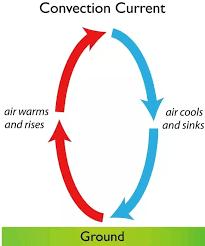
Which of the following is an example of convection?

a)

A hair dryer is drying up your hair.

b)

When the AC or heater changes the temperature.

c)

When a car engine turns hot after being turned on.

d)

When you are making soup and the water is rising and lowering.

4.
What is the definition of CONVECTION
a)
When heat transfers through waves.
b)
When heat transfers from objects that are touching.
c)
a  hot liquid or air that  expands, becomes less dense, and rises or becomes more dense, and sinks.
d)
Heat traveling from the sun
5.
The baby chickens are kept warm from the heat lamps demonstrates this type of heat transfer. 
a)
conduction
b)
convection
c)
radiation
6.
What is the definition of CONDUCTION?
a)
When heat is transferred from objects like rays of light or electromagnetically.
b)
a  hot liquid or air that  expands, becomes less dense, and rises or becomes more dense, and sinks.
c)
When heat transfers from objects that are touching.
d)
When heat transfers through the heater or AC in your house.
7.
All living things on earth are part of the....
a)
Biosphere
b)
Geosphere
c)
Hydrosphere
d)
Cryosphere
8.
All frozen water on Earth is...
a)
Hydrosphere
b)
Geosphere
c)
Cryosphere
d)
Atmosphere
9.
Geo = 
a)
Earth
b)
Sphere
c)
Life
d)
Water
10.
Hydro = 
a)
Sphere
b)
Earth
c)
Life
d)
Water
11.
This is part of the....
a)
Geosphere
b)
Atmosphere
c)
Biosphere
d)
Hydrosphere
12.
This is part of the....
a)
Geosphere
b)
Biosphere
c)
Cryosphere
d)
Atmosphere
13.
This is part of the....
a)
Geosphere
b)
Atmosphere
c)
Hydrosphere
d)
Cryosphere
14.
This is part of the....
a)
Geosphere
b)
Atmosphere
c)
Cryosphere
d)
Hydrosphere
15.
This is part of the....
a)
Hydrosphere and Atmosphere
b)
Cryosphere
c)
Biosphere and Geosphere
d)
Geosphere & Atmosphere
16.

What gas makes up most of the atmosphere?

a)

Air

b)

Oxygen

c)

Nitrogen

d)

CO2

17.
Water vapor is water in which form?
a)
liquid
b)
gas
c)
solid
d)
tiny droplets
18.
Low pressure will usually bring what kind of weather?
a)
Sunny
b)
Calm
c)
Stormy
19.
Pressure is the effect of
a)
the weight of all the air above pressing down
b)
water vapor in the atmosphere
c)
greenhouse gases
d)
solar radiation
20.
High pressure will usually bring what kind of weather?
a)
clear and dry
b)
cloudy and wet
21.
What type of air pressure is present?
a)
High 
b)
Low
22.

The height above sea level is known as

a)

altitude

b)

latitude

c)

longitude

d)

attitude

23.

Which box has a higher density?

a)

A

b)

B

c)

They are the same

24.
How do we characterize an air mass that forms over the ocean?
a)
Dry
b)
Wet
c)
Cold
d)
Warm
25.
How do we characterize an air mass that forms near the poles?
a)
Dry
b)
Wet
c)
Warm
d)
Cold
26.
How do we characterize an air mass that forms over near the equator?
a)
Dry
b)
Wet
c)
Cold
d)
Warm
27.
How do we characterize an air mass that forms over land?
a)
Dry
b)
Wet
c)
Cold
d)
Warm
28.
Describe a tropical air mass.
a)
Dry
b)
Wet
c)
Cold
d)
Warm
29.
What types of air masses form over land?
a)
Maritime
b)
Continental
c)
Polar
d)
Tropical
30.
What types of air masses would be colder?
a)
Maritime
b)
Continental
c)
Polar
d)
Tropical
31.
What types of air masses would be warmer?
a)
Maritime
b)
Continental
c)
Polar
d)
Tropical
32.
What types of air masses form over oceans?
a)
Maritime
b)
Continental
c)
Polar
d)
Tropical
33.
What tool do we use to measure temperature?
a)
Thermometer
b)
Ruler
c)
Balance
d)
Magnifying Glass
34.

The amount of water vapor in the air is known as ___.

a)

dew point

b)

humidity

c)

air pressure

d)

rain

35.

Which front is there little movement?

a)

warm front

b)

cold front

c)

occluded front

d)

stationary front

36.

What happens when two air masses meet?

a)

a hurricane occurs

b)

a dog barks

c)

a front is created

d)

warm air enters

37.

What kind of front results in thunderstorms?

a)

warm front

b)

cold front

c)

occluded front

d)

stationary front

38.

An air mass has similar

a)

temperature and moisture

b)

cold and wind

c)

rain and temperature

d)

warm and dry

39.
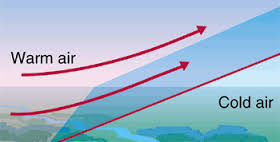
Which type of front is pictured?
a)
Cold front
b)
Warm front
c)
Occluded front
d)
Stationary front
40.

What type of front is shown?

a)

Warm Front

b)

Cold Front

c)

Occluded Front

d)

Stationary Front

41.

A _____________ weather front occurs two cold air masses meet and push/force the warm air in the middle upwards.

a)

Cold

b)

Warm

c)

Stationary

d)

Occluded

42.

Frigid air that travels southward from Canada would be what type of air mass?

a)

continental polar

b)

continental tropical

c)

maritime polar

d)

arctic

43.

Low-pressure systems are usually associated with ________ weather.

a)

cold and dry

b)

cloudy and rainy

c)

sunny and dry

d)

warm and humid

44.

the study of weather

a)

Weather Man

b)

True

c)

False

d)

Meteorology

45.
What is the water cycle?
a)
the 3 forms of water
b)
the movement of water on, above, or below the surface of the Earth
c)
when water melts
d)
when clouds form
46.
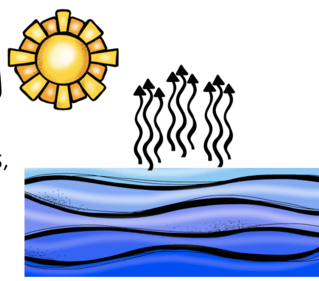
What part of the water cycle does this picture show?
a)
condensation
b)
precipitation
c)
evaporation
47.
Snow, sleet, hail, and rain are all examples of  ________________. 
a)
evaporation
b)
condensation
c)
accumulation
d)
precipitation
48.
What is it called when plants give off water vapor as a waste product?
a)
condensation
b)
evaporation
c)
sublimation
d)
transpiration
49.
Precipitation happens when clouds of water droplets are too ______________.
a)
cold
b)
light
c)
heavy
d)
hot
50.
Evaporation happens when the sun ___________ water and turns it into vapor.
a)
cools
b)
heats up
c)
freezes
d)
lights up