wayground logo

Free Printable Worksheets

Font size

S
M
L
XL
Worksheets

OVERALL DEVELOPMENT QUIZ

Total questions: 106

Worksheet time: 2hrs 46mins

Name
Class
Date
1.

What is Newton's first Law of Motion?

a)

Every action has an equal opposite reaction

b)

Sandwich

c)

An object in motion stays in motion unless acted upon by an unbalanced force

d)

The force acting on an object is equal to the mass of an object times its Acceleration

2.

What is the atomic number of oxygen?

a)

5

b)

17

c)

Sandwich

d)

8

3.

What is the atomic number of oxygen?

a)

5

b)

17

c)

Sandwich

d)

8

4.

What is the molecular structure of Table salt?

a)

Sandwich

b)

Molecular who?

c)

NaCI

d)

H2O

5.

Biology is the study of What?

a)

Sandwich

b)

Life

c)

The human brain

d)

Weather

6.

What Female Nobel prize winner Conducted research on radioactivity?

a)

Sandwich

b)

Marie curie

c)

Tierra Guinn

d)

Issac Newton

7.

Energy= ___ to the speed of light squared

a)

Gravity

b)

Sandwich

c)

Mass

d)

Lighting

8.

who was Dimitri Ivanovich Mendeleev?

a)

Periodic Table inventor

b)

Sandwich

c)

An Astronomer

d)

A singer

9.

What is formula of Force?

a)

Net force * Mass

b)

Mass / Acceleration

c)

Sandwich

d)

Mass / Velocity

10.

What was the first animal sent into Space?

a)

Laika the dog

b)

Alfred the Monkey

c)

Sandwich

d)

Urusula the fish

11.

How Long does it take for light to get from the sun to the Earth?

a)

150 Million Years

b)

8 minutes

c)

Sandwich

d)

10 seconds

12.
A substance that pollutes something, especially water or the atmosphere is called
a)
dirt
b)
pollutant
c)
oxygen
d)
precipitant
13.
Liquid water changing slowly into a gas and rising into the atmosphere is called
a)
evaporation
b)
condensation
c)
rain
d)
typhoon
14.
Shifting pieces of the Earth's crust are called
a)
tectonic plates
b)
volcano
c)
magma
d)
island
15.
What is the amount of water vapor in the air called?
a)
Condensation
b)
Precipitation
c)
Evaporation
d)
Humidity
16.
Which is the most abundant gas in the atmosphere?
a)
Oxygen
b)
Nitrogen
c)
Ozone
d)
Carbon Dioxide
17.
Which measures air pressure?
a)
Thermometer
b)
Accelerometer
c)
Barometer
d)
Anemometer
18.
Only about how much of available water on Earth is fresh water?
a)
97%
b)
1%
c)
53%
d)
11%
19.
What is the source of energy for the water cycle?
a)
gravity
b)
transpiration
c)
the oceans
d)
the sun
20.
A local wind that blows from an ocean or lake is
a)
global wind
b)
thunderstorm
c)
equator
d)
sea breeze
21.
Reflection of light by dust particles and gases in the atmosphere is
a)
scattering
b)
greenhouse effect
c)
Coriolis effect
d)
absorption
22.

Rocket works on which law of motion ?

a)

Newton's first law

b)

Newton's second law

c)

Newton's third law

23.

Who is the father of space science ?

a)
b)
c)
24.

The rockets are made up of light but very strong material like

a)

aluminium

b)

steel

c)

copper

d)

titanium

25.

What is the shape of a rocket ?

a)

Thin , tall , cylindrycal , heavy weight , manned or unmanned

b)

Thin , tall , cylindrycal , light weight , manned or unmanned

c)

Thin , tall , triangle , light weight , manned or unmanned

26.

What was the colour of the rocket in my ppt ( question and answer ) ?

a)

Green and blue

b)

Red and Blue

c)

White and red

27.

What "G" represent in " B.H.A.A.G "

a)

Good

b)

God

c)

Great

28.

ISRO was founded on 15 August .......

a)

1969

b)

1960

c)

1990

d)

1947

29.

The first private manned space ship, is known for its unusual fuel. What is it.

a)

water

b)

hydrogen

c)

sodium hydroxide

d)

rubber

30.

when was the first rocket launched into space in the history of mankind ?

a)

April 12, 1961

b)

October 3, 1942

c)

October 11, 1937

d)

October 4, 1957

31.

Who built the first rocket powerful enough to enter outer space ?

a)

American

b)

Russian

c)

Chinese

d)

Germans

32.
The second energy level can hold up to how many electrons?
a)
2
b)
8
c)
10
d)
12
33.
What is the atomic mass of "F"
a)
9
b)
18
c)
17
d)
19
34.
How do you find out the number of protons in an atom?
a)
atomic number
b)
atomic mass
c)
charge
d)
atomic mass - atomic number
35.
How do you find out the number of neutrons in an atom?
a)
atomic number
b)
atomic mass
c)
charge
d)
atomic mass - atomic number
36.
All matter is made of _________. 
a)
energy 
b)
atoms 
c)
electrons 
d)
compounds 
37.
Which particle has a similar mass to a proton?
a)
Electron
b)
Neutron
c)
Photon
d)
Marble
38.
The mass of a proton is _______.
a)
1 amu
b)
1 gram
c)
has no mass
d)
undetermined
39.
The part of the atom that determines the identity of the atom is the ____________.
a)
proton
b)
nucleus
c)
electron
d)
neutron
40.
A substance that is made up for one type of atom is called an:
a)
atom
b)
element
c)
compound
d)
mixture
41.
How are elements ordered on the Periodic Table?
a)
Alphabetical Order
b)
By their color.
c)
By their atomic mass.
d)
By their atomic number.
42.
Which item on this element square is the chemical symbol?
a)
Copper
b)
29
c)
Cu
d)
63.546
43.
Which item on this element square represents the atomic number?
a)
13
b)
Al
c)
Aluminum
d)
26.981538
44.
How many neutrons are in the atom "K"?
a)
7
b)
19
c)
39
d)
20
45.
How many protons does an atom of Carbon have? 
a)
3
b)
12.011
c)
6
d)
none
46.
The first energy level can hold up to how many electrons?
a)
8
b)
4
c)
2
d)
5
47.
What are the number of electrons in Carbon?
a)
12
b)
10
c)
6
d)
14
48.
Which is an electron?
a)
A
b)
B
c)
C
49.
Which is a neutron?
a)
A
b)
B
c)
C
50.
What is the number of protons that the element in this image contain?
a)
14
b)
7
c)
15
d)
18
51.
Which is a proton?
a)
A
b)
B
c)
C
52.
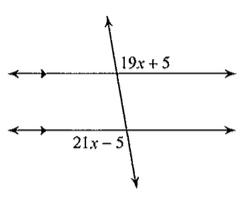
Solve for x. 
a)
3
b)
5
c)
6
d)
8
53.
Find the missing side.
a)
9.4 km
b)
8.8 km
c)
1.9 km
d)
12.9 km
54.
What is equal to 38/76
a)
1/2
b)
10/20
c)
19/38
d)
100/200
55.
3x + 2(4x - 4) = 3
a)
4
b)
3
c)
2
d)
1
56.
Find the length of the missing side. 
a)
17 cm
b)
22 cm
c)
15 cm
d)
13 cm
57.
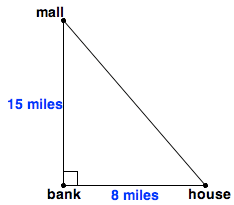
Casey travels from her house directly west to the bank and then directly north from the bank to the mall. She then travels home on the road connecting the mall and her house. What is her total distance traveled?
a)
17 miles
b)
32 miles
c)
37 miles
d)
40 miles
58.
5.68 in a fraction 
a)
1/900
b)
568/100
c)
400/68
d)
100/8000
59.
Solve for the variable. 
a)
11
b)
-7.5
c)
35
d)
-2.52
60.
Solve this mixed number equation:
1⅔ + 1⅚
a)
3 1/2
b)
2 7/6
c)
3 7/6
d)
2 7/9
61.
Who was the philosopher that taught by asking questions?
a)
Plato
b)
Socrates
c)
Aristotle
d)
Alexander
62.
Which philosopher wrote 170 books?
a)
Plato
b)
Socrates
c)
Aristotle
d)
Alexander the Great
63.
Which philosopher was a student of Socrates?
a)
Plato
b)
Aristotle
c)
Alexander
64.
Who was a student of Aristotle?
a)
Plato
b)
Socrates
c)
Alexander the Great
d)
Zeus
65.
Which philosopher did not write any books based on the belief that debating was better than writing?
a)
Socrates
b)
Plato
c)
Aristotle
d)
Pluto
66.
Which philosopher was known as the greatest scientist of the ancient world?
a)
Socrates
b)
Plato
c)
Hercules
d)
Aristotle
67.
Which philosopher willingly drank a cup of poison in prison?
a)
Socrates
b)
Plato
c)
Posiedon
d)
Aristotle
68.
Which philosopher started an Academy in Greece?
a)
Aristotle
b)
Socrates
c)
Plato
d)
Zeus
69.
Which philosopher did not believe in democracy. He introduced a belief in "aristocracy of merit" instead.
a)
Plato
b)
Aristotle
c)
Socrates
d)
Zeus
70.
Which philosopher was a student at Plato's Academy?
a)
Plato
b)
Aristotle
c)
Socrates
d)
Hades
71.
Which philosopher opened a school named Lyceum that focused on teaching the sciences?
a)
Plato
b)
Aristotle
c)
Socrates
d)
Mittens
72.
Which philosopher wrote "The Republic"?
a)
Plato
b)
Socrates
c)
Aristotle
d)
Confucious
73.
Where did the philosophers live?
a)
Greek
b)
Greece
c)
China
d)
Egypt
74.

What are ethics?

a)

How you feel about a certain topic and how you behave

b)

The principles that govern individual behaviour

c)

What is dictated by the principal at school

d)

Only relevant to the plot of The Good Place

75.

Why do we use ethics in Science?

a)

To restrict how we do science

b)

To ensure that we only sometimes do the right thing

c)

To ensure that we are always doing the right thing in our experiments

d)

To justify everything that we do

76.

The purpose of a code of ethics is

a)

set standards for a profession

b)

know our unique values and makes decisions based off them

c)

be a guide for professional behavior

d)

all of these

77.

Everyone shares the same moral principles.

a)

True

b)

False

78.
Science involves people's beliefs.
a)
True
b)
False
79.

If something is unethical it is also illegal

a)

True

b)

False

80.

Ethics in Science only apply to human test subjects

a)

True

b)

False

81.

Ethics can apply to things in Science outside of experiments

a)

True

b)

False

82.

Consent is an important part of ethics in Science

a)

True

b)

False

83.

Which best describes a situation in which there is no clear right or wrong answer?

a)

Code of ethics

b)

Fatalism

c)

Morality

d)

Ethical dilemma

84.

Which one is an example for values?

a)

Empathy

b)

Tolerance

c)

Responsibility

d)

All of the above

85.

How can you show respect when someone is talking to you?

a)

Make eye contact

b)

Give them a hug

c)

Interrupt them with questions

d)

Ignore them

86.

If you hurt someone’s feelings, what is the rightful thing to do?

a)

Cry about it

b)

Apologize

c)

Laugh at them

d)

Pretend nothing happened

87.

True or False: You need to have a lot of money to be worthy of respect.

a)

False

b)

True

88.

It’s important to ________ the differences that make us unique.

a)

Appreciate

b)

Ignore

89.

Which is certainly not respect?

a)

To hit

b)

To talk

c)

To listen

d)

To answer

90.

How can you show respect on the playground?

a)

Keep playing once the whistle blows to go inside

b)

Use appropriate language

c)

Push and be unkind to others playing near by

91.

5,000 years ago, people invented and begun to use this. Its adoption marked the beginning of recorded history.

a)

art

b)

writing

c)

tools

d)

filing

92.

The time before written history is called ________________ ?

a)

Before Christ (B.C.)

b)

pre-man

c)

prehistory

d)

Before Common Era (B.C.E.)

93.

These scholars study and write about the human past.

a)

biographers

b)

anthropologists

c)

archaeologists

d)

historians

94.

Objects made by humans in the past such as clothing, coins, artwork, and tombstones are:

a)

artifacts

b)

archaeology

c)

old

d)

hominids

95.

This is the study of the origins of people and societies.

a)

geology

b)

archaeology

c)

arthropodogy

d)

anthropology

96.

This branch of anthropology looks at past cultures by studying their material remains.

a)

archaeology

b)

geology

c)

geography

d)

historianism

97.

Archaeologists use these two methods to determine the age of an object.

a)

random

b)

relative

c)

absolute

d)

radioactive

98.

In the 1950s, archaeologists began uncovering human-like ancient bones, tools, and footprints in this part of the world.

a)

West Africa

b)

East Africa

c)

South America

d)

North America

99.

In 1974, archaeologist Donald Johanson found pieces of a 3-million-year-old, 4-foot-tall hominid skeleton he called ...

a)

Suzy

b)

Mary

c)

Lucy

d)

Nancy

100.

True or False: Early modern humans remained on the African continent.

a)

True

b)

False

101.

Mixed Martial Arts is a dynamic and full contact sport.

a)

True

b)

False

102.

Which of the following is NOT allowed in MMA?

a)

Grappling

b)

Striking

c)

Biting

d)

Throwing

103.

The featherweight class is under 135 pounds.

a)

True

b)

False

104.

How many judges judge an MMA event?

a)

5

b)

2

c)

6

d)

3

105.

MMA matches can be won in a number of ways. Which way is being described here:If both fighters continually break the rules or if one fighter is injured unintentionally by an illegal action.

a)

Knock-out

b)

No-contest

c)

Submission

d)

Forfeit

106.

The brothers fight each other in the final round.

a)

True

b)

False