
Font size
 Worksheets
Mutations/Transcription translation
Total questions: 21
Worksheet time: 33mins

The model shows a mutation in a partial sequence of bases in a gene. What type of mutation does the model demonstrate?
DELETION
INSERTION
SUBSTITUTION
TRANSLOCATION
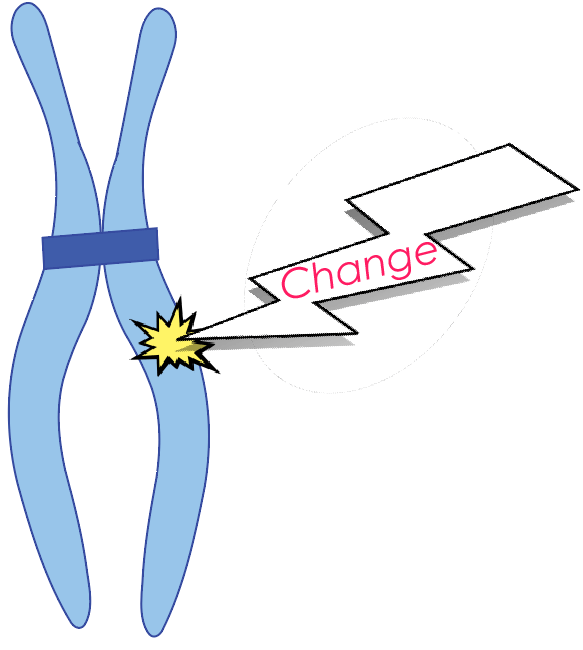
What do you call a change in DNA?
Replication
Mutation
Translation
Transcription
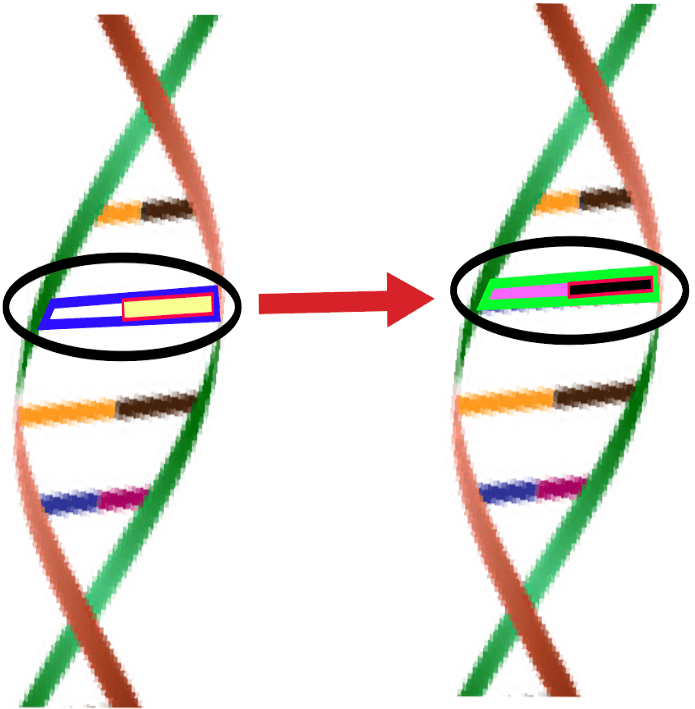
A change to a single part of DNA or to one gene is called a...
Homeostasis
Somatic cell
Chromosomal mutation
Gene mutation

A point mutation where one nucleotide base replaces an original nucleotide base
Mutation by Inversion
Chromosomal Mutation
Translocation
Substitution Mutation
Match the following about mutations
mutation
a change in the DNA sequence
substitution
replacing a nucleotide with a different nucleotide
deletion
removing a nucleotide
insertion
adding a nucleotide
Match the following about mutations
gene mutation
a change in a nucleotide or a segment of DNA
chromosomal mutation
a change in structure of a chromosome
point mutation
a change in only a single nucleotide
frameshift mutation
a change that affects all amino acids after the mutation; insertions or deletions
Match the following chromosomal mutations to their correct image

deletion

duplication

inversion

translocation
What best summarizes the role of DNA in protein production?
The DNA contains the instructions used to make proteins.
The DNA transports amino acids to the ribosomes to make proteins.
The DNA moves to the cytoplasm to build proteins.
The DNA breaks the hydrogen bonds between the amino acids.
Transcribe the following DNA into RNA: TAG CAG TAC
ATC GTC ATG
AUC GUC AUG
AUG CUG AUC
UTC GTC UTG
What are nucleotides made of?
Sugar, Phosphate, Nitrogen base
Phosphate, Adenine, Nitrogen base
Thymine, Adenine, Cytosine
Phosphate, Nitrogen, Adenine
What does adenine pair with?
Guanine
Thymine
Cytosine
Adenine
Guanine pairs with ______________.
Adenine
Guanine
Cytosine
Thymine

How does RNA differ from DNA?
RNA contains uracil and deoxyribose
RNA contains ribose and thymine
RNA contains uracil and ribose
RNA contains adenine and ribose
. What are the building blocks of proteins?
nucleotides
proteins
amino acids
carbohydrates
How many bases are there in a codon?
1
2
3
4
Describe the path of protein production?
RNA --> DNA --> Protein
Protein --> RNA --> DNA
DNA --> RNA --> Protein
DNA --> Protein --> RNA

What amino acid is made from the RNA codon UUA?
Phenylalanine
Leucine
Serine
Tyrosine

What is the relationship between a protein, the cell, and DNA?
The DNA is produced by the protein that is produced in the cell
The protein is composed of DNA that is produced in the cell
The DNA makes RNA which is translated into protein
A cell is composed of DNA and protein
Where does translation take place in the cell?
Nucleus
DNA
Chloroplast
Ribosome
What type of molecule is the final product of translation?
Glucose
Glucose
Fatty Acid
Glycogen
Protein
Explain in your own words why a frameshift mutation (an insertion or deletion) in the DNA of a gene will make the protein encoded by that gene completely useless.

