
Font size
 Worksheets
Ancient India
Total questions: 53
Worksheet time: 4hrs 46mins
What is the highest mountain range in the world that separates India from other countries in Asia?
The Alps
The Andes
The Himalayas
The Rocky Mountains
Through what geographical feature were people able to pass and settle in places like the Indus River Valley?
Deserts
Rivers
Small gaps in the mountains
Coastal areas
What time period does the term "Ancient India" refer to in the context of this learning material?
1500 BCE – 500 CE
2600 BCE – 500 CE
3200 BCE – 300 CE
2100 BCE – 700 CE
What is the Indus River Valley known for?
Its mountain ranges
Its rich soil and name derived from the Indus River
Its dry deserts
Its large urban developments
Which two rivers are mentioned as creating fertile land for farming in the Indus River Valley?
The Nile and the Amazon
The Yangtze and the Mississippi
The Indus and the Ganges
The Tigris and the Euphrates
Where does the Ganges River empty into?
The Arabian Sea
The Red Sea
The Bay of Bengal
The Mediterranean Sea
Which major cities emerged in the Indus River Valley?
Delhi and Mumbai
Harappa and Mohenjo-Daro
Beijing and Shanghai
Athens and Sparta
How far does the Indus River flow?
Until it merges with the Ganges River
As far as the Arabian Sea
Up to the Bay of Bengal
It does not leave the Himalayas
What was the population of the cities around 2600 BCE?
Nearly 20,000 people
Nearly 40,000 people
Nearly 60,000 people
Nearly 80,000 people
How were the cities laid out?
In a circular pattern
In a random layout
In a grid pattern
Along a riverbank
What does the term "CITADEL" refer to?
A public well
A grain storage house
A fortress that overlooks the city
A drainage system
What were the main exports of the cities?
Gold and silver
Copper and lumber
Spices and silk
Pottery and textiles
With which culture did the cities have similarities in art?
The Egyptian culture
The Greek culture
The Roman culture
The Sumerian culture
What event around 2000 BCE led to the Indus Valley farmers abandoning their land?
A) A prosperous economic boom
B) Natural disasters and invasions by nomads
C) The development of a new writing system
D) The establishment of the caste system
Around 1500 BCE, which group moved in from Central Asia and mixed with the original inhabitants of the Indus Valley?
A) The Dravidians
B) The Brahmins
C) The Aryans
D) The nomads
What is the name of the ancient religious document from the northern midlands of India?
A) The Mahabharata
B) The Ramayana
C) The Bhagavad Gita
D) The Rig Veda
Which ancient language, once spoken by many people, is still spoken in southern India?
A) Hindi
B) Urdu
C) Dravidian
D) Sanskrit
What is the caste system referred to in the text?
A) Jatis
B) Varnas
C) Brahmanism
D) Moksha
Who were the Brahmins according to the caste system mentioned in the text?
A) The warrior caste
B) The merchant caste
C) The highest caste, performing religious services
D) The laborer caste
What does the term "noble" refer to in the context of the caste system?
A person with low moral character
A person with a high rank or high moral character
A person who is an artisan or merchant
A person who is a farmer, laborer, or servant
Who were considered "untouchables" in the caste system?
Warriors and nobles
Artisans and merchants
Farmers, laborers, and servants
People considered so impure that their only work could be burying bodies or collecting trash
According to the caste system, what was the possibility of upward mobility for individuals?
Individuals could easily move up in the caste system
Individuals had limited mobility based on their occupation
There was no upward mobility for individuals
Upward mobility was possible only for farmers and laborers
What determined a person's role in society under the caste system?
Their personal ambitions and desires
The education they received
Their lineage
The wealth they accumulated
What is the prevailing spiritual belief in Hinduism according to the text?
There is no spiritual power in Hinduism.
There is one prevailing spiritual power that lives in everything.
There are multiple spiritual powers that live in select objects.
Spiritual power is only present in living beings.
Hinduism originated from the blending of which cultures?
Greek and Roman beliefs
Aryan beliefs and the cultures of the original settlers of India
Egyptian and Mesopotamian beliefs
Chinese and Mongolian beliefs
Which of the following is NOT one of the gods mentioned in the text as being part of Hinduism?
Brahma
Vishnu
Shiva
Zeus
What does the concept of REINCARNATION in Hinduism refer to?
The belief that after death, the soul permanently resides in heaven.
The belief that after death, the soul is extinguished.
The belief that after death, the soul returns to Earth in another body or form.
The belief that after death, the soul splits into multiple entities.
According to Hindu philosophy, what determines how the soul is reborn?
The soul's age at the time of death.
The soul's level of education.
The soul's karma.
The soul's material wealth.
Where are Hindu beliefs found as described in the text?
In the Bible
In the Upanishads
In the Quran
In the Torah
What is Karma according to the text?
A form of yoga
The spiritual center of the universe
Behavior or intention that brings about a result according to that behavior, either in a person's current life or their next life
A divine law of religious and moral duties
What must believers obey to unite with Brahman?
Karma
Dharma
Siddhartha Gautama's teachings
The caste system
What is the difference between 'Brahman' and 'Brahma' as mentioned in the text?
Brahman is a form of yoga, while Brahma is a top deity
Brahman is the top of the caste system, while Brahma is the spiritual top of the universe
Brahman is a top deity, while Brahma is the top of the caste system
Brahman is the spiritual top of the universe, while Brahma is a top deity
Who was Siddhartha Gautama?
The founder of yoga
A young Hindu prince who sought the meaning of life
A deity in Hinduism
The creator of the caste system
What did Siddhartha Gautama find in the foothills of the Himalayas that influenced his quest?
Wealth and prosperity
Sickness and poverty, sorrow, greed, love, and death
The teachings of Brahman
The principles of Karma
What practice did Siddhartha take up from Hinduism to focus his mind and reach a higher level of awareness?
Yoga
Meditation
Rituals
Pilgrimage
What do Buddhists believe Siddhartha achieved through meditation?
Wealth
Nirvana
Enlightenment
Power
What is the main teaching of the Four Noble Truths?
Achieving wealth and power
Feelings of suffering end when we stop trying to satisfy selfish desires
Chanting is essential for spiritual growth
Meditation should be done in silence only
What is the Eightfold Path?
A pilgrimage route
A meditation technique
A set of principles laid down by Siddhartha
A Buddhist scripture
What is Nirvana according to Buddhism?
A place of worship
A type of meditation
Everlasting peace where the self ends and reunites with the Great World Soul
A sacred text
Who can reach Nirvana according to the text?
Only the wealthy and powerful
Only the president
Only monks and nuns
Anyone, regardless of social class
What does RIGHT SPEECH in the Eightfold Path of Buddhism emphasize?
Saying no hurtful or negative things; telling no lies
Meditating regularly
Performing rituals
Eating vegetarian food
What is the mnemonic device for remembering the main principles of the Eightfold Path of Buddhism?
Unicorns In Saris Always Love Eating My Curry
Cats In Space Always Land Every Monday Carefully
Umbrellas Inside Stores Are Low Every Monday Come
Unique Ideas Shine Above Light Every Morning Coffee
What does RIGHT EFFORT in the Eightfold Path of Buddhism encourage?
Thinking positively
Gaining wealth
Exercising the body
Learning new languages
According to the Eightfold Path of Buddhism, what does RIGHT LIVELIHOOD involve?
Living and working in a peaceful way
Achieving high social status
Seeking pleasure in life
Focusing on personal success
What is the focus of RIGHT MINDFULNESS in the Eightfold Path of Buddhism?
Being aware of your own and others' bodies, feelings, and thoughts
Memorizing religious texts
Predicting the future
Chanting mantras
What aspect of life does RIGHT ACTION in the Eightfold Path of Buddhism pertain to?
No killing, stealing, or harming others
Pursuing artistic talents
Engaging in debates
Building physical strength
Who founded the Maurya Empire around 322 BCE?
Ashoka
Chandragupta Maurya
Samudragupta
Harshavardhana
What did Chandragupta Maurya overthrow to establish the Maurya Empire?
Kingdoms along the Indus River
Kingdoms along the Ganges River
Kingdoms in Southern India
Kingdoms in Western India
Chandragupta Maurya's rule was characterized by which type of governance?
Democratic rule
Absolute rule
Feudal rule
Theocratic rule
How many war elephants did Chandragupta Maurya have?
9,000
900
90
9
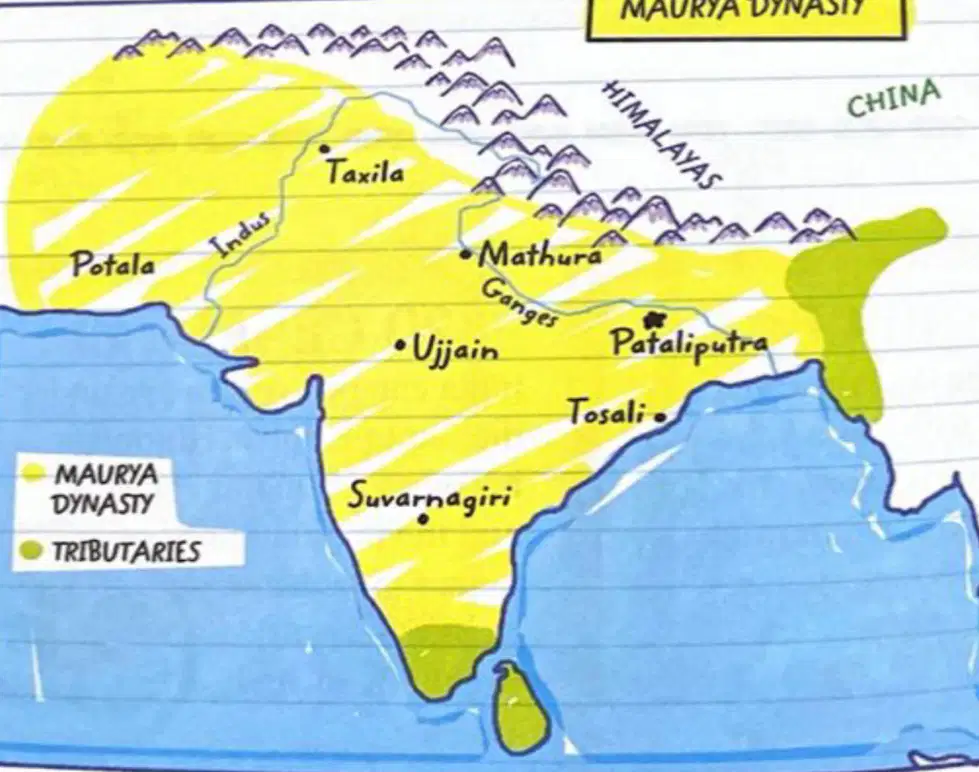
Which city was the capital of the Maurya Empire?
Ujjain
Taxila
Pataliputra
Mathura
What did Chandragupta's grandson Asoka do after the war in Kalinga?
He converted to Jainism.
He converted to Buddhism.
He abandoned his kingdom.
He expanded his empire further.
What happened to the Maurya Empire after Asoka's death?
It continued to grow stronger.
It remained stable and unchanged.
It weakened and faced foreign invasions.
It split into multiple smaller kingdoms.
Who was Kalidasa?
A Mauryan emperor.
A Gupta emperor.
A great Indian poet.
A philosopher.
What is the name of the poem written by Kalidasa?
The Silent Earth.
The Windy Skies.
The Cloud Messenger.
The Ocean's Tale.
What cultural development occurred during the Gupta dynasty?
Techniques for printing on cloth were devised.
Schools of philosophy declined.
The Mauryan Empire was restored.
Buddhism was abandoned.
What were built during the golden age of culture and trade in India?
Palaces and fortresses
Hindu and Buddhist temples and shrines
Markets and trading posts
Universities and libraries
Which significant mathematical concepts were invented during the golden age of culture and trade in India?
The number system and the concept of infinity
Algebra and geometry
The decimal system and the concept of zero
Calculus and trigonometry
Until when did the golden age of culture and trade last in India?
Until the early fifth century CE
Until the late fifth century CE
Until the mid-sixth century CE
Until the end of the seventh century CE
What event caused the fracturing of India in the late fifth century CE?
The invasion of the Mongols
The invasion of the Huns
The invasion of the British
The invasion of the Persians
What is the name of the highest mountain range in the world that separates India from other countries in Asia?
The Alps
The Andes
The Himalayas
The Rockies
Through what geographical feature were people able to pass and settle in places like the Indus River Valley?
Deserts
Rivers
Small gaps in the mountains
Forests
What time period does the term "Ancient India" refer to in the context of this learning material?
1000 BCE – 300 CE
2600 BCE – 500 CE
1500 BCE – 600 CE
3200 BCE – 400 CE
What does the Indus River Valley get its name from?
The Arabian Sea
The Ganges River
The Indus River
The Himalaya Mountains
Which river mentioned in the text also cuts through the Himalayas besides the Indus River?
The Nile River
The Amazon River
The Yangtze River
The Ganges River
Into which body of water does the Ganges River empty?
The Arabian Sea
The Bay of Bengal
The Indian Ocean
The Red Sea
What was created by the two rivers that provided fertile land for farming? (a)
Which of the following cities emerged in the Indus River Valley?
Delhi and Mumbai
Harappa and Mohenjo-Daro
Beijing and Shanghai
Athens and Sparta
What was the population of the cities like Harappa/Mohenjo-Daro around 2600 BCE?
Nearly 20,000 people
Nearly 40,000 people
Nearly 60,000 people
Nearly 80,000 people
How were the cities like Harappa/Mohenjo-Daro laid out?
In a circular pattern
In a random layout
In a grid pattern
Along a riverbank
What was located on each city's highest point?
The main marketplace
The royal palace
The citadel
The central temple
What were the main exports of the cities like Harappa/Mohenjo-Daro?
Gold and silver
Copper and lumber
Spices and silk
Pottery and textiles
With which civilization did the cities like Harappa/Mohenjo-Daro trade and share similarities in art?
The Egyptian civilization
The Mesopotamian civilization
The Chinese civilization
The Greek civilization
What event around 2000 BCE led to the Indus valley farmers abandoning their land?
A) A prosperous economic boom
B) Natural disasters and invasions by nomads
C) The development of a new system of writing
D) The introduction of the caste system
Who moved into the Indus Valley around 1500 BCE and created a new culture?
A) The Dravidians
B) The nomads
C) The Aryans
D) The Brahmins
Which ancient religious document is mentioned as the oldest text in the Sanskrit language?
A) The Mahabharata
B) The Upanishads
C) The Rig Veda
D) The Ramayana
What is the caste system referred to in the text?
A) A system of government
B) A religious congregation
C) A social structure where classes are determined by birthright
D) A form of economic distribution
Which caste is described as the highest and performed religious services?
A) Kshatriyas
B) Vaishyas
C) Shudras
D) Brahmins
What does the term "noble" refer to in the context of the caste system?
A person with low moral character
A person of high rank or high moral character
A skilled worker or merchant
A farmer or laborer
What kind of work were "untouchables" considered to do in the caste system?
Farming and laboring
Artisan and merchant work
Burying bodies or collecting trash
Warrior and noble tasks
According to the caste system, what determined a person's profession?
Their personal choice when they grew up
The education they received
Their lineage or the caste they were born into
Their skills and abilities
Was there upward mobility for individuals in the caste system?
Yes, individuals could work hard to move up in the caste system
Yes, but only through marriage
No, a person's caste was fixed and determined by birth
No, unless they were granted a special exception by the king
What is the prevailing spiritual belief in Hinduism according to the text?
There is no spiritual power in Hinduism.
There is one prevailing spiritual power that lives in everything.
There are multiple spiritual powers that live in select objects.
Spiritual power is only present in living beings.
Hinduism originated from the blending of which cultures?
Greek and Roman beliefs
Aryan beliefs and the cultures of the original settlers of India
Egyptian and Mesopotamian beliefs
Chinese and Mongolian beliefs
Which sacred texts are mentioned in the text as describing Hindu philosophy?
The Bible
The Quran
The Upanishads
The Torah
What is the concept of Karma in Hinduism?
It is a type of meditation.
It is a festival.
It is a ritual practice.
It determines how the soul is reborn.
What does the term 'Reincarnation' signify in Hinduism?
The belief that the soul moves to a higher plane of existence after death.
The belief that after death, the soul returns to Earth in another body or form.
The belief that the soul ceases to exist after death.
The belief that the soul becomes one with the universe after death.
(a) is NOT one of the gods mentioned in the text as being believed in by Hindus.
What is Karma according to the text?
A form of exercise that frees the soul
The spiritual center of the universe
Behavior or intention that brings about a result according to that behavior, either in a person's current life or their next life
A divine law of religious and moral duties unique to each individual
What must believers obey to unite with Brahman?
Karma
Dharma
Siddhartha Gautama's teachings
The caste system
What is the difference between 'Brahman' and 'Brahma' as mentioned in the text?
Brahman is a form of exercise, while Brahma is the spiritual center of the universe
Brahman is the top of the caste system, while Brahma is a top deity
Brahman is a top deity, while Brahma is the spiritual top of the universe
Brahman is the spiritual center of the universe, while Brahma is the top of the caste system
Who was Siddhartha Gautama?
The founder of yoga
A young Hindu prince who sought the meaning of life
A deity in Hinduism
The spiritual center of the universe
Match the following descriptions with what Siddhartha Gautama found in the foothills of the Himalayas that influenced his quest.
Wealth and prosperity
What one might mistakenly seek for happiness
Sickness and poverty, sorrow, greed, love, and death
Realities of life that led to the quest for enlightenment
The teachings of Brahman
A spiritual teaching Siddhartha Gautama might have encountered
The principles of Karma
A concept that influences actions and consequences
What is the ultimate goal that the Eightfold Path leads to according to Buddhism?
Enlightenment
Nirvana
Wealth
Power
What did Siddhartha focus his mind on to reach a higher level of awareness?
Yoga
Meditation
Prayer
Study
What are the teachings that Siddhartha spent the rest of his life spreading after achieving enlightenment?
The Three Jewels
The Four Noble Truths
The Ten Commandments
The Five Precepts
According to the text, who can reach Nirvana?
Only the wealthy
Only the powerful
Only the enlightened
Anyone, regardless of social class
What does "Right Speech" in the Eightfold Path of Buddhism emphasize?
Saying no hurtful or negative things; telling no lies
Meditating regularly
Performing physical exercises
Eating vegetarian food
According to the Eightfold Path, what is "Right Action" about?
No killing, stealing, or harming others
Studying the Buddha's teachings
Working in a high-paying job
Chanting mantras daily
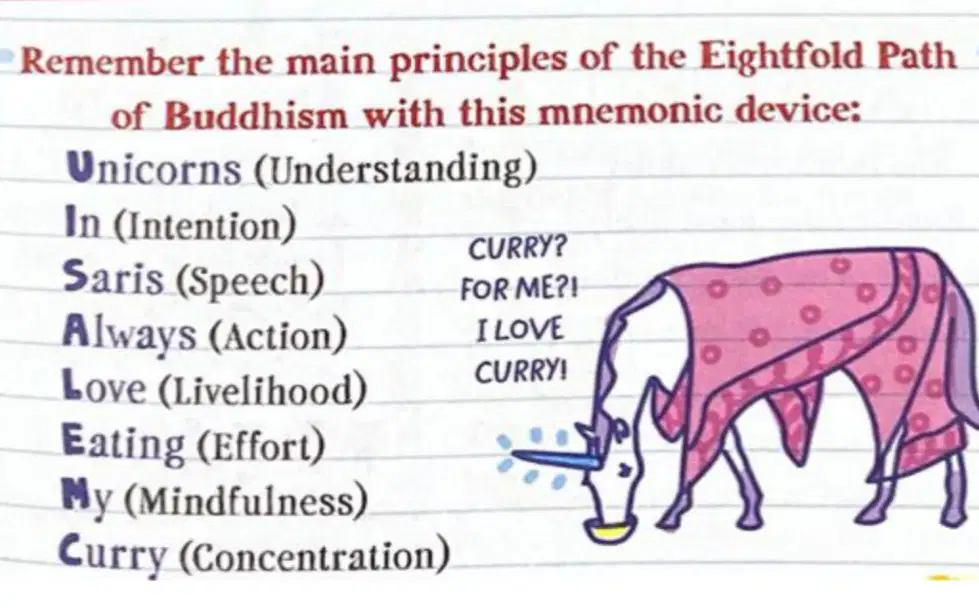
What is the mnemonic device mentioned in the image for remembering the main principles of the Eightfold Path of Buddhism?
Unicorns In Saris Always Love Eating My Curry
Umbrellas In Sand Always Leak Every Morning Coffee
Understanding Intention Speech Action Livelihood Effort Mindfulness Concentration
Unique Ideas Shine Above Light Every Morning Clearly
Who founded the Maurya Empire?
Ashoka
Harsha
Chandragupta Maurya
Samudragupta
What did Chandragupta Maurya overthrow to establish the Maurya Empire?
Kingdoms along the Indus River
Kingdoms along the Ganges River
Kingdoms in Southern India
Kingdoms in the Himalayas
Chandragupta Maurya's rule was characterized by (a) type of governance?
How many war elephants did Chandragupta Maurya have?
5,000
7,000
9,000
11,000
What did Chandragupta's grandson Asoka do after the war in Kalinga?
He converted to Buddhism and spread it throughout the empire.
He abandoned his kingdom and lived as a hermit.
He expanded his empire further into Southeast Asia.
He wrote a famous poem about the war.
After Asoka's death, the Maurya Empire (a) .
Who was Kalidasa?
A ruler of the Gupta dynasty.
A philosopher who developed new schools of thought.
One of the great Indian poets who wrote "The Cloud Messenger."
The inventor of techniques for printing on cloth.
What were built during the golden age of culture and trade in India?
Castles and fortresses
Hindu and Buddhist temples and shrines
Markets and trading posts
Universities and libraries
Which mathematical concepts were invented during the golden age of culture and trade in India?
The number system and the concept of infinity
Algebra and geometry
The decimal system and the concept of zero
Calculus and trigonometry
Until when did the golden age of culture and trade last in India?
Until the early fifth century CE
Until the late fifth century CE
Until the seventh century CE
Until the ninth century CE
Who invaded India in the late fifth century CE, leading to the fracturing of the country?
The Mongols
The Huns
The Persians
The Greeks
What was the state of Northern India after the invasion in the late fifth century CE?
It remained united and strong.
It became a major trading hub.
It remained splintered for hundreds of years.
It was completely abandoned.

