Worksheets
BIOSCORE W15 CHAPTER 8 : TRANSPORT SYSTEM
Total questions: 20
Worksheet time: 21mins

Which shows the correct pathway of oxygenated blood entering and leaving the heart?
Pulmonary vein > left atrium > left ventricle > aorta
Pulmonary vein > left atrium > right ventricle > aorta
Vena cava > right atrium > right ventricle > pulmonary artery
Vena cava > right atrium > left ventricle > pulmonary artery
When impulses are conducted through the heart, transmission is delayed at the _____________ so that the ____________ may fully contract before the ___________ contract.
Sinoatrial node, atria, ventricles
Sinoatrial node, ventricles, atria
Atrioventricular node, atria, ventricles
Atrioventricular node, ventricles, atria
Lymph nodes are widely distributed throughout the body. Along the lymphatic veins they filter the _________ before it is returned to the _______.
lymph, blood
lymph, heart
blood, lymph
blood, heart

Sugar is loaded into the phloem from a source or an area of ______________ to a sink or an area of ______________
Low sucrose concentration, high sucrose concentration
High sucrose concentration, low sucrose concentration
Positive water potential, negative water potential
Negative water potential, positive water potential
In the pressure flow hypothesis, what causes the pressure?
Root pressure
The osmotic uptake of water by sieve tubes at the sink
The osmotic uptake of water by sieve tubes at the source
The accumulation of mineral and water by the stele in the root
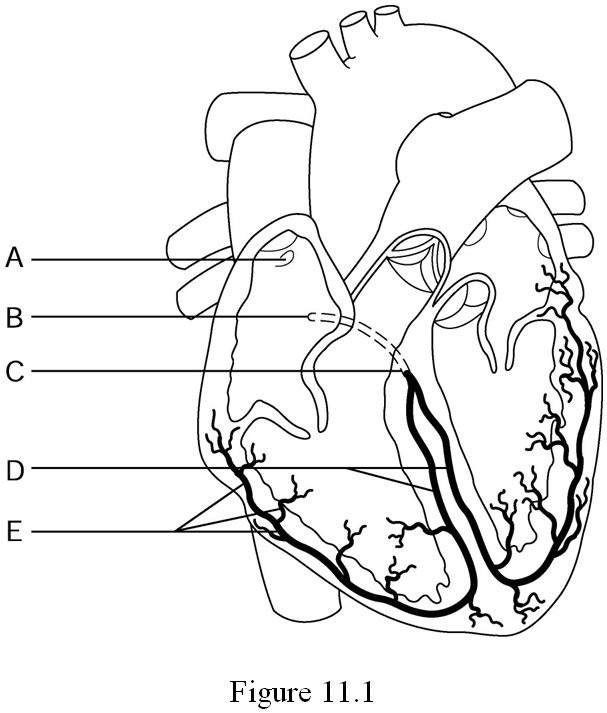
Which structures of the human heart receives impulses directly from the sympathetic and parasympathetic system?
Sinoatrial node
Atrioventricular node
Bundle of His
Purkinje tissue
Root pressure which plays a small role in xylem flow is caused by
transpiration of water out of the xylem.
cohesion of water molecules to one another
adhesion of water molecules to walls of the xylem
osmotic flow of water into the xylem

What is the function of the blood vessel labelled D?
To transport blood from the heart to the lungs
To transport blood from the heart to the rest of the body.
To transport blood from the rest of the body to the heart.
To transport blood from the lungs to the heart.
Xylem transports water and dissolved minerals in which direction?
(a)
Name the valve that prevent the backflows of blood from right ventricle to right atrium
(a)
Lymp nodes are widely distributed throughout the body along the lymphatic veins where they filter the (a) before it is returned to the blood
What area of the heart is responsible for the contraction of atria and allow atria to empty completely before ventricles contract?
Right bundle branch
AV node
Bundle of his
SA node
Choose all that are main functions of the Lymphatic System:
Return excess fluid to bloodstream
Transport fatty acids and glycerol
Transport oxygen/glucose
Remove and destroy pathogens
Reduce the number of leukocytes
The fluid, originating from the blood capillary, that is formed in the spaces between the cells is known as:
(a)

The condition shown when there is accumulation of interstitial fluid in the body tissue. Name the concequence.
Oedema
Inflamation
Thrombosis
Blood clot
The structural difference between lymphatic capillary and blood capillary:
Lymph capillary is blind-ended
Lymph capillary is continous
Lymph capillary is thicker
Lymph capillary is green in color
Which is the correct pathway of lymph in lymphatic system
Blood capillary - Interstitial space - Lymphatic capillary - Lymphatic ducts - Lymphatic vessel - Subclavian veins
Interstitial space - Blood capillary - Lymphatic capillary - Lymphatic vessel - Lymphatic ducts - Subclavian veins
Blood capillary - Interstitial space - Lymphatic capillary - Lymphatic vessel - Lymphatic ducts - Subclavian veins
Interstitial space - Blood capillary - Lymphatic capillary - Lymphatic vessel - Subclavian veins - Lymphatic ducts -
Sucrose enters the phloem sieve-tube by ____________
Active transport
Water potential
Osmosis
Diffusion

What is the name for a circulatory system that has blood leave heart to go to lungs then goes back to heart before delivering the oxygenated blood to the rest of the body?
(a)