
 Worksheets
AU Bio Module 5 Multiple Choice
Total questions: 16
Worksheet time: 18mins
Tick three human activities which negatively impact on an ecosystem.
deforestation
littering
planting trees
recycling
using cars
Combustion, Photosynthesis, Consumption, Respiration and Decomposition are categories that fall under which Ecosystem Cycle?
Oxygen
Nitrogen
Hydrogen
Carbon
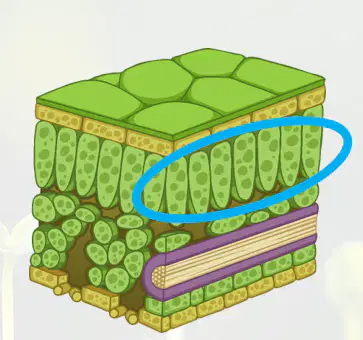
What Is the Tissue Circled?
Palisade cells
Stomata
Spongy mesophyll
Outer Epidermal layer
How can we define biodiversity?
(Can you also match habitat, Population, Ecosystem?)
The range of organisms in a given area
A community of animals and plants and where they live.
All the animals of one type of species that live in a given area.
The area where an organism lives, for example, pond
What are the DISADVANTAGES of Biogas? Select all that apply.
Continuous generators are expensive as the waste and the products are mechanically added and removed all the time.
The waste material being put into the generators is very smelly. You wouldn’t want to position one near to your home!
The biogas produced cannot be stored as a liquid because it requires too high a pressure, so it must be used immediately.
The microorganisms work at an optimum
temperature of 35°C, so some generators require insulation or a heat source.
Which of the following is an example of an abiotic factor?
availability of food
introduction of a new pathogen
soil pH and mineral content
species outcompeting each other
Which term describes an organism which is usually a green plant or alga that makes glucose by photosynthesis?
predator
prey
producer
prokaryote
Which of the following does not DIRECTLY contribute to water pollution?
fertiliser
sewage
smoke
toxic chemicals
Which of the following adaptations of a cactus helps it to increase its water uptake in a dry environment?
flowering only at night
large, shallow root system
sharp spines instead of leaves
thick waxy cuticle
On average, how much of the biomass is transferred to the next trophic level each time?
5%
10%
20%
33%
What are the ADVANTAGES of Biogas. Select all that apply.
There is a lot of waste material produced and so it is cheap and plentiful
Methane is a greenhouse gas and so by using it as a fuel, it is prevented from entering the atmosphere and contributing to global warming.
The waste material put into the generator is made useful and is not dumped, where it would otherwise release pollutants into water supplies.
The digested material by-products make very good fertilisers which improve crop yield.
4. What type of reaction is cellular respiration? (hint: what happens to the temperature of a compost pile?)
displacement (heat moved)
endothermic (takes heat)
exothermic (releases heat)
neutralisation (no heat lost or made)
The glucose produced by photosynthesis is transferred into insoluble starch for what purpose?
protein synthesis
storage
to strengthen the cell wall
to make more chloroplasts
Once bacteria have fixed nitrogen, it can be taken up by plants and animals. What is it used for?
Production of nitrogen oxides (nitrate and nitrite)
Energy
Proteins
Carbohydrates
Which of the following would belong to the four main nitrogen compounds in the Nitrogen Cycle? Select all that apply.
ammonia (NH3)
ammonium ions (NH4+)
nitrate ions (NO3-)
nitrite ions (NO2-)
What is the function of the phloem in the plant?
transports water in the plant
transports food in the plant
allows the exchange of gases (CO2 in/O2 out)
change shape to open and close the stomata

