
 Worksheets
Constitution, Early Republic and Age of Jackson (Dec. - Feb.)
Total questions: 82
Worksheet time: 1hrs 15mins

Type of gov't system were the power of the federal government is shared with the state governments (10th amendment)
federalism
legislative branch
U.S. Constitution
Articles of Confederation

The first ten amendments to the Constitution guaranteeing individuals freedoms and rights (Anti-federalists would not ratify the constitution until these were included)
Bill of Rights
Articles
Amendments
Preamble

This Branch of Government makes laws and has the power to declare war
Executive
Legislative
Judicial
The Senate

This branch interprets (explains) laws and includes the Supreme Court.
Executive
Legislative
Judicial
Congress

This term refers to the two parts of Congress: The House of Representatives and The Senate.
Amendment
Bicameral
Checks and Balances
Popular Sovereignty

This term refers to the system to ensure one branch doesn't get too much power.
Amendment
Bicameral
Checks and Balances
Popular Sovereignty
The Senate and the House of Representatives (who make the laws) are all members of?
Congress
Executives
Commander-in-chief
Supreme Court
Who works in the Executive Branch?
Congress
President
Justice
House of Representatives
What is required to add a new amendment to the U.S. Constitution? (2 correct answers)
Executive Branch approval
2/3 vote of both houses of Congress
ratified by the legislatures or conventions in 3/4's of the states
2/3's Supreme Court approval
passing the Bill of Rights
The first plan of government which gave more power to the states and had a weak central government was called the ..... ?
Declaration of Independence
Articles of Confederation
War for Independence
Constitutional Convention
Which Virginian, who would later become our 4th President, was the primary author of the U.S. Constitution?
George Washington
Thomas Jefferson
James Madison
James Monroe
What was the purpose of the authors who wrote the Federalists Papers?
To ratify (approve) the Articles of Confederation
For the 3/5ths Compromise
To decrease slavery in the south
To (ratify) approve the U.S. Constitution
This group of policymakers felt that the states should have more power than the federal government?
Thomas Paine
Federalists
Anti-Federalists
House of Representatives

Based on the picture what Compromise was created?
3/5 Compromise
the Compromise of 1850
the Great Compromise
the Missouri Compromise
The Preamble
The Declaration of Independence
The U.S. Constitution
The Bill of Rights
Which of the following is a role that the President fills?
Commander-in-Chief of the military
Leader of the Senate
Chief Justice
Speaker of the House

Why did the Anti-Federalists demand that a bill of rights be added to the U.S. Constitution?
To strengthen the authority of the federal government.
To improve the organization of the judiciary.
To give each state an equal amount of power.
To protect individual freedoms from the federal government.

With which of the following arguments would the authors of The Federalist Papers most likely have agreed?
A bill of rights should be included in the Constitution before it is ratified.
Having a stronger central government will make the country more stable and prosperous.
The Three-Fifths Compromise will result in fair and equal representation.
Universal suffrage should be constitutionally guaranteed.
Under what governing document was the Northwest Ordinance created (about the only positive thing from this newly installed gov't)?
The Declaration of Independence
The Articles of Confederation
The Ohio State Constitution
The United States Constitution
The Northwest Ordinance is considered a historical milestone because it ...?
more than doubled the size of the United States
established a method for admitting new states into the Union
encouraged state legislatures to ratify the Constitution
proposed treaties with American Indians to allow the peaceful settlement of new territories
This is the introduction to the U.S. Constitution (highest law of the land) and the purpose of the document
Bill of Rights
The Preamble
The Articles of Confederation
An Amendment
Which part of the legislative branch has representation based on a states population?
Representatives
Which part of the bicameral legislative branch has equal representation for each state (2 reps per state)?
House of Representatives
Judicial
Executive
Senate

What do we call a change to the U.S. Constitution?

What constitutional amendment is being represented in the picture?
The Founding Fathers chose to ensure against a ruler with absolute authority by-
dividing power among 3 branches of government
requiring multiple political parties in each election
guaranteeing the rights of those accused of a crime
creating a civilian-led militia with a right to bear arms
The Anti-Federalists argued against ratification of the U.S Constitution because they-
disagreed with the Great Compromise
wanted a parliamentary system of government
believed that states' rights were not being protected
Which amendments deal specifically with the court systems?
Amendments 8 - 10
Amendments 5 - 8
Amendments 1 - 4

The ___ amendment grants us FIVE rights: The freedom of speech, press, religion, assembly, and to petition the government.
1st
3rd
5th
7th
No unreasonable search or seizure.
10th Amendment
5th Amendment
7th Amendment
4th Amendment

Which Amendment protect us from having to house or quarter soldiers?
6th
3rd
10th
5th

Which Amendment guarantees a speed trial, jury, and a right to a lawyer?
6th
10th
1st
7th
Which amendment guarantees Americans right to bear arms (own weapons)
Second Amendment
First Amendment
27 Amendments
Third Amendment
5th Amendment
No self-incrimination
No double jeopardy
Due process
The right to a jury trial in civil cases involving more than $20
No cruel and unusual punishment
No excessive bail
The right to a fair, speedy and public trial in criminal cases.
The right to a lawyer.
8th Amendment
No self-incrimination
No double jeopardy
Due process
The right to a jury trial in civil cases involving more than $20
No cruel and unusual punishment
No excessive bail
The right to a fair, speedy and public trial in criminal cases.
The right to a lawyer.


British trade was cut off during the War of 1812, so how did this affect the U.S. economy?
American manufacturing industries expanded to replace those goods from Europe
America started to export their crops to other countries
Many Americans moved to Europe for better jobs
America sought help from France and Spain

Full control of the Gulf of Mexico
Control of the Great Lakes
Full control of the Mississippi River

The significance of the decision by the U.S. Supreme Court in Marbury v. Madison (judicial review) was that it established the Supreme Court’s ability to...

- Feelings of nationalism increased
- The Era of Good Feeling began
- International respect increased
Which of the following would be the best title for the information above?
Effects of the Whiskey Rebellion
Effects of the Alien and Sedition Acts
Effects of the War of 1812
Effects of the Embargo Act

The Treaty of Versailles ended the war. The United States gained new land.
The Treaty of Ghent ended the war. No one gained any new territory.
The Treaty of Paris ended the war and France gained more land.
The Treaty of Ghent ended the war and the United States gained new land.

Summarize the Monroe Doctrine
Trade alliances with foreign nations was made illegal.
Further colonization of N. America by European nations was prohibited (not allowed).
Further colonization on N. America by Enropeans was encouraged by President Madison.
New trade alliances would be completed by the Northern states only.
Dissagreement on the election of George Washington.
Dissagreement over the uses of the Articles of Confederation.
Dislike over political figures like James Marshall and Haym Salomon
Disagreement over the formation of the national bank and the power of the federal government

Debt from the French and Indian War
Debt from the American Revolutionary War
What laws from Adams' domestic policy made it a crime to talk negatively about the government?
XYZ Affair
Proclamation of Neutrality
Alien and Sedition Acts
Farewell Address
During the fighting and bombing of Fort McHenry in the War of 1812, the writing of the "Star Spangled Banner" (which became the U.S. national anthem) took place. Who wrote this anthem?
Star Spangled Banner
Thomas Jefferson
Francis Scott Key
John Paul Jones

According to Hamilton, what was required to get America out of debt and maintain the stability of the nations economy?
a trade embargo with Europe
the abolition of taxes
a trade alliance with France
the creation of a national bank
How did the Embargo Act of 1807 and the War of 1812 affect the U.S. economy ( hint: we were no longer trading with foreign countries )?
the value of federal currency increased
agricultural imports increased
Imports of raw material increased
Manufacturing in the U.S. increased

What did the Judiciary Act of 1789 accomplish?
established a federal courts system
Made it easier to pass laws in Congress
Gave the Executive branch veto power over Congress
Made it illegal for slaves to vote
What caused northern manufacturers to benefit from less foreign competition in trading goods?
Boycott of Chinese made products
Protective tariffs issued by the U.S. gov't
The Alien and Sedition Act
The passing of the Treaty of Paris

The British navy became aggressive and kidnapped our sailors, forcing them to fight, this is called....
impressment
salutary neglect
indentured servant
slavery

Which nation began seizing U.S. ships and impressment of American sailors, forcing them to fight for their navy during the French and British War?
France
Canada
Great Britain
Spain

This resulted from a dispute over French government attempting to bribe the U.S. out of $250,000 and interfere with American trade.
Jay's Treaty
Pinckney's Treaty
Treaty of Greenville
XYZ Affair

Who lead the Corps of Discovery after the purchase of the Louisiana Purchase to survey the land and see what was out there in the land that the country had just bought?
Washington
Hamilton
Adams and Grant
Lewis and Clark

Became part of the U.S. in 1783 after the Revolutionary War
H
B
D
I
Became part of the U.S. in 1803
H
B
D
I
Bought from Spain, this territory became part of the U.S. in 1819 under the Adams-Onis Treaty
H
B
D
I
The NEWLY formed Democratic-Republican Party basically held the same beliefs as which earlier group of lawmakers (states should have most of the power to govern themselves)?
Anti-federalist
Whigs
Federalist
What type of people supported the Democratic-Republican party?
farmers and southerners
bankers
wealthy elite
businessmen
What type of people supported the Federalist party ( strong central gov't )?
Southern farmers and plantation owners
women
gold miners
wealthy bankers, business owners, and Northerners
Jacksonian democracy, that practiced rewarding political supporters with government jobs became known as
the spoils system.
the common man
Trail of Tears
tariffs
Which of the following are major characteristics during the era of Andrew Jackson? (two correct answers)
Justice for American Indian groups
The spoils system
Greater democracy for the common man
Wealthy industrialists control domestic policies
The boycott system
The Nullification Crisis was when:
Georgia made the Native Americans relocate to Indian Territory
Sen. Clay opposed Jackson's plan to kill the bank of the US
South Carolina opposed high tariffs and threatened to secede the Union
Supreme Court justice John Marshall voted in favor on the Cherokee Nation
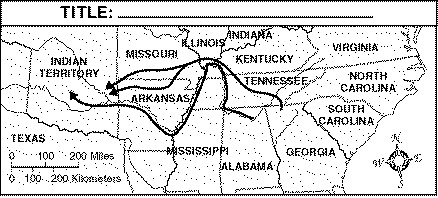
What event of the 1830s is shown by the heavy black lines on the map?
the Northwest Ordinance
The Proclamation line of 1763
The Trail of Tears
Manifest Destiny
Why did the National Bank of the United States became a political issue?
President Jackson thought it was too powerful and favored the wealthy
bank officials were usually not honest.
it had to be supported with taxpayers' money.
every state had their own money money.
Which Supreme Court case ruled that Georgia could not take land that was occupied by the Cherokee Nation?
Passed in 1830, this authorized the removal of Native Americans who lived east of the Mississippi River to land called Indian Territory.
One way suffrage/voting expanded during the Jackson presidency was by -
recognizing a woman's right to vote
permitting free African Americans to vote
eliminating property qualifications to be able to vote
extending citizenship to American Indian tribes
Why did northern states favor tariffs that were placed on European products imported to the United States?
They wanted to expand democracy.
They wanted to continue doing business with the King of England
Native Americans were beginning to build factories west of the Appalachian Mountains.
Manufacturers feared foreign competition on products.
Why did the United States pass the Indian Removal Act? (two correct answers)
to avoid conflict between white settlers and American Indian tribes
to provide legal protections for American Indian tribal land ownership
to assimilate American Indian tribes into the culture of the United States
to use American Indian tribes to push out foreign control of western territories
To gain natural resources from the land that they occupied
What was Jackson's response to the court decision Worcester (white, male missionary who represented the Cherokee Tribe) v. Georgia?
He ignored the Supreme Courts decision
He passed the Bill of Rights into law
He allowed Native Americans to stay on their occupied land
He asked them to reconsider the case
During the Nullification Crisis, South Carolina threatened to secede the Union. What constitutional principle was being tested?
Popular Sovereignty
Federalism
Individual Rights
Republicanism


This was an economic policy of the United States where the government does not interfere with factories and industries.
Impressment System
Spoils System
Suffrage system
Laissez-faire
The Embargo Act of 1807
banned all U.S. imports and exports (trade) with European countries
increased the amount of exports to France
placed a heavy tax on all imported goods
led to war with England
What was the cause of the Whiskey Rebellion? George Washington responded with 13,000 troops and the farmers backed down.
Farmers refused to pay taxes on whiskey to help the nation get out of debt.
Farmers refused to use grain to produce whiskey.
The government would not allow the trade of whiskey.
The government made the production of whiskey illegal.

