
 Worksheets
Body Basics
Total questions: 49
Worksheet time: 29mins
What is anatomy?
The study of the systems
The study of the body's structure
The study of how the organs and systems function
True or False: The study of how the organs and systems function is called physiology.
True
False
An example of a multiellular organism is...
Yeast
Dogs
Amoeba
Humans
Unicellular organism means...
an organism with one cell
an organism with one system
an organism with three systems
an organism with trillions of cells
How much is the body made of water?
6/9
2/3
1/2
5/6
Which is organized correctly in levels of organization?
Systems, tissues, organs, cells
Organs, cells, systems, tissues
Cells, tissues, organs, systems
Tissues, systems, cells, organs
True or False: Cells are the biggest units of the human body.
True
False
Which is an example of a cell?
Neurons
Stomach
Intestines
What are tissues?
Paper that you use to blow your nose
Groups of cells
Two systems working together
Which tissue gives support and structure to the body?
Which is true about organs? Choose all that apply.
They make systems.
They are components of blood.
They are groups of tissues.
A cell can become differentiated. This means it
can live outside your body
only do one job
do many different things
work in all organs of your body
building blocks that make up our bodies
cells
tissue
organs
organ systems
a group of similar cells that does a particular job or function
cells
tissue
organs
organ systems
part of an organism that is made of tissue and cells that has a particular job or function
cells
tissue
organs
organ systems
a system of cells, tissue and organs that perform a particular job
cells
tissue
organs
organ systems

your brain is an example of
cells
tissue
organ
organ systems

your heart is an example of
cells
tissue
organ
organ systems
a system of cells, tissue and organs that breaks food down and absorb required nutrients
excretory system
digestive system
circulatory system
respiratory system
a system of cells, tissue and organs that removes wastes from our body
excretory system
digestive system
circulatory system
respiratory system
a system of cells, tissue and organs that moves nutrients and wastes around the body
excretory system
digestive system
circulatory system
respiratory system
a system of cells, tissue and organs that is responsible for getting gases into and out of your body
excretory system
digestive system
circulatory system
respiratory system
Groups of cells work together to form...
tissues
organs
organ systems
organisms
Some organisms, like bacteria or amoeba, only have 1 cell and are called...
multicellular
organ cellular
unicellular
dicellular
Which of these things is NOT made of cells?
tree
human
cloud
grasshopper
Which is smaller: a cell or atom?
cell
atom
same size
A group of cells, tissues, organs, and systems working together form a(n)...
organelle
organ
tissue
organism

Muscle tissue is made of ...
muscle cells
skin tissue
stem cells
Which of the following is NOT a main tissue type?
muscle
epithelial
cuboidal
connective
Where would you NOT find epithelial tissue?
skin
glands
heart
lining of hollow organs
Which tissue is responsible for transmitting signals?
muscle tissue
epithelial
Nervous
Connective
How are epithelial tissue classified?
by shape
by size
by number of layers
by shape and number of layers.
Another name for skeletal muscles is:
cardiac
involuntary
voluntary
simple squamous
Which tissue is found in the spinal cord?
nervous tissue
skeletal muscle
smooth muscle
cardiac muscle
Connective tissue is grouped into dense, loose and _______.
bone
cartilage
blood
tendons
Nerve cells can not be repaired:
true
false
Nerve tissue is made up of:
neurons and neuroglial cells
connective and muscle tissue
neurons and epithelial cells
muscle tissue and neuroglial
Raising your arm is an example of:
smooth muscle use
skeletal muscle use
cardiac muscle use
nervous tissue use.
Which of the following is connective tissue?
Bone
cartilage
blood
all of these
which tissue is attached to bone?
skeletal muscle
smooth muscle
cardiac muscle
nervous tissue
What do the connective tissues do? (their main job)
protect
connect tissues together
provide movement
provide impulses.
What are the two main organs of the nervous system?
heart and lungs
liver and spleen
brain and spinal cord
small intestine and large intestine.

What kind of muscle is this?
Smooth
Cardiac
Skeletal

What muscle is this?
Smooth
Skeletal
Cardiac
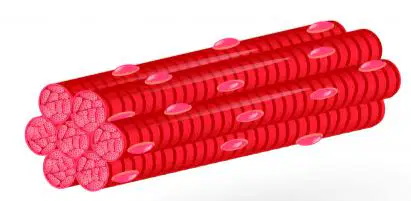
What muscle is this?
Skeletal
Cardiac
Smooth

Which type of tissue is this?
Connective tissue

Which type of tissue is this?

Which type of tissue is this?
Nervous Tissue
Muscle tissue

Which type of tissue is this?

