
 Worksheets
Classification Review
Total questions: 32
Worksheet time: 16mins
An animal's qualities are listed below:
ANIMAL'S QUALITIES
● Moist skin
● Has four legs
● Lays eggs
● Breathes with lungs and gills
● Cold blooded
What type of animal is described in the box?
amphibian
fish
mammal
reptile
bird
A biologist observes that a plant specimen has
no true roots, stems, or leaves. What term would
she use to describe this plant?
vascular
flowering
wilted
non-vascular
Which of the following organisms is a vertebrate?
insect
sponge
monkey
earthworm
What trait do all mammals share?
walk upright
have an opposable thumb
have large brains
nurse their young with milk
Which vertebrate is ectothermic (cold-blooded)?
cat
chicken
human
lizard
Which term describes an animal without a
backbone?
chordate
invertebrate
protozoan
vertebrate
Although the bald cypress tree loses its leaves in
the winter, its seeds are similar to evergreen pine
trees. How are bald cypress and pine tree seeds
similar?
They are found in bulbs.
They are found in cones.
They are found in fruits.
They are found in shells.
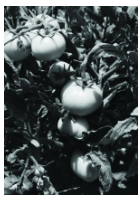
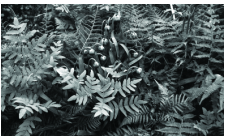
Which of the following plants produces spores?
Which of the following organisms lack vascular
tissue?
mosses
whisk ferns
pine trees
flowering plants
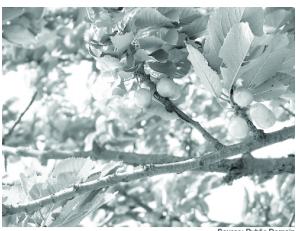
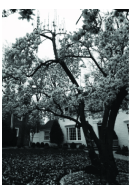
The picture above shows a cherry tree
What do cherry trees produce that helps
scientists classify them?
flowers and cones
flowers and seeds
leaves and spores
leaves and spores
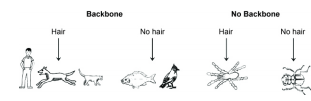
According to the classification key above, which pair of animals could be classified as mammals?
humans and dogs
birds and fish
birds and fish
cats and birds

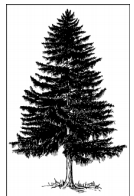
The picture above shows a hemlock tree at different times of the year.
deciduous
evergreen
spores
flower producing
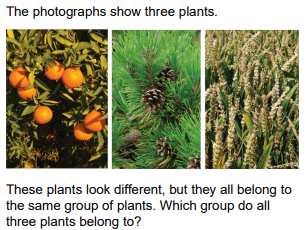
plants that produce seeds
plants that produce flowers
plants that produce spores
plants that produce needles
Insects, arachnids, worms, and mollusks all belong to which group?
vertebrate
invertebrate
classification
vascular
Fish, amphibians, reptiles, birds and mammals all
belong to which group?
vertebrate
invertebrate
bacteria
vertebrate and invertebrate
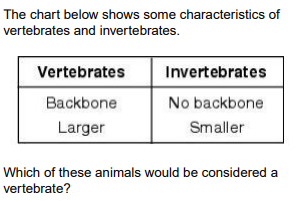
fish
clam
sponge
octopus
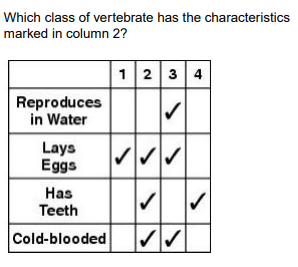
fish
bird
reptile
mammal
Organisms with a body covering of feathers are
classified as a__________.
bird
mammal
fish
reptile
Classification is...
The process of grouping things based on their similarities
The process of dissecting a frog
The process in which someone puts an animal in a box
I don’t know
A species is...
A group of vastly different organisms
A group of similar organisms that can mate with each other and produce offspring that can also mate and reproduce
An animal that is one of its kind
A cell
Binomial Nomenclature is...
The making and producing of paper
A study lesson
The system in which each organism is given a unique, two-part scientific name that indicates its genus and species
The name of a French Scientist
Levels of Classification...
Domain, kingdom, class, phylum, order, family, genus, species
Kingdom, class, phylum, domain, family, genus, species, order
Domain, kingdom, phylum, class, order, family, genus, species
None of them
The three domains are..
Family, archea, order
Archea, bacteria, chordata
Eukarya, archea, bacteria
None of them
Eukarya includes...
Familiar kingdom of plants, animals, and fungi, and a less familiar kingdom, Protista, which has much simpler organisms. (Eukarya members are also called eukaryotes.) Eukaryotes contain a nucleus with DNA.
A group of closely related animals.
Similar to Charles Darwin.
None of these
Archaea contains...
A group of one-celled organisms with no nucleus in their cells.
I don’t know.
A group of spine animals.
Cells with a nucleus.
Bacteria contains...
Viruses
A nucleus with a virus cell
One cell, no nucleus but has a different structure and chemical processes from those of Archaea
None of the above
A complete scientific name...
Has to be over 30 letters long
Is written in italics and the first letter in the first word is capitalized, it is also most likely written in Latin
Has all capital letters
All lowercase and contains an X
Charles Darwin was...
The person who discovered america
One of the first scientists to understand evolution and believed in natural selection
A French sailor
None of the above
The process by which unrelated organisms evolve similar characteristics is called..
Taxonomic key
Convergent evolution
Dolphin
Donut
Carolus Linneas..
Created the taxonomic key which arranged organisms in groups based on their observable characteristics
Invented bones
Created the first boat
None of the above
Which one is NOT a domain?
Chordata
Bacteria
Eukarya
Archaea
Divergent evolution refers to..
They share the same food/diet
Two different organisms that are related because they share a common physical characteristic
Two different organisms that are related because they share a common ancestor
None

