
 Worksheets
English 3 Exam Review
Total questions: 93
Worksheet time: 1hrs 5mins
The men in question Harold Keene, Jim Peterson, and Gerald Greene deserve awards.
NO CHANGE
The men in question, Harold Keene, Jim Peterson, and Gerald Greene, deserve awards.
The men in question—Harold Keene, Jim Peterson, and Gerald Greene—deserve awards.
The men in question: Harold Keene, Jim Peterson, and Gerald Greene deserve awards.
Several countries participated in the airlift Italy, Belgium, France, and Luxembourg.
Several countries participated in the airlift, Italy, Belgium, France, and Luxembourg.
Several countries participated in the airlift. Italy, Belgium, France, and Luxembourg.
Several countries participated in the airlift: Italy, Belgium, France, and Luxembourg.
Several countries participated in the airlift; Italy, Belgium, France, and Luxembourg.
There's no room for error, said the engineer so we have to double check every calculation.
NO CHANGE
"There's no room for error," said the engineer, so we have to double check every calculation."
"There's no room for error," said the engineer, "so we have to double check every calculation."
"There's no room for error," said the engineer. "So we have to double check every calculation."
Judge Carswell later to be nominated for the Supreme Court had ruled against civil rights.
NO CHANGE
Judge Carswell later to be nominated, for the Supreme Court, had ruled against civil rights.
Judge Carswell, later to be nominated for the Supreme Court had ruled against civil rights.
Judge Carswell—later to be nominated for the Supreme Court—had ruled against civil rights.
In last week's New Yorker, one of my favorite magazines, I enjoyed reading Leland's article How Not to Go Camping.
NO CHANGE
In last week's New Yorker, one of my favorite magazines, I enjoyed reading Leland's article How Not to Go Camping.
In last week's New Yorker, one of my favorite magazines, I enjoyed reading Leland's article "How Not to Go Camping."
In last week's New Yorker, one of my favorite magazines, I enjoyed reading Leland's article "How Not to Go Camping."
Yes, Jim said, I'll be home by ten.
NO CHANGE
"Yes, Jim said, I'll be home by ten."
"Yes," Jim said, "I'll be home by ten."
"Yes," Jim said, I'll be home by ten."
Which sentence below is NOT written correctly?
There was only one thing to do—study till dawn.
There was only one thing to do study till dawn.
There was only one thing to do: study till dawn.
Montaigne wrote the following: "A wise man never loses anything, if he has himself."
NO CHANGE
Montaigne wrote the following, A wise man never loses anything, if he has himself.
Montaigne wrote the following, "A wise man never loses anything, if he has himself."
Montaigne wrote the following. "A wise man never loses anything, if he has himself."
The following are the primary colors red, blue, and yellow.
The following are the primary colors, red, blue, and yellow.
The following are the primary colors: red, blue, and yellow.
The following are the primary colors. Red, blue, and yellow.
The following are the primary colors; red, blue, and yellow.
Arriving on the 8 10 plane were Liz Brooks, my old roommate her husband and Tim, their son.
NO CHANGE
Arriving on the 8:10 plane were: Liz Brooks, my old roommate, her husband, and Tim, their son.
Arriving on the 8:10 plane were Liz Brooks, my old roommate her husband and Tim, their son.
Arriving on the 8:10 plane were Liz Brooks, my old roommate; her husband; and Tim, their son.
When the teacher commented that her spelling was poor, Lynn replied All the members of my family are poor spellers. Why not me?
NO CHANGE
When the teacher commented that her spelling was poor, Lynn replied, "All the members of my family are poor spellers. Why not me?"
When the teacher commented that her spelling was poor, Lynn replied, "All the members of my family are poor spellers. Why not me"?
When the teacher commented that her spelling was poor, Lynn replied "All the members of my family are poor spellers. Why not me?"
He used the phrase you know so often that I finally said No, I don't know.
NO CHANGE
He used the phrase "you know" so often that I finally said, "No, I don't know."
He used the phrase you know so often that I finally said: "No, I don't know."
He used the phrase you know so often that I finally said "No, I don't know."
The automobile dealer handled three makes of cars Volkswagens, Porsches, and Mercedes Benz.
NO CHANGE
The automobile dealer handled three makes of cars: Volkswagens, Porsches, and Mercedes Benz.
The automobile dealer, handled three makes of cars, Volkswagens, Porsches, and Mercedes Benz.
The automobile dealer handled three makes of cars, Volkswagens, Porsches, and Mercedes Benz.
Though Phil said he would arrive on the 9:19 flight, he came instead on the 10:36 flight.
NO CHANGE
Though Phil said he would arrive on the 9 19 flight, he came instead on the 10 36 flight.
Though Phil said, "he would arrive on the 9:19 flight, he came instead on the 10:36 flight."
Though Phil said he would arrive on the 9:19 flight. He came instead on the 10:36 flight.
Whoever thought said Helen that Jack would be elected class president?
NO CHANGE
Whoever thought said, "Helen that Jack would be elected class president?"
"Whoever thought," said Helen, "that Jack would be elected class president?"
"Whoever thought," said Helen that Jack would be elected class president?
In baseball, a show boat is a man who shows off.
NO CHANGE
In baseball, a "show boat" is a man who shows off.
In baseball a "show boat" is a man who shows off.
In baseball, a "show boat" is "a man who shows off."
The minister quoted Isaiah 5 21 in last Sunday's sermon.
NO CHANGE
The minister quoted "Isaiah 5:21" in last Sunday's sermon.
The minister quoted Isaiah 5:21 in last Sunday's sermon.
The minister quoted: "Isaiah 5:21 in last Sunday's sermon."
There was a very interesting article entitled The New Rage for Folk Singing in last Sunday's New York Times newspaper.
NO CHANGE
There was a very interesting article entitled "The New Rage for Folk Singing" in last Sunday's New York Times newspaper.
There was a very interesting article entitled The New Rage for Folk Singing in last Sunday's New York Times newspaper.
There was a very interesting article entitled "The New Rage for Folk Singing" in last Sunday's New York Times newspaper.
Whoever is elected secretary of the club Ashley, or Chandra, or Aisha must be prepared to do a great deal of work, said Jumita, the previous secretary.
NO CHANGE
Whoever is elected secretary of the club, Ashley, or Chandra, or Aisha, must be prepared to do a great deal of work, said Jumita, the previous secretary.
"Whoever is elected secretary of the club: Ashley, or Chandra, or Aisha must be prepared to do a great deal of work," said Jumita, the previous secretary.
"Whoever is elected secretary of the club—Ashley, or Chandra, or Aisha—must be prepared to do a great deal of work," said Jumita, the previous secretary.
Darwin's On the Origin of Species (1859) caused a great controversy when it appeared.
NO CHANGE
Darwin's "On the Origin of Species: 1859" caused a great controversy when it appeared.
Darwin's "On the Origin of Species 1859" caused a great controversy when it appeared.
Darwin's On the Origin of Species 1859 caused a great controversy when it appeared.
True or false: a satire uses humor to critique something that is wrong with society
True
False

To present things that are out of place or absurd.
sarcasm
incongruity
understatement

What is this image satirizing?
the lack of education for young children
the danger of playgrounds
the overuse of technology today
the expense of iPhones today

What rhetorical device is being used in the image?
Sarcasm
Caricature
Hyperbole

Of what is the picture an example?
hyperbole
understatement
parody
inversion

Identify the type of irony.
verbal irony
situational irony
dramatic irony
not irony; a coincidence

Identify the type of irony.
verbal irony
situational irony
dramatic irony
not irony; a coincidence

What form of irony is demonstrated in this image?
Verbal
Dramatic
Situational
No Irony Present

When the exact opposite of what is expected happens
situational irony
verbal irony
dramatic irony

To present the opposite of the normal order
ambiguity
ambiguous
reversal
parody

What device is used in the image?
Hyperbole
Satire
Understatement
Euphemism

What device is used in the image?
hyperbole
incongruity
understatement
satire
The point of satire is to entertain.
True
False
Which of these is NOT part of an argumentative essay introduction?
Hook
Claim
Summarize the Issue
Evidence
What is the purpose of an argumentative essay?
to persuade the reader
to tell an interesting story
to entertain the reader
to give information about a topic
In which part of the argumentative essay will you include your evidence?
Introduction
Body Paragraph
Hook
Conclusion
What two paragraphs in your essay should look similar?
Body and Conclusion
Body and Introduction
Introduction and Conclusion
Body Paragraph 1 and Body Paragraph 2
What is the purpose of a hook sentence?
To tell the reader what your essay is going to be about.
To get your reader interested in your essay.
To share the authors opinion with the reader.
To provide facts to the reader.
What is the purpose of a counterclaim?
Shows that you are smart.
Shows that you have considered the other side of the argument.
Shows that only your opinion matters.
Shows that you are only discussing one side of the argument.
What is included in a concluding paragraph?
Restated argument, evidence and call to action.
Restated argument and call to action.
Restated argument, restated claims and call to action.
Summary and call to action
What does an argumentative essay presents in order to let the reader know why it is more favorable?
The main idea of an essay.
Evidences for a claim
A sentence that gets the reader's attention.
All of the above
What is a Counterargument?
Agreeing with your opponent's claim.
The response to an argument.
An idea given by the opposing side against the claim given.
All of the above
What is a rebuttal?
The response counterargument.
The conclusion.
The return to your claim.
All of the above.
There are three parts to an essay. Which choice contains all of them?
Thesis, Lead, Hook
Introduction, Body, Conclusion.
Claim, Counterclaim, Rebuttal.
Only A and B
In which paragraph is the thesis statement found?
Body
Introduction
Conclusion
None of the above
It is the paragraph where facts of the given thesis statements of the essay are written?
Introduction
Refutation
Body
Conclusion
Facts, statistics, quotations, and anecdotes could all be used as:
reasons
thesis statements
evidence
claim
Why does Douglass say to his audience that “The Fourth of July is yours, not mine”?
African Americans are excluded from public holidays.
African Americans should not celebrate Independence Day until they have independence.
He doesn't believe in the values of freedom and equality.
The liberty that is celebrated has been denied to African Americans
When Douglass says he hears the "wails of millions," what is the "wail of millions" referring to?
angry protest of African Americans
suffering of enslaved people
anger of slaveholders
outrage of Northerners
Which of the following best summarizes Douglass’s judgment of the “conduct of this nation” in his Fourth of July speech?
By engaging in slavery, the U.S. participates in the evil crime upon which the nation was built.
By engaging in slavery, the U.S. violates its original principles of equality and freedom.
By celebrating freedom, the U.S. promises hope and an end to slavery.
By celebrating freedom, the U.S. redeems itself despite slavery.
Which of the following words are synonyms of stolid?
unemotional
umpleasant
vulgar
enthusiastic
A person who concedes, does which of the following?
gives in; surrenders
forgives; understands
agree; confirm
learns; grows
If there is a disparity between two classes, it means
there is communication
there is a large difference
there is a similarity
there is an argument
To denounce someone is to...
praise
honor
curse
criticize
Which of the following best summarizes this quote:
"The manhood of the slave is conceded. It is admitted in the fact that Southern statute books are covered with enactments forbidding … the teaching of the slave to read or to write."
There is no argument that a slave is a man. The law proves it.
The Bible supports that slavery is wrong.
Only slaveholders can prove this.
The nation does not see the contradiction of its values and its practices.
Which answer choice best summarizes the view of the future expressed in the quotation?
"I do not despair … “The arm of the Lord is not shortened,” and the doom of slavery is certain. I, therefore, leave off where I began, with hope. While drawing encouragement from “the Declaration of Independence,”
Slavery will end because slaveholders will lose their money.
Slavery will end because slaveholders will be punished.
Public awareness will lead to the end of slavery.
Slavery will end because of the nation's principles and the abolitionist movement.
Which of the following supports the claim that slavery is an evil that goes against American values and principles?
"I am not included within the pale of glorious anniversary!"
above your national, tumultuous joy, I hear the mournful wail of millions! whose chains, heavy and grievous yesterday, are, today, rendered more intolerable
I will, … in the name of liberty which is fettered, in the name of the constitution and the Bible which are disregarded and trampled upon, dare to call in question and to denounce … everything that serves to perpetuate slavery.…
I would, to-day, pour out a fiery stream of biting ridicule, blasting reproach, withering sarcasm, and stern rebuke
In which of the following quotations from Douglass’s Fourth of July speech does Douglass offer evidence to support his claim that enslaved persons are human beings who work and live, not brutes?
To drag a man in fetters into the grand illuminated temple of liberty
Is it not astonishing that, while we are ploughing, planting, and reaping, using all kinds of mechanical tools...
What, am I to argue that it is wrong to make men brutes, to rob them of their liberty...?
To [the slave], your celebration [of the Fourth of July] is a sham; your boasted liberty, an unholy license
Which of the following is a counterclaim (an argument that Douglass rebuts) addressed by Douglass in his Fourth of July speech? Refer to this passage for help.
That which is inhuman, cannot be divine! Who can reason on such a proposition?
The Fourth of July “belongs to” the free.
Slavery is clearly an inexcusable practice.
Slavery was established by religious law and is condoned by God.
The Fourth of July is a holiday doomed to end.
Which of the following best describes parallelism as a rhetorical device?
repeated sentence/phrase structure for emphasis
repetition of adjectives
questions that are not expected to be answered
emotional appeal
Which of these best describes Douglass's purpose in delivering this speech?
To inform the audience of the horrors of slavery by teling his story
To entertain the audience with tales of folklore and mythology
To persuade the audience to act more radically to end slavery by showing the toll that the national holiday takes on enslaved people.
2. Hot Text: Select the word from Paragraph 3 that comes from a Latin word meaning “future”. (V.1.2)
“We, the people of the United States, in order to form a more perfect Ⓐ union, establish justice, insure domestic Ⓑ tranquillity, provide for the common defense, promote the general welfare, and secure the blessings of Ⓒ liberty to ourselves and our Ⓓ posterity, do Ⓔ ordain and establish this Constitution for the United States of America.”
union
tranquility
liberty
posterity
ordain
4. Read this excerpt from Paragraph 8.
“And I hardly believe any of our opponents will have the hardihood to say they are not.” (Paragraph 8)
What does hardihood mean in this sentence? (V.1.3)
proof
modesty
boldness
determination
6. Read this excerpt from paragraph 6.
“It is not a republic. It is an odious aristocracy; a hateful oligarchy of [gender]; the most hateful aristocracy ever established on the face of the globe; an oligarchy of wealth, where the rich govern the poor.” (Paragraph 6)
What is the meaning of odious as it is used in the paragraph? (V.1.3)
awful
agreeable
nauseating
unpleasant
8. Hot Text: Select the word from Paragraph 5 that comes from a Latin word meaning “restriction” or “limitation”. (V.1.2)
“For any state to make [gender] a Ⓐ qualification that must ever result in the Ⓑ disfranchisement of one entire half of the people, is to pass a bill of Ⓒ attainder, or, an ex post facto law, and is therefore a Ⓓ violation of the supreme law of the land. By it the blessings of Ⓔ liberty are forever withheld from women and their female posterity.” (Paragraph 5)
qualification
disenfranchisement
attainder
violation
liberty
9A. Which central idea of the text does the following quote support?
“it is a downright mockery to talk to women of their enjoyment of the blessings of liberty while they are denied the use of the only means of securing them provided by this democratic-republican government” (Paragraph 4)
Central Idea 1: Women should be treated as citizens of America.
Central Idea 2:
Women should be equal to men.
Both Central Ideas
9B. Which central idea of the text does the following quote support?
“By it the blessings of liberty are forever withheld from women and their female posterity.” (Paragraph 5)
Central Idea 1: Women should be treated as citizens of America.
Central Idea 2:
Women should be equal to men.
Both Central Ideas
9C. Which central idea of the text does the following quote support?
“ordains all men sovereigns, all women subjects, carries dissension, discord, and rebellion into every home of the nation.” (Paragraph 6)
Central Idea 1: Women should be treated as citizens of America.
Central Idea 2:
Women should be equal to men.
Both Central Ideas
9D. Which central idea of the text does the following quote support?
“every discrimination against women in the constitutions and laws of the several states is today null and void” (Paragraph 8)
Central Idea 1: Women should be treated as citizens of America.
Central Idea 2:
Women should be equal to men.
Both Central Ideas
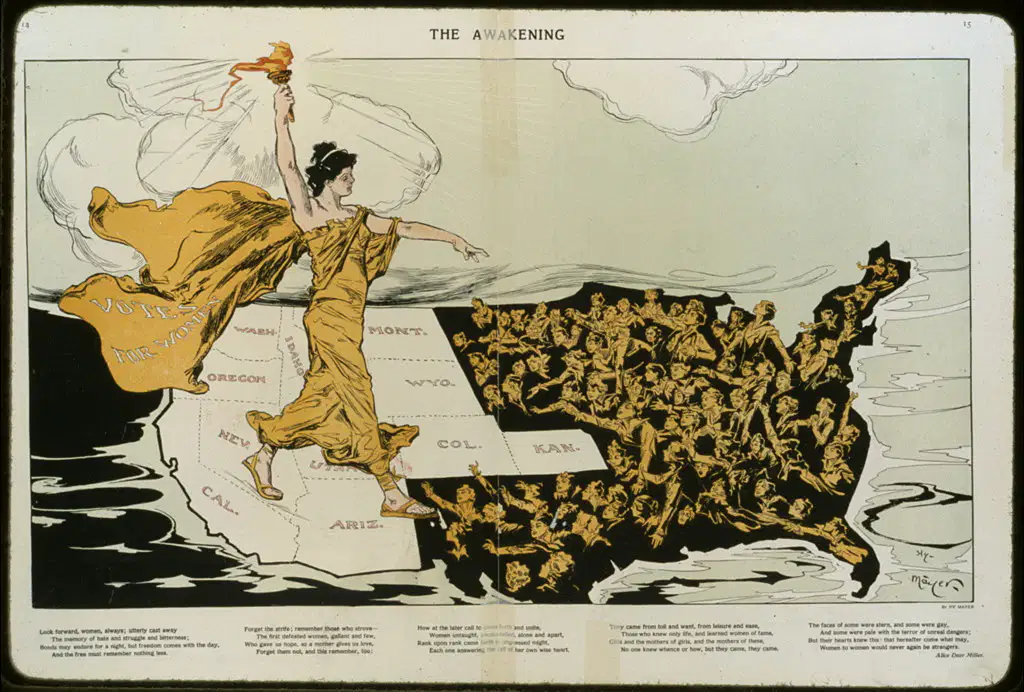
10. How does “The Awakening” represent women’s suffrage differently than “On Women’s Right to Vote”? (R.3.3)
The cartoon depicts how much women yearn for and want the right to vote.
The cartoon portrays the female perspective on being given the right to vote.
The cartoon depicts that some states have already established the right to vote.
The cartoon portrays who is leading the fight for women to gain the right to vote.
What is the name of the widow in this story?
Mrs. Malloy
Mrs. Mallard
Mrs. McCaffrey
Mrs. Moi
Into this she sank, pressed down by a physical exhaustion that haunted her body and seemed to reach into her soul.
Based on the context, what do you think is the best definition of haunted?
frequented by a ghost
to be persistently on someone's mind
showing signs of mental anguish or struggle
to go somewhere often
. But now there was a dull stare in her eyes, whose gaze was fixed away off yonder on one of those patches of blue sky.
Based on the context, what is the best definition of the word yonder?
at some far distance; over there
in a bored or tired manner
with your eyes closed
in an angry or defiant manner
She did not hear the story as many women have heard the same, with a paralyzed inability to accept its significance. She wept at once, with sudden, wild abandonment, in her sister's arms. When the storm of grief had spent itself she went away to her room alone. She would have no one follow her.
Which of the following phrases is the metaphor?
sudden, wild abandonment
storm of grief
paralyzed inability
she went away to her room
When the storm of grief had spent itself she went away to her room alone.
How does the metaphor "storm of grief" function in the sentence?
it describes the weather outside of her window
it describes how chaotic and intense Mrs. Mallard's sadness is
it shows how excited Mrs. Mallard feels to be independent
it highlights how intensely sad Josephine is
Which sentence most strongly suggests that Mrs. Mallard was hesitant to say what was on her mind?
When she abandoned herself a little whispered word escaped her slightly parted lips.
The vacant stare and the look of terror that had followed it went from her eyes.
Her pulses beat fast, and the coursing blood warmed and relaxed every inch of her body.
She knew that she would weep again when she saw the kind, tender hands folded in death;
How do Mrs. Mallard's feelings evolve throughout the story?
She is initially elated with joy that her husband survives the crash, then becomes distraught when she realized she misses her opportunity to be on her own, and finally is overcome with shock that Josephine and Mr. Richards are having an affair.
At first, she weeps wildly, then calms down and is hopeful of her future independence, and finally is so shocked at her husband's return that she dies.
She first cries when she sees her husband on the news, then screams when she realizes she will have to provide for herself, and finally accepts that she will need to marry Mr. Richards in order to survive.
All answers can be supported with text evidence.
How does Mrs. Mallard's thought process demonstrate that she is different from other women?
Most women would have been unable to accept news of their husband's death, but she comes to terms with it rather quickly and realizes she loves the idea of living independently more than she loves him.
Most women would have been ecstatic that such an abusive spouse died in an ironic twist of fate, but Mrs. Mallard fails to see the irony.
The fact that she is unable to process her husband's death shows how she is actually far less emotionally intelligent than other women like her sister, Josephine.
Mrs. Mallard is actually not different from other women. She is an example of how all women are only good as housewives.
At the end of the story we learn that Brently Mallard
was cheating on Mrs. Mallard with Josephine.
jumped off the train before it crashed.
was never even on the train in the first place.
made up the entire story to play a joke on his wife.
In 1894, this story was probably controversial because
Railroad accidents were common and this story made people lobby for safer railroads.
Women were not supposed to think independently and Mrs. Mallard's thought process was too extreme.
Authors did not commonly use irony and Kate Chopin's use of irony was groundbreaking.
None of the above.
What is ironic about the sounds that Mrs. Mallard hears after she learns of her husband's death?
There are crickets chirping to symbolize the night to come.
There is only the wind to symbolize her loneliness.
There are birds chirping, and happy sounds outside.
There is just a fly buzzing to symbolize death and decay
What is a theme in "The Story of an Hour"?
Personal freedom
love
hatred
cohersion
WHAT TYPE OF CONDITION DOES THE MAIN CHARACTER HAVE?
ARTHIRITIS
DYSLEXIA
IMPRISONED
HEART TROUBLES
Chopin's story about an independent-minded woman who had her own personal desires and needs -- a controversial concept at the time -- anticipated the 20th century _______________ literary movement.
social
feminist
civil rights
American
Which detail signals a change in Mrs. Mallard's sadness?
her weeping with “sudden, wild abandonment”
b.trees “aquiver with the new spring life”
c.her husband's “tender hands folded in death”
d.the sound of “Josephine's piercing cry”

