wayground logo

Free Printable Worksheets

Font size

S
M
L
XL
Worksheets

HHB 1.7 Respiration

Total questions: 31

Worksheet time: 33mins

Name
Class
Date
1.
ATP consists of...?
a)
Adenine and 2 inorganic phosphate molecules
b)
Adenosine and 3 inorganic phosphate molecules
c)
Adrenaline and 3 inorganic phosphate molecules
d)
Adenosine and 2 inorganic phosphate molecules
2.
The addition of a phosphate group to a molecule is known as...?
a)
synthesis
b)
phosphorylation
c)
degradation
d)
anabolism
3.
The name of the enzyme that synthesises ATP is...?
a)
ATP synthesis
b)
ATP synapse
c)
ATP synthase
d)
ATP phosphorylase
4.
The 3 stages of aerobic respiration are...?
a)
Glycolysis , Citrus Acid Cycle and Electron Transport Chain
b)
Glycolysis , Citric Acid Cycle and Electron Transport Chain
c)
Glycolysis , Citric Acid Cycle and Fermentation
d)
Photolysis , Citric Acid Cycle and Electron Transport Chain
5.
Where in the cell does Glycolysis take place?
a)
mitochondria
b)
ribosome
c)
cytoplasm
d)
nucleus
6.
Where in the cell does the citric acid cycle take place?
a)
ribosome
b)
matrix of the mitochondria
c)
cytoplasm
d)
inner membrane of mitochondria
7.
Where in the cell does the electron transport chain take place?
a)
ribosome
b)
matrix of the mitochondria
c)
cytoplasm
d)
inner membranes of the mitochondria
8.
What is the name of the co-enzyme used to carry hydrogen ions & electrons to the electron transport system?
a)
NAD
b)
dehydrogenase enzymes
c)
coenzyme A
d)
acetyl coenzyme a
9.

What is the name of enzymes that remove hydrogen ions and electrons from their substrates?

a)
NAD
b)
Dehydrogenase
c)
Coenzyme A
d)
Acetyl coenzyme A
10.

Dehydrogenase enzymes remove hydrogen ions and electrons and pass them to the coenzyme NAD, forming NADH. During what stages of respiration does this occur?

a)

Glycolysis & The Citric Acid Cycle

b)

Glycolysis & The Electron Transport Chain

c)

The Citric Acid Cycle & The Electron Transport Chain

d)

Glycolysis only

11.
What are the two phases that take place during glycolysis?
a)
Energy Investment phase & Energy Payoff Phase
b)
Energy Investment phase & Energy Buy off Phase
c)
Energy Investment phase & Electron Payoff Phase
12.
What is the net gain of ATP from Glycolysis?
a)
2
b)
4
c)
38
d)
3
13.

In Glycolysis what are the compounds that form between the glucose, and the pyruvate called?
a)
citrates
b)
intermediates
c)
oxaloacetates
d)
dehydrogenases
14.
Citric acid cycle - the acetyl group of acetyl coenzyme A combines with what substance to form citrate?
a)
lactate
b)
oxaloacetate
c)
NAD
d)
carbon dioxide
15.

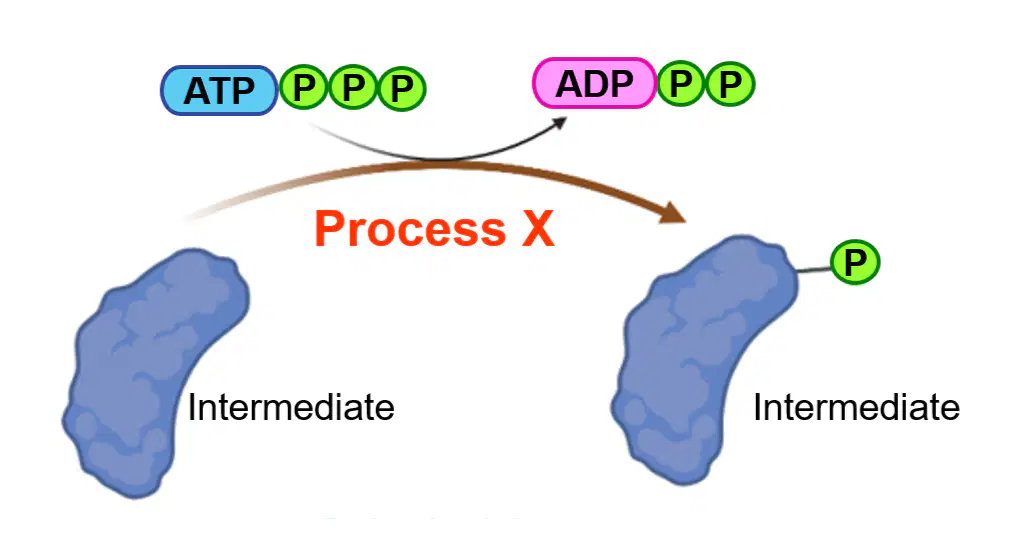
From the diagram, what is process X?

a)

Fermentation

b)

Phosphorylation

c)

Translocation

d)

Polymerase chain reaction

16.

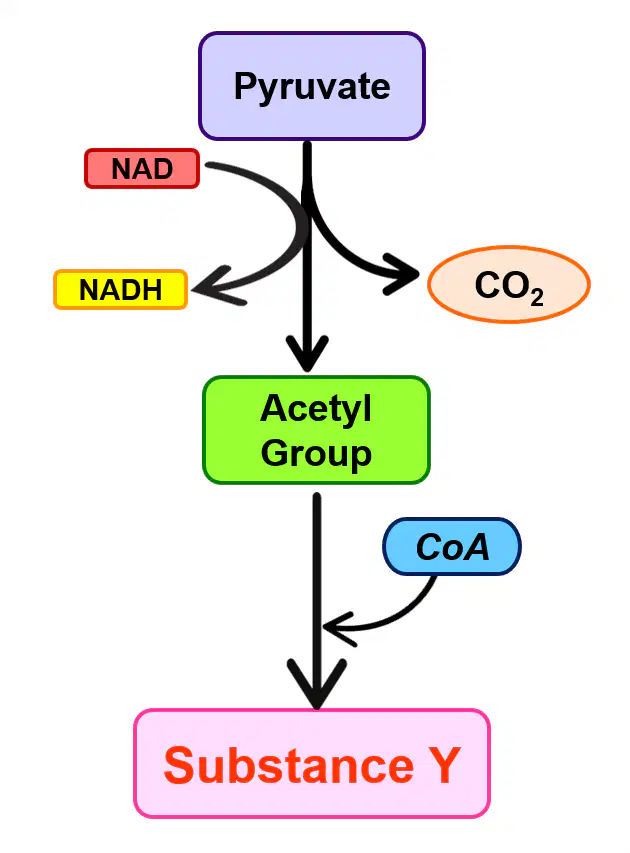
In aerobic conditions, the pyruvate made in glycolysis is broken down into carbon dioxide and ______________ ?

a)

acetyl group

b)
citrate
c)

lactate

d)
oxaloacetate
17.

From the diagram, what is substance Y?

a)

Lactate

b)
Citrate
c)

Acetyl Coenzyme A

d)
Oxaloacetate
18.

From the diagram, what is substance A ?

a)
Pyruvate
b)
Citrate
c)
Dehydrogenase
d)
Oxaloacetate
19.

From the diagram, what is substance B ?

a)
Pyruvate
b)
Citrate
c)
Dehydrogenase
d)
Oxaloacetate
20.
In the citric acid cycle how many carbon dioxide are released?
a)
8
b)
16
c)
2
d)
1
21.

The electron transport chain is formed from a chain of …?

a)
carbohydrates
b)
phospholipids
c)
proteins
22.
In the electron transport chain what is the final hydrogen acceptor?
a)
water
b)
oxygen
c)
ATP
d)

carbon dioxide

23.
During which stage of aerobic respiration is the most ATP produced?
a)
Glycolysis
b)
Citric acid cycle
c)
Electron Transport chain
24.
Which letter represents the transfer of electrons?
a)
W
b)
X
c)
Y
d)
Z
25.
The region containing the highest concentration of hydrogen ions would be...?
a)
W
b)
X
c)
Y
26.
Which letter represents phosphorylation occurring?
a)
W
b)
X
c)
Y
d)
Z
27.
The function of molecule E is to ...?
a)
pump hydrogen ions out of the matrix of the mitochondrion
b)
breakdown ATP
c)
catalyse the synthesis of ATP
d)
pump electrons out of the matrix of the mitochondrion
28.
What is the name of the co-enzyme used to carry hydrogen ions and electrons to the electron transport system?
a)
NAD
b)
Coenzyme A
c)
ATP Synthase
d)
Dehydrogenase enzymes
29.

The hydrogen ions and electrons from _________ are passed to the electron transport chain on the inner mitochondrial membrane.

a)

NAD

b)

CoA

c)

NADH

d)

Pyruvate

30.

In the electron transport chain, energy from electrons is used to pump _______ across the inner membrane of the mitochondria into the intermembrane space of mitochondria.

a)

Hydrogen ions

b)

ATP

c)

NAD

d)

ADP

31.

The flow of hydrogen ions back through the membrane protein ATP synthase

results in the production of...?

a)

ATP

b)

ADP

c)

NAD

d)

Water