
 Worksheets
Middle Ages
Total questions: 130
Worksheet time: 2hrs 43mins
The city of Jerusalem is important to what three major religions?
Buddhism, Hinduism, and Islam
Islam, Christianity, and Hinduism
Islam, Christianity, and Judaism
What was the result of the First Crusade?
The crusaders captured and gained control of Jerusalem.
The crusaders were defeated and returned home.
The crusaders never made it to Jerusalem.
What religious leader from the Catholic Church helped to organize the First Crusade?
Stephen Harding
Pope Urban II
Saint Benedict
How did the Crusades fail?
Crusaders failed to keep control of Jerusalem
Crusaders failed to conquer Egypt
Crusaders never won a battle in the Holy Land
Crusaders destroyed trade relations between East/West
What Muslim leader reconquered Jerusalem after the 2nd Crusade?
William the Conqueror
Saladin
Richard I
Ibn Batuta

What was the original goal of the Crusades?
To make sure that kings no longer ruled over peasants.
To recapture the Holy Land from the Muslims.
To end Feudalism
To open new trade routes to the East.
Which Crusade attacked Constantinople?
1
2
3
4


Where did the Bubonic Plague originate?
Northern Europe
South Africa
Central Asia
Middle East
What was a major effect of the Crusades?
Religious toleration for Jews
Economic control of North Africa
Increased influence of the Patriarch
Increased trade with Arab cultures
Church scholars preserved ancient literature by translating it into —
English
Latin
Greek
Arabic
The Pope promised them a lot of money
Why was Jerusalem so important to Christians?
It was the area where Jesus was crucified.
It was where their first temple was.
It was the side where Muhammad went to heaven.
It was the center of the Catholic Church.
Pope Urban II wanted to recapture the Holy Lands so that...
Christians going on pilgrimages to visit the Holy Land would be safe.
Muslims had the right to visit the Holy Lands.
the Byzantine emperor could be defeated.
Jerusalem could remain in the hands of the Turks.
What group's conquest of Jerusalem caused the start of the Crusades?
Seljuk Turks
Fatimid Arabs
Byzantine Empire
Roman Rebels
A pilgrimage is....
a journey to a sacred place
the government of the Roman Catholic Church
a series of actions tending toward a particular end
True or False: The Crusades continued on and off for over 200 years.
True
False
What was the most important result of the Crusades?
The Crusades resulted in many new religions to emerge.
The Crusades resulted in the Holy Roman Empire's permanent possession of Jerusalem.
The Crusades caused the Holy Roman Empire to isolate themselves from the rest of the world.
The Crusades led to trade and new kinds of knowledge.
What was the primary motivation for the Crusades?
political
economic
social
spiritual
What inspired the Third Crusades?
A disagreement between the Pope and the Monarchy.
Egypt was a center of Muslim power.
Saladin took control of Jerusalem.
Expanding the Empire.
a Muslim leader name Saladin began a major campaign against Jerusalem that started the...
First Crusade.
Second Crusade.
Third Crusade.
Check ALL that are effects of the Crusades.
Weakened Pope and Nobles
Strengthened the monarchs
Strengthened the Byzantine Empire
Bitterness between Christians, Muslims, and Jews
Which of the following focused on the need for education throughout his Empire?
Charlemagne
Clovis
Charles Martel
Pepin the Short

Vocabulary: A grant of land given to a vassal
Fief
Feudal Contract
Chivalry
Vassal
Vocabulary: Social and Political system of the middle ages that revolves around land ownership
Fief
Feudalism
Feudal Contract
Chivalry
Why did the serfs work on the land for the vassals?
to have a place to live
in hopes of owning it
by force of the lords
because they enjoyed farming
Which of these is a way that Catholic monasteries preserved ancient languages and learning?
they taught ancient Chinese beliefs on religion
they wrote stories about early Egyptian legends
they saved and recopied ancient Greek and Roman writings
they preserved artwork from Babylon and Persia


What is a fief?
large piece of land
manor
payment

What is a vassal?
person who receives a piece of land
another name for a king
person who works on a ship
person who works in the church

Agreements between those who owned the land and those who worked on the land were called?
manor obligations
feudal obligations
vassals
fiefs

Large farming communities that included manor houses, cultivated lands, woodlands, pastures, fields, and pastures were called?
Manors
feudalism
vassals
fiefs
Which leader tried to reinterpret Roman culture by building new roads, libraries, and schools?
Charlemagne
Charles Martel
Clovis
Justinian

What religion did the Frankish kingdom practice?
Christianity
Islam
Hinduism
Shintoism

Why did peasants enter into feudal agreements with Vassals?
to make money
for protection
for better trade
What offered protection from invaders during the Middle Ages?
fallow field
castles
mill
tunnels


Who maintained me and order in medieval society?
Lord
Serf
King
Pope
The code of behavior for a knight was known as_____.
Monasticism
Chivalry
Feudalism
Manorialism
Which of the following fought in the Crusades?
Muslims
Christians
The Pope
Children
Which of the following could not leave the land unless given permission?
Lord
Vassal
Peasant
Serf
A ______ is granted a fief in exchange for military service and loyalty.
Lord
Vassal
Serf
Knight
Which of the following is true of the Crusades?
Fought between Muslims and Christians
There were four
Series of conflicts over the Holy Land
Battles between Christendom and the Persians
Which of the following was an effect of the Bubonic Plague?
Population decline
Population increase
Prices went up
Towns and cities emerged
Feudalism developed because of the _________.
Need for protection and no central government.
Need for trade routes and networks.
need for a military to protect from the Muslims.
need for more land to be distributed.
What did crowning Charlemagne do to the power of the Pope?
Decreased his political authority
Increased his political authority
Gave him religious authority
Took the power of the church away from the Pope
This style of Architecture was widely used AFTER the Middle Ages
Gothic
Renaissance
Neoclassical
Romanesque
What was the Great Schism?
Split between East and West Rome
Split between the Church
Split between Islamic Empire and Christianity
Split between England and Italy

Some characteristics of Romanesques architecture are?
Small windows and pointed arch windows
Stained Glass windows and flying Buttresses
Gargoyles and small windows
Small windows and thick walls

Some of earliest churches built in the last parts of the Roman Empire are called?
Gothic Churches
Romanesque Churches
Lithuanian Architecture
Etruscan Architecture

The building of Gothic Cathedrals sometimes required what architectural system be used so that walls could be supported?
Post and Lintel system
Flying Butresses
Round arch
Stained glass windows

What are characteristics of Romanesque Churches
Thick walls, Pointed arches, Rose window, Highly Decorated Outside
Gargoyles, Small windows, Thick walls
Thick Walls, Small windows, Short walls, Plain outside Decoration
High Walls, Pointed Arched Windows, Stained Glass
This type of architecture has tall "spires" that reach toward Heaven to honour God.
Gothic
Romanesque
Medieval
Secular


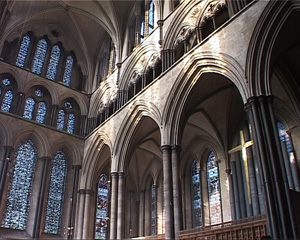

Early Christians believed that Gargoyles on Gothic Churches represented what?
Evil leaving the church
animals of the underworld
Ancient animals
the Good leaving the church

What is the name of this church which is one of the most famous Roman Catholic Gothic Cathedrals in France?
Rouen Cathedral
Saint Michel
Chartres Cathedral
Notre Dame Cathedral
The building of Gothic Cathedrals sometimes required what architectural system be used so that walls could be supported?
Post and Lintel system
Flying Butresses
Round arch
Stained glass windows

The main differences in Gothic and Romanesque churches are what?
Windows and Flying Buttresses
Gargoyles, Pointed arches
Rose window. stained glass
All three answers
What are characteristics of Romanesque Churches
Thick walls, Pointed arches, Rose window, Highly Decorated Outside
Gargoyles, Small windows, Thick walls
Thick Walls, Small windows, Short walls, Plain outside Decoration
High Walls, Pointed Arched Windows, Stained Glass
During the Middle Ages, many towns purchased royal charters to gain independence. A charter granted them the right to
replace, terminate, and hire feudal lords.
elect nobles, church officials, and bishops.
buy land, sell land, and rule over feudal lords.
make laws, raise taxes, and govern themselves.
During the Middle Ages, at about what age did people usually start preparing for their adult roles?
three
seven
fifteen
twenty
In England, the decisions of royal judges helped lead to a system of
combat trials.
noble courts.
criminal jails.
common law.
What led to the surplus of food and trading in Medieval Europe? (More than 1 correct)
More variety of seeds
Improvements in agriculture technology
Better weather
Better farming practices
Series of wars between France and England for control of land, access to the English Channel and control of trade.
War of the Roses
Crusades
Hundred Years' War
Thousand Years' War
Invaders from China to Eastern Europe who ruled Russia and were eventually overthrown by Ivan the Great.
English
Spanish
French
Mongols
King of England who developed common law and a trial by jury.
Henry II
King John
William the Conqueror
King Edward
This man led the Norman conquest and united most of England following King Edward.
Henry II
Charlemagne
William the Conqueror
King John
Peasant girl who believed she was led by God to rescue France from England during the Hundred Years' War.
Catherine
Isabella
Joan of Arc
Victoria
Muslim leader who gained control of Jerusalem in 1187 C.E., during the Second Crusade.
Saladin
Ali
Charles V
Muhammad
Who was forced to sign the Magna Carta?
Hugh Capet
William the Conqueror
King John
Henry II
Group of Muslim's that gained control of the Holy Land during the late 1000's.
Moors
Seljuq Turks
Byzantines
Mongols
Which institution in Western Europe had the most power during the Middle Ages?
Merchant guilds
The feudal system
Roman universities
The Church
Which notable battle do historians credit with ending the Muslim expansion into Western Europe?
Battle of Demon's Run
Battle of New York
Battle of Fallujah
Battle of Tours
The term "excommunication" refers to:
Talking to former boy/girlfriends
Being barred from the church
Getting kicked out of your parents' house
Not being allowed to leave the manor
Where were the Vikings from?
Byzantium
Scandinavia
Gaul
Minnesota
Joan of Arc is most remembered as -
a Renaissance inventor who created arcs
the Queen of France who defeated the English
a Christian saint who died during the Viking invasions
a peasant girl who led the French armies in the Hundred Years' War
William the Conqueror (aka William of Normandy) established himself as the King of England after winning which decisive battle?
Battle of Tours
Battle of New York
Battle of Hastings
Battle of Demon's Run
Which of the following statements accurately describes feudalism?
Under feudalism, kings gave land to nobles/lords in exchange for their military service.
Feudalism served to spread Christianity throughout Western Europe.
Feudalism began as a way to protect those on pilgrimages to Jerusalem.
The rise of feudalism marked the end of the Medieval Age.
Social structure of the Middle Ages
Caste System
Feudalism
Manorism
Monarchy
Why did historians call 500 - 1000 C.E. the Dark Ages?
It was a dark and trying times
They were unsure how old many people in the area were
There was not a lot of information about this time period
It was too long ago to understand
Explain how the Vikings lived.
although pirated Europe, they were traders, craftspeople, and merchants
mostly pirated other kingdoms
were mostly craftspeople
lived in fear of the Saxons
The representative government in the Middle Ages was called?
Checks and Balances
The Magna Carta
Parliament
The Royal Courts
Why was Joan of Arc important?
Joan of Arc had little influence on King Charles; he did as he pleased
Joan of Arc influenced the King of France to not unite his kingdom
Joan of Arc inspired the people of France and the king to keep fighting to unite France
Joan of Arc was the Maid of Lorraine and didn't influence Charles
This Muslim leader allowed Christians safe passage after he took Jerusalem, he also sparked the Third Crusade.
King Harold
Saladin
Aladdin
Mohammad
Why did the Crusader kingdoms depend on Italian Ports?
It was a great way to avoid the Visigoths since they normally controlled those lands.
The had better prices on goods.
They were invaded by the Seljuk Turks meaning easier for them to pillage.
They could receive supplies by boat avoiding the Muslim control lands.

Why did so many people volunteer to fight the Crusades?
they were paid generously
the Church granted forgiveness for anyone who goes on the Crusades
Because they wanted to
because they loved Jerusalem

EXCOMMUNICATION happens when:
The pope stops giving your kingdom money unless you fight holy wars for him.
The pope "kicks you out" of the church, taking away your chance to go to heaven.
The pope sends priests and monks to assist a kingdom in feeding and aiding the poor.
The pope makes the call across all of the churches for a Crusade, or holy war.

What were two indirect results of the Crusades?
trade and commerce increased and the feudal system was strengthened
trade and commerce declined and the feudal system was strengthened
trade and commerce increased and the feudal system was weakened
trade and commerce declined and the feudal system was weakened

Economic activities during feudalism were based on....
Agriculture
Factory jobs
Business banking
Fashion Design

Clovis


Which of the following is NOT a characteristic of a Gothic Cathedral?

