
 Worksheets
General Physics 2 3rd Quarter Quiz 1
Total questions: 20
Worksheet time: 15mins
If an object is outside the focal point on a concave mirror, the image will be
virtual and inverted
virtual and upright.
real and inverted
None of the above
Images formed by concave lenses are
real and inverted
virtual
enlarged
None of the above
You see the reflection of the clock without numbers in your plane mirror. The image formed by the hands of the clock shows the time of 3:30. What is the real time?
3:30
8:30
9:30
10:30
A light ray, travelling parallel to a concave mirror's axis, strikes the mirror's surface. The reflected ray
passes through the mirror's focal point
again travels parallel to the mirror's axis
travels at right angles to the mirror's axis
passes through the mirror's center of curvature axis
An object is placed between a concave mirror and its focal point. What is the type and orientation of the image formed?
virtual and inverted
real and inverted
virtual and erect
real and erect
What kind of mirror is used in automobiles and trucks to give the driver a wider area and smaller image of traffic behind him?
plane mirrro
convex mirror
concave mirror
none of the above
What type of mirror do dentists usually use to see clearly the images of our teeth?
plane mirror
convex mirror
concave mirror
none of the above
When a small object is placed on the principal axis of a concave mirror between the focus and the mirror, the image formed is _____________.
erect, magnified, and virtual
inverted, magnified, and real
inverted, reduced, and real
erect, reduced, and real
A white sheet of paper cannot act as mirror because it ______ the rays of light.
diffracts
diffuses
interferes
refract
You see your face clearly if you look down on a pool of still water. Which one of the following statements give the best explanation for this observation?
Light entering the water is dispersed.
Regular reflection of light happens on the surface of still water.
Irregular reflection of light happens on the surface of still water.
Light is reflected from the surface of water in different directions.
Which of the following is true of a concave mirror?
It will never form a real image.
An inverted image will be formed if the object distance is greater than the focal length.
An object can be magnified if placed at F.
None of the above
A light ray, travelling parallel to a concave lens' axis and strikes the lens, will refract and __________.
pass through the lens' focal point
travel parallel to the principal axis
continue to travel in the same direction
travel at right angles to the principal axis
Sun's rays are observed to focus at a point behind a lens. What kind of lens was used?
converging lens
diverging lens
focusing lens
none of the above
a flat sheet of glass that has a smooth, silver-colored coating on one side
plane mirror
concave mirror
convex mirror
solid mirror
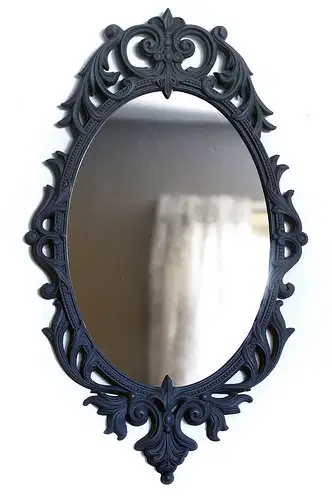
An image that you can see when you look into a mirror, but does not really exist is called which of the following?
Real Image
Fake image
Virtual image
Digital image
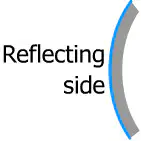
The following is a picture of what type of mirror?
Convex (diverging) mirror
Concave (converging) mirror
Plane Mirror
Flat Mirror
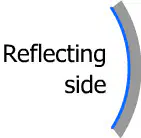
The following is a picture of what type of mirror?
Convex (diverging) mirror
Concave (converging) mirror
Plane Mirror
Flat Mirror
Which of these is not true about a real image?
It is enlarged
It can be projected onto a screen
It is inverted
It appears behind the mirror
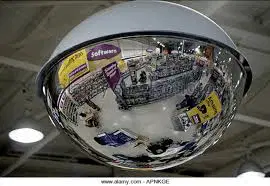
Which type of mirror is shown.
Concave
Convex
Specular
Plane
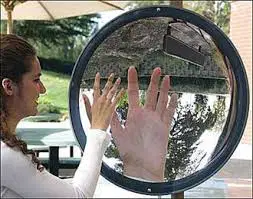
Which type of mirror magnifies a close up image, like a make-up mirror.
Concave
Convex
Specular
Plane

