
Font size
 Worksheets
OC - USH - Game Show Friday (WW2-1950s) Test Bank
Total questions: 100
Worksheet time: 1hrs 8mins
Four countries (United States, Soviet Union, Britain, and France) occupied Germany after World War 2
True
False
The U.S. and the Soviet Union began to have issues with each other after WW2 because the American troops were putting Capitalist and Democratic governments in Eastern Europe, violating Stalin's "buffer zone".
True
False
Stalin and the Soviets TOP PRIORITY as the liberate Eastern European nations from Nazi occupation is to create friendly countries that Stalin can control in order to create a "buffer zone" for postwar Soviets.
True
False
The accomplishments of the "American Homefront" (mostly women and non-Veteran men) during World War 2 created a massive amount of production that helped the United States to become the wealthiest nation in the world immediately following WW2.
True
False
Because the United States was the location of some of the bloodiest and property-destroying battles during WW2, their citizens needed help rebuilding the nation following WW2.
True
False
By the end of WW2 and then certainly in right after the war, China was emerging as the primary rival to the United States.
True
False
The G.I. Bill of World War 2 followed a strong tradition of the American Government generously providing for war veterans throughout its history. Examples would be the Revolutionary War and WW1.
True
False
One example of a benefit of the G.I. Bill was offering Veterans low-interest loans so they could buy their own property.
True
False
The Baby Boomer Generation in the United States is the generation responsible for fighting and winning World War 2
True
False
The Baby Boomers, born just after WW2, would go on to challenge authority and social norms in America during the 1960s.
True
False
Taft-Hartley expanded the rights of labor unions, building on the pro-union policies of FDR in the 1930s
True
False
President Wilson's "14th Point" was made into a reality after World War 1 when the League of Nations was created as a worldwide organization dedicated to solving world problems.
True
False
The United Nations, similar to the League of Nations (after WW1) was created after WW2 to serve as a worldwide representive body dedicated to resolving worldwide issues.
True
False
The United Nations created both a General Assembly (made up of all countries of the world) and a "Security Council" made up of a few privileged nations that have the most power in the U.N.
True
False
Stalin and the Soviets wanted a "buffer zone" in Eastern Europe so they would be surrounded by nations who would trade with them and make them wealthy.
True
False
BOTH the United States and the Soviet Union were given a spot in the United Nations' Security Council following World War 2.
True
False
As Allies in World War 2, the United States fought mostly in Eastern Europe and the Soviet Union fought mostly in Western Europe
True
False
The G.I. Bill provided affordable college education and/or skills training for veterans of World War 2
True
False
Truman and the Americans expected the Soviets to allow self-determination in the Eastern European countries they liberated after the war. This means those countries could choose their own government and leaders (democracy).
True
False
Most of the Eastern European nations, including East Germany, set up Communist and/or Soviet-friendly governments after WW2, giving Stalin his desired "buffer zone".
True
False
Japanese Americans were interned as a result of what major event?
Germany invading Poland
Pearl Harbor
The Appeasement Policy
the death of Franklin Roosevelt

Where were most of the Internment Camps
South
North
East Coast
West Coast

Symbol of the campaign to hire women during WWII.
Double V
Rosie the Riveter
Women's Army Auxiliary Corps
Victory Suit
what was the root cause for Japanese internment camps?
D-Day
Pearl Harbor
Battle of the Bulge
V.E. Day
What roles did rationing play in WWII?
there weren't enough men around to produce needed goods
allowed more goods to be used for the military effort
prevented shortages of goods needed within the US
to help end the Great Depression
The committee set up by FDR to investigate charges of discrimination in the work place was called
Federal Deposit Insurance Corporation
Fair Employment Practice Committee
Works Progress Administration
Nuremberg Trials


In Roosevelt's speech after ____ ,he called it , " A day that will live in infamy."
Normandy ,France
Invasion of North Africa
Pearl Harbor , Hawaii
Bombing of Japan
What US policy allowed the sale, loan, or lease of war materials to any country whose defense was necessary for US security?
Lend Lease
Neutrality Act
Cash and Carry
Borrow and Pay

What was the major reason for U.S. neutrality in the 1930's?
The U.S. didn't care.
The U.S. had committed itself to a policy of total nonviolence.
The economic and emotional effects of WWI made Americans reluctant to get involved in another war
The U.S. was confident that Britain and France could handle the situation.
What was the purpose of the Lend-Lease Act that was passed in March of 1941?
It was part of the New Deal.
It was to help American farmers get new farming equipment.
It solidified the U.S.'s commitment to neutrality in the war.
It allowed the United States to sell, lend, or give ships, planes, tanks, or other equipment to the Allies.

Why did Americans grow Victory Gardens during World War II?
To exchange for extra ration coupons at grocery stores
To sell the food for profit to the government
To make sure they had enough food as the nation rationed
If they grew a certain amount of food they could skip military service
Which most accurately characterizes the policy followed by the United States between World War I and World War II?
military alliances between Britain and France
isolation from European conflicts
active membership in the League of Nations
containment of Communism

What was the purpose of this poster from World War II?
changes in the traditional role of women
the establishment of women's suffrage
combat training for women
the election of women political leaders

What total war policy is advertised in this propaganda poster?
The draft
Women in the workforce
Conservation & rationing
Blitzkrieg
The action of a country or its government preparing and organizing troops for active service
Mobilization
Reparations
U-Boat
Neutral
Process of assembling troops & supplies to become ready for war.
Collaboration
Blitzkrieg
Mobilization
Annexation

Which describes Executive Order 9066?
To create a draft lottery system for military service
It officially brought the U.S. into World War II
It forced Japanese-Americans into internment camps against their will
It forced the repatriation of Mexican Americans to reduce job competition

1944- declared that the government had the right to keep Japanese Americans in internment camps due to the idea of “national security threat”
What U.S. action against Japan led to the attack on Pearl Harbor?
The U.S. attacked Japan's capital.
The U.S. had Japan removed from the League of Nations.
The U.S. placed all Japanese Americans in prison.
The U.S. placed an oil embargo on Japan.
Axis Powers
Alliance of Germany, Italy, and Japan during the WW2
Alliance of France Italy, and Latin American during 1987
Alliance of Russia, Germany, and Prussia
Alliance of Germany, Austria Hungary, and Italy

What were war bonds used for?
certificates sold by the US government to pay for the war
pictures of soldiers preparing for war
documents that displayed guns
funds used by the government to provide financial assistance to the poor
What is an Executive Order (in the American Government)? (NOTE: multiple choices are correct.)
An act by the President alone (Congress does NOT have a role)
An order by the President that has the same effect of a law;
Gives the President the power to do something WITHOUT the checks and balances of Congress.
While Congress can vote to BLOCK and executive order, it is rare because the President can VETO the block.
What ethnic group was rounded up and put in camps on the American west coast by Executive Order 9066?
German-Americans
Itallian-Americans
Russian-Americans
Japanese-Americans
Why was Executive Order considered Unconstitutional?
You are not allowed to discriminate in a law based on one's race/ethnicity.
It took away the right to bear arms
It closed down newspapers that published stories against FDR.
It prevented Americans from protesting during the war.
What was FDR's position on the matter?
The safety of Americans comes before rights and he was afraid the Japanese would invade the west coast.
He felt as though Japanese-Americans were not fully human
He had evidence that most Japanese-American families secretly supported a Japanese victory.
He said he did not have to say "why" he did this because HE was President.
What is total war?
A new PS5 game.
Only military personnel were involved in the war effort.
Every person is involved in the war effort.
How much the war cost.
What was the name of the symbol for women civilians entering the workforce to support the war effort?
Roberta the Robot
Rosie the Riveter
Jane Doe
Rebecca of Sunnybrook Farm
War bonds included which of the following? (Note: multiple correct answers)
War Bonds were a gift from the citizen to government. Meaning the citizen never received anything back.
War Bonds were an investment. The citizen would receive the money back PLUS interest at a later date.
The U.S. government raised over $100 BILLION dollars from War Bonds during WW2.
There was a massive advertising campaign during WW2 go encourage Americans to "do their part" by purchasing War Bonds.
What is it called when the government tries to control public opinion?
Politics
Propaganda
Civil rights
Control
What was the purpose of Executive Order 8802?
Forced African American workers to work for less money.
It required businesses that were funded with government money to discriminate based on race when hiring workers.
It required businesses that were funded with government money to Not discriminate based on race when hiring workers.
In what ways are the riots during World War II similar to the riots that occurred in 1919? (multiple answers are correct)
They both occurred after Americans migrated to cities.
They both occurred as Americans competed for jobs.
They both happened in rural areas.
In the previous clip, we learned that a conscientious objector (someone who refuses to FIGHT in war) can still serve the country in the war without fighting.
True
False
What was the GI Bill?
Helped Veterans afford houses
Helped people named Bill buy a house
Discrimination bill against African Americans
The population growth in the US occurred mostly
In the south
In the cities
In the suburbs
In the west

Which President ordered the federal army to go to Little Rock?
Truman
Kennedy
Johnson
Eisenhower
President of the US during most of the 1950s (1952-1960)
Richard Nixon
Franklin Roosevelt
Harry Truman
Dwight Eisenhower

The birth of the largest generation of Americans born between 1946 & 1955 was called the
Hippie Generation
Gen X
Millenials
Baby Boom
In 1957, the USSR successfully launched this satellite into space:
Hubble Telescope
Gemini 2
Apollo 11
Sputnik
What were Jim Crow laws?
Laws that legalised slavery
Laws that legalised segregation
Laws that prohibited African Americans from leaving the country
Laws that denied African Americans an education
What did Rosa Park's action of refusing to give up her seat to a white passenger lead to in 1955?
Montgomery bus boycott
the civil rights movement
1963 March on Washington
Desegregation of the transport system
What methods of protest did Martin Luther King advocate for?
Violent, direct action
Rallies and marches
Non-violent, civil disobedience
Who became president of Egypt in 1956?
Tut
Nasser
Gaddafi
Assad
Nasser __________ the ______ _______.
nationalized - Suez Canal
conquered - British Empire
joined - Soviet Union
helped - United States
(a) is law that limited labor unions’ rights
What do we call the policy of "controlling the spread of communism" throughout the world?
domino theory
Red Scare
containment
appeasement
Which candidate was expected to DOMINATE the 1948 Election?
Truman
Dewey
Wallace
Thurmond
Harry Truman's "Truman Doctrine" did which of the following?
Provided funding to war-torn nations to rebuild after WWII
Provided military support to Turkey and Greece
Sought to prevent the spread of Communism
Helped escalate tensions in Europe after WWII
Who was the winner of the 1952 Election?
Harry S Truman
Dwight Eisenhower
John F Kennedy
Adlai Stevenson
Who ran on the DEMOCRATIC TICKET in the 1952 Election?
Harry S Truman
Dwight Eisenhower
John F Kennedy
Adlai Stevenson
True/False: Dwight Eisenhower was close to being the DEMOCRATIC NOMINEE during the 1948 Election.
True
False
Using the data from before, how does this support the Korean War being a PROXY WAR?
Because it was a civil war, the two are synonymous.
Any war following a World War = Proxy War
Any nation using another as a "battlefield" against another country who does the same thing is a proxy.
Any time third-world nations fight 1st World Powers, we have a Proxy War
This conflict BEGAN in the 1950s. It became one of the United States' most CONSEQUENTIAL wars in the 1960s and 1970s. It is considered a Cold War-era "PROXY WAR". The leader of the opposition to the United States was named Ho Chi Minh. The conflict began when France (an American ally) started to lose its colonial dominance over the country. Which war was this?
Hungarian Revolt
Korean War
Japanese Uprising
Vietnam War
This war occurred in the EARLY 1950s. It included soldiers from the United States, China, and "United Nations" forces. It did NOT include ground troops from the Soviet Union (Russia). The lead American military figure in the conflict was General Douglas MacArthur. Ultimately, President Truman would fire MacArthur. This was a Cold War-era "PROXY WAR". The result was a nation split in two (one side Communist, one side Democratic). Which war was this?
Chinese Civil War
Korean War
Vietnam War
War of the Philippines
In 1956 Hungarians stood up in opposition to its Communist government and presence of Soviet troops. What was the RESULT of the uprising?
Hungarians secured more individual freedoms and the Communists were ultimately voted out of office.
The United States provided air support and bombed the "Red" Army. Hungary would become partially "free"
The Soviet "Red" Army swiftly and effectively crushed the uprising. Communism would survive in Hungary
Hungarian Democratic "Rebels" escaped to an island off of its coast and created the "Democratic Nation of Hungary"
Which of the following became successful and a fundamental part of the American economy as a result of "consumerism" in the 1950s?
Speakeasies (private underground clubs)
Diners and Luncheonettes
Fast-Food Restaurants
Radio Stations
The largest of the Great Lakes
Lake Erie
Lake Michigan
Lake Superior
Lake Ontario
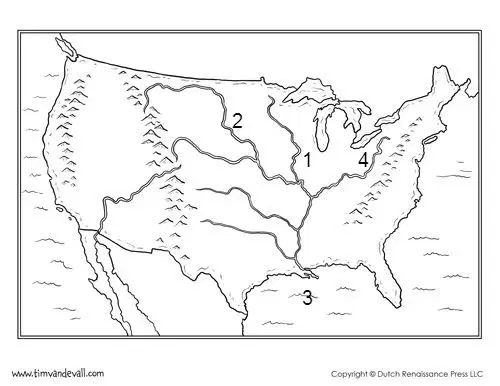
Which number on the map represents the Gulf of Mexico?
1
2
3
4

