
NEW
Font size
 Worksheets
Oceans & Atmosphere
Total questions: 14
Worksheet time: 7mins
Solar radiation provides more heat near the equator than near the poles on Earth. The greatest amount of heat is moved away from the equator by…
ocean currents
aquatic plants
surface winds
tectonic plates
Because water can hold a large amount of heat, which effect do oceans have on nearby land areas?
They prevent rapid extreme temperature changes.
They form high-pressure areas that cause magma currents.
They provide the energy that triggers volcanic events.
They lower the freezing point of fresh water
Deep ocean currents continually circulate from the warm waters near the equator to the colder waters in other parts of the world. What is the main cause of deep currents?
Differences in the topography along the ocean floor
Differences in density of ocean water
The rotation of Earth on its axis
Movement of the jet stream
Sand changes temperature faster than water. Why is this?
water has a higher density
water freezes as it expands
water has a higher specific heat
water has a lower specific heat
Which statement BEST explains the link between ocean currents and heat from solar radiation?
The movement of water creates heat.
Ocean currents circulate heat away from the equator.
Earth’s internal heat is pushed outward through volcanic activity.
Land warms as ocean water makes direct contact with land.
What is the primary source of stored thermal energy in oceans?
sunlight
plankton
volcanoes
hurricanes
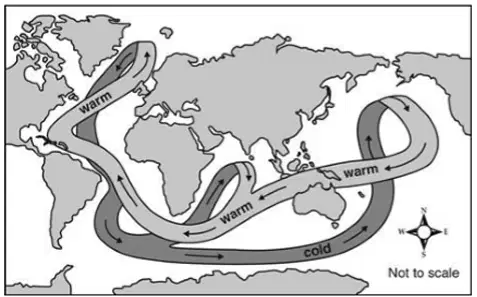
The Great Ocean Conveyor Belt shows the flow pattern of deep-sea density currents. Which statement BEST describes an effect caused by these currents?
They prevent tsunamis from occurring.
They control low and high tides.
They influence climate by distributing energy from the Sun.
They cause hurricanes to move in a counterclockwise direction.
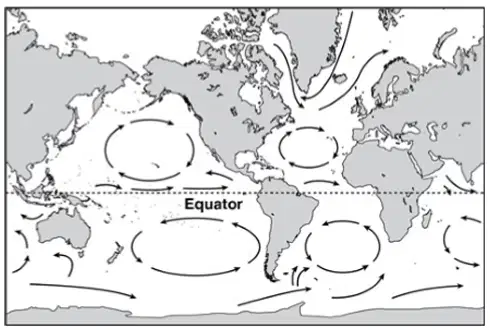
The diagram shows an image of the major ocean currents. What phenomenon is MOST likely responsible for the currents’ circulation patterns?
Coriolis Effect
Density Difference
The Sun's Tidal Effect
Temperature difference
Which statement about the relationship between the ocean and air in the atmosphere is true?
Ocean currents flow into the atmospheric air.
The air in the atmosphere stores more heat than the ocean.
The ocean can hold heat more efficiently than the air.
Ocean currents can move faster than air or wind currents.
El Nino might lead to...
less hurricanes in the Atlantic
warmer water in the Pacific
none of the above
both A and B
The presence of what greenhouse gas is most responsible for global warming?
water vapor
carbon dioxide
methane
carbon monoxide
Which gas accounts for the largest percentage of greenhouse gases in the atmosphere?
carbon monoxide
carbon dioxide
nitrous oxide
water vapor
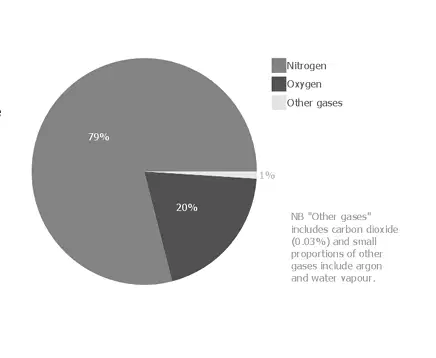
Using the figure to the right, what is the percentage of oxygen in the atmosphere?
79%
1%
20%
Not represented in the graph
What property of water is demonstrated by a bug standing on the surface of water?
capilarry action
high specific heat
surface tension
water freezes as it expands

