
 Worksheets
Financial Institutions Quiz
Total questions: 1
Worksheet time: 22mins
What is one of the essential functions of financial institutions?
Providing internet services
Managing the money supply
Offering travel accommodations
Conducting scientific research
Financial institutions offer a range of services to consumers. Which of the following is a service provided by them?
Storing Money
Providing legal advice
Offering medical assistance
Conducting educational courses
What does the Federal Deposit Insurance Corporation (FDIC) insure?
Customer deposits up to $100,000 if a bank fails
Customer deposits up to $250,000 if a bank fails
All customer investments without any limit
The safety of bank vaults and their contents
Which of the following is NOT one of the four most common ways to save money as mentioned in the material?
Savings accounts
Checking accounts
Money market accounts
Stock investments
What is a characteristic of savings and checking accounts?
They offer high rates of interest
They are the least common types of bank accounts
They offer very low rates of interest
They do not allow you to write checks
Money market accounts typically require which of the following?
No minimum balance
A low minimum balance
A fairly high minimum balance
No ability to write checks
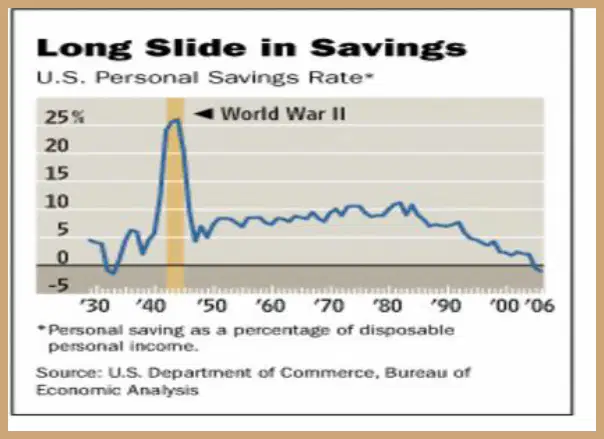
According to the graph titled "Long Slide in Savings," how did the U.S. Personal Savings Rate change after World War II?
It increased steadily
It remained constant
It showed a long-term decline
It fluctuated without a clear trend
What is a Certificate of Deposit (CD)?
A document that offers a variable interest rate and allows for immediate withdrawal of funds.
A financial instrument that offers a guaranteed rate of interest and funds can be removed at any time.
A document that offers a guaranteed rate of interest, but funds cannot be removed until the end of a certain period of time.
A type of checking account with a high rate of interest.

According to the table, which CD term had the highest interest rate this week?
3 Month CD
12 Month CD
36 Month CD
60 Month CD

Which CD term experienced a decrease in the interest rate from last week to this week?
3 Month CD
18 Month CD
24 Month CD
All of the above
Which type of account is suitable for someone who needs to handle direct deposits and set up auto payments for bills?
Certificate of deposit (CD)
Savings account
Money market account
Checking account
What type of account might be best for Jessica, who is working full time and wants an account that allows a few checking transactions each month but also earns?
Certificate of deposit (CD)
Savings account
Money market account
Checking account
Which account type is most appropriate for Tim, who is too quick to spend his cash?
Certificate of deposit (CD)
Savings account
Money market account
Checking account
Anna wants to hit her target of $1,000 saved in an account. Which type of account should she consider?
Certificate of deposit (CD)
Savings account
Money market account
Checking account
What is fractional reserve banking?
A banking system that lends all of its funds without keeping any reserves
A banking system that keeps only a fraction of its funds on hand and lends out the remainder
A banking system that keeps all funds on hand and does not lend any money
A banking system that only lends money for home improvements
For what purposes is money loaned in fractional reserve banking?
Only for business development
Only for college tuition
For home improvements, college tuition, and business development
Only for purchasing vehicles
Why do bankers need to consider the security of the loans they make?
To ensure they earn a high interest rate
To avoid the borrower defaulting on their loan
To comply with international banking regulations
To increase the bank's reserve funds
What is a mortgage?
A type of insurance policy
A specific type of loan used to purchase real estate
A savings account offered by banks
A credit card service
How long do mortgages usually last?
5, 10, or 15 years
15, 25, or 30 years
10, 20, or 25 years
20, 30, or 40 years
What happens if you fail to pay your credit card monthly bill in full?
The bank will extend the payment period
The bank will decrease the credit limit
The bank will charge a high rate of interest on the outstanding amount
The bank will cancel the credit card
What do you need to enter if you select "debit" when making a transaction?
A signature
A Personal Identification Number (PIN)
A credit card number
No additional information
When are funds immediately deducted from your account?
When you select "credit"
When the merchant settles the purchase with their card processor
When you use your card with a PIN for an "online" transaction
When you sign for a transaction
What type of transaction is considered "offline"?
A debit transaction with a PIN
A credit transaction that requires a signature
Any transaction with immediate fund deduction
A transaction that does not require a PIN or signature
Why might someone choose to select "credit" for a transaction?
Funds are deducted immediately
It requires a PIN
It offers more protection from VISA® than a PIN based transaction
The transaction is processed faster
Which of the following types of financial institutions operate in the U.S.?
Commercial banks
Grocery stores
Technology companies
Automobile manufacturers
What happened to the differences between various financial institutions during the 1990s in the U.S.?
They became more pronounced
They began to fade
They remained unchanged
They were not affected by the economic changes
What services do commercial banks traditionally offer?
Insurance services only
Services to individuals only
Services to businesses
Online services only
How are some commercial banks chartered and regulated?
By federal authorities only
By state authorities and the FDIC
By international banking regulations
They are not regulated
What portion of commercial banks are national banks and part of the Federal Reserve System?
1/4
1/2
1/3
All of them
Which type of bank plays the largest role in the economy?
Investment banks
Central banks
Commercial banks
Savings and loan associations
What are credit unions usually established by and for?
Government regulatory bodies
Private investment firms
Particular groups, such as employees of a specific firm or government agency
International financial institutions
What do credit unions commonly specialize in?
Large corporate investments
Consumer loans with favorable interest rates
International trade finance
Stock market trading
Can credit unions be open to the entire community?
Yes, they can be open to the entire community
No, they are exclusively for private sector employees
No, they are only for members of the military
No, they are solely for government officials
What is the typical size of credit unions?
Very large with international branches
Fairly small
Medium-sized with a focus on commercial lending
They vary greatly in size with no common trend
What do finance companies typically offer to consumers?
Short-term loans with lower interest rates than banks
Installment loans to spread the cost of major purchases over a number of months at a typically higher rate than banks
Investment opportunities in stocks and bonds
Savings accounts with high interest rates
What is the date of the "Web Bill Payment - MASTERCARD" transaction on John Jones' chequing account statement?
2003-10-14
2003-10-21
2003-10-10
2003-10-28
How much was the "ATM Withdrawal - FIRST BANK" on the account statement?
$100.00
$200.00
$29.08
$21.25
What was the balance in John Jones' account after the "Mortgage Payment" transaction?
$648.02
$-62.47
$748.02
$781.57
Which transaction had a reference number of 1975?
Interac Purchase - ELECTRONICS
Web Bill Payment - AMEX
Interac Purchase - SUPERMARKET
Telephone Bill Payment - VISA

