
 Worksheets
2025 Corcoran- Astronomy Chapter 1 Quiz
Total questions: 29
Worksheet time: 15mins
Which of the following is the word that describes the study of the moon, stars, and other objects in space?
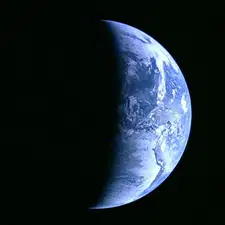
The picture above shows part of the Earth in daylight and the other in the darkness of night. What type of movement is responsible for these changes on Earth?
Which of the following describes the path an object takes as it revolves around something else in space?

Which of the following choices best describes the motion shown above with the Earth traveling around the Sun?
Which of the following words best describes the two days each year that the Earth is neither tilted towards or away from the sun, which results in equal hours of day and night?
This is an imaginary line that passes through the Earth's center and poles that represents the angle at which the planet is rotating.
The Earth is tilted ______ degrees on its axis.
It takes 365 and 1/4 days for the Earth to travel around the Sun. Since a year is only 365 days, what do we do with the extra 1/4 of a day each year?
Which of the following is the first day of Spring?
Which of the following dates is the approximate date for the winter solstice in the Northern Hemisphere?
How long does it take for the Earth to rotate once on its axis?
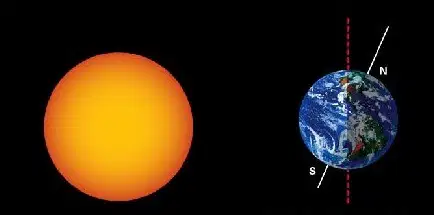
In the picture above, what season is being experienced in the Southern Hemisphere?
If the Earth's axis was 0 degrees and it wasn't tilted at all, what would be the effect?
From the new moon phase to the full moon phase you see
During what moon phase can a lunar eclipse occur?
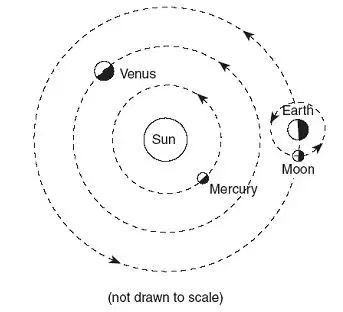
The diagram below shows a portion of the solar system as seen from space. For which object is the lighted surface shown incorrectly?
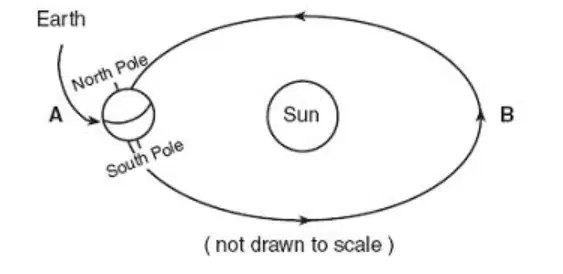
The diagram below shows Earth, as viewed from space, as it moves around the Sun. Approximately how long does it take Earth to move from position A to position B?
The moon can be seen from Earth because ________ reflects off the moon.
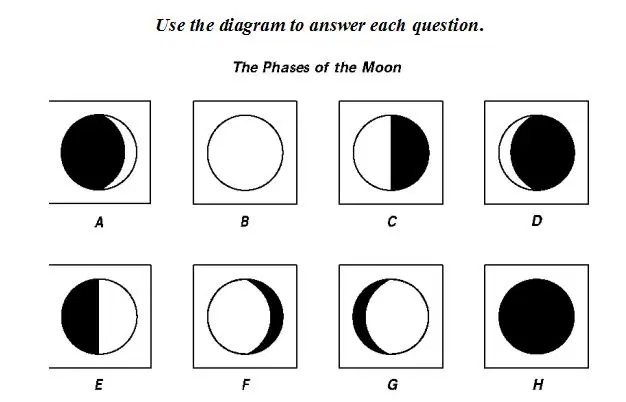
What moon phase does letter "B"represent?
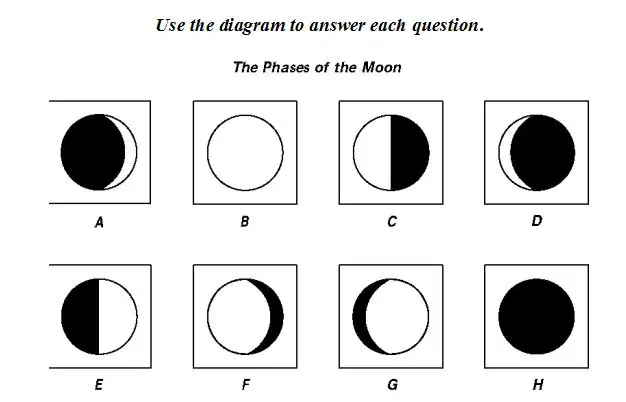
What moon phase does letter "H"represent?
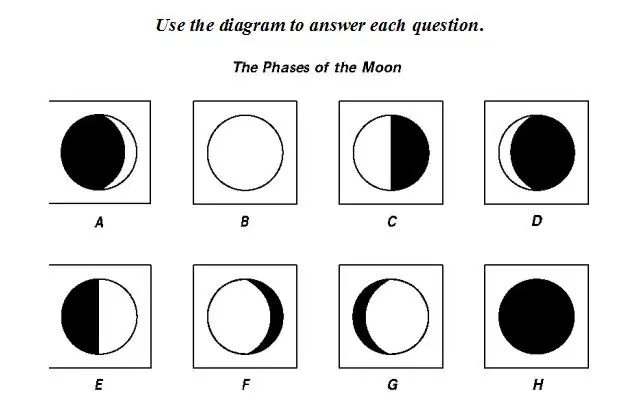
What moon phase does letter "A"represent?
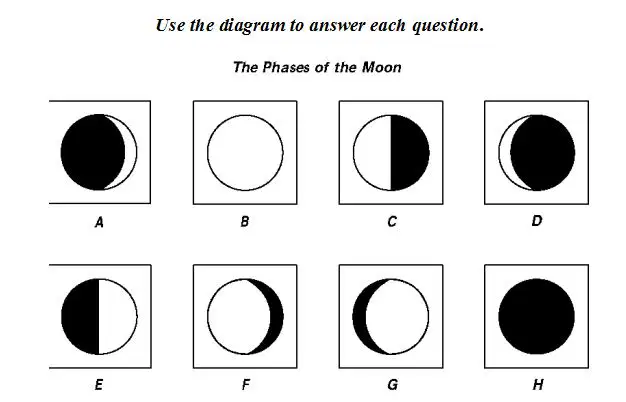
What moon phase does letter "G"represent?
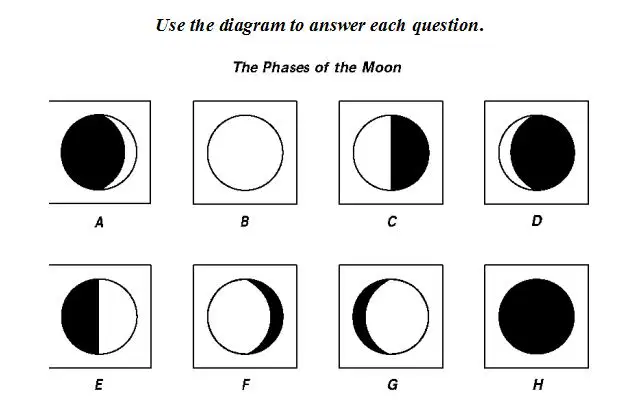
What moon phase does letter "E"represent?
Which diagram model a hypothetical situation in which every location on earth would have 12 hours of daylight and 12 hours of darkness per day?


No longer tilted on its axis
Stopped rotating on its axis
Took an additional month to orbit the Sun
Revolved around the Sun in the opposite direction
What is the shape of Earth's orbit around the Sun?
Perfect circle
Ellipse
Square
Straight line
What is a solar eclipse?
When the Moon passes between the Sun and Earth, blocking the Sun's light
When the Earth passes between the Sun and Moon, casting a shadow on the Moon
When the Sun moves behind the Earth, causing darkness
When the Moon moves into the Earth's shadow
What causes the seasons on Earth?
The distance between the Earth and the Sun
The rotation of the Earth on its axis
The tilt of the Earth's axis as it orbits the Sun
The revolution of the Earth around the Sun
No longer tilted on its axis
Stopped rotating on its axis
Took an additional month to orbit the Sun
Revolved around the Sun in the opposite direction

