
 Worksheets
Population Ecology and Succession
Total questions: 27
Worksheet time: 18mins
Which of the following could be a density-independent limiting factor in the desert?
number of prey
food supply
parasitism
rainfall
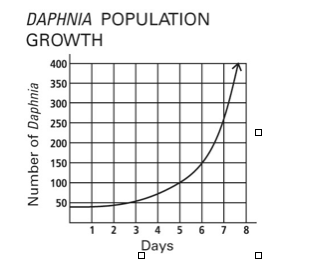

What type of population growth is shown in this graph?
logistic growth
exponential growth
logical growth
density-independent growth

Which point on the graph best represents the carrying capacity?
Letter A
Letter B
Letter C
Letter D
Letter E
Which of the following is density-independent limiting factor?
disease
competition
earthquake
predation

In which month(s) did the Cottontail Rabbits reach their carrying capacity?
January and February
March and May
April and January
April and May
At which point on the graph does population growth begin to be affected by density-dependent factors?
Letter A
Letter B
Letter C
Letter D
Letter E

Review the graph provided. What statements can be made about the significant decline in wolves around 1979?
The wolf decline was a direct result of moose decline.
The is no way to know why the wolf population dropped.
The drop is most likely due to the declining moose population, but more information would be needed to determine that.
The drop is most likely due to the increasing moose population, but more information would be needed to determine that.
The wolf decline was a direct result of the moose increase.
In one study using capture, mark, recapture to estimate population size, 521 individuals were captured and marked. One month later, the traps were reset and 438 individuals were captured. Of these, 136 were marked. Use the Lincoln index to calculate the size of the population.
N=mM×n
(a)
A population of emus was studied for five years. During that time there were 300 births and 120 deaths. 40 emus immigrated into the population and 20 emigrated out of it. Calculate the population growth over this period.
(a)
What is an increase of biodiversity over time, after a natural or man made disturbance?
ecological recession
climax recession
ecological succession
climax succession
What is the main difference between primary and secondary ecological succession?
Primary begins WITHOUT soil; Secondary begins WITH soil
Primary is the first stage and secondary is the second stage
Primary builds plant community; secondary builds animal community.
Primary begins WITH soil; Secondary begins WITHOUT soil
___ are the first organisms to colonize an area and begin the process of ecological succession.
foundational organisms
introductory organisms
primary organisms
pioneer species
What is the term that describes a steady and stable community?
peak community
turf community
climax community
disturbed community
Which of the following is NOT a pioneer species?
Shrubs
Lichen
Mosses
Fungi
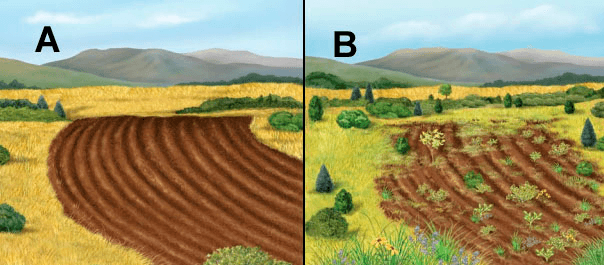
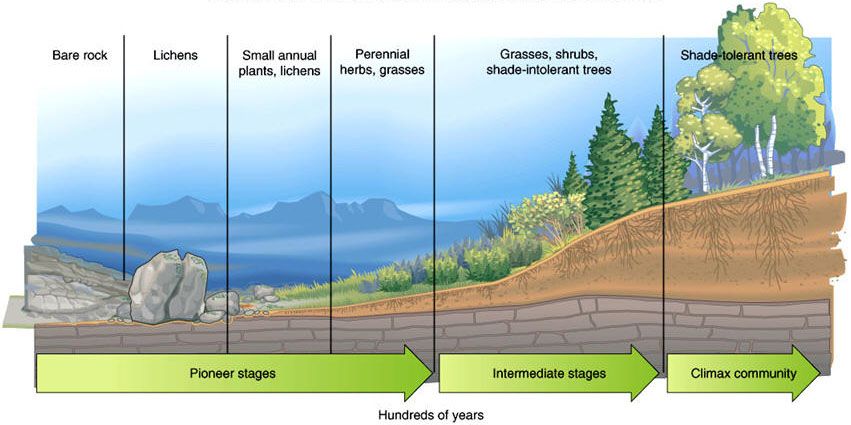

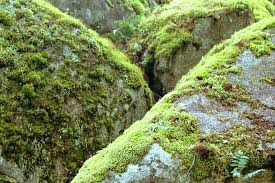

Which of the following best describes primary succession?
Volcano wipes out ecosystem that gradually grows back from ash covered soil
Volcano creates a new island of rock that must break down to form an ecosystem
Forest fire burns down forest that must bounce back over time
Tornado destroys a crop that must slowly grow back over time.
Why does biodiversity increase during the course of succession?
Biodiversity refers to the difference in ages of organisms, so some organisms arrive earlier than others.
Over time, the same trees begin to reproduce and take over an area.
Many populations of organisms gradually begin to occupy the same area to create a climax community.
Many organisms move in to the area for a short amount of time, then leave to find a better habitat.
Humans often build asphalt or concrete roads to travel through areas, such as forests. After many years, plants can be seen growing on the roads. What kind of succession is this?
Primary Succession
Secondary Succession
Tertiary Succession
Quaternary Succession

This is the ecosystem 137 years after a devastating forest fire, what type of community is this known as?
primary community
secondary community
hostile community
climax community

