
 Worksheets
H. Biology Phylogenetic Trees
Total questions: 16
Worksheet time: 32mins
If you were building a phylogenetic tree of cats, which of the following would be the best outgroup?
wolf
domestic cat
frog
leopard
categories above the kingdom level
Domain
Phylum
Class
Division
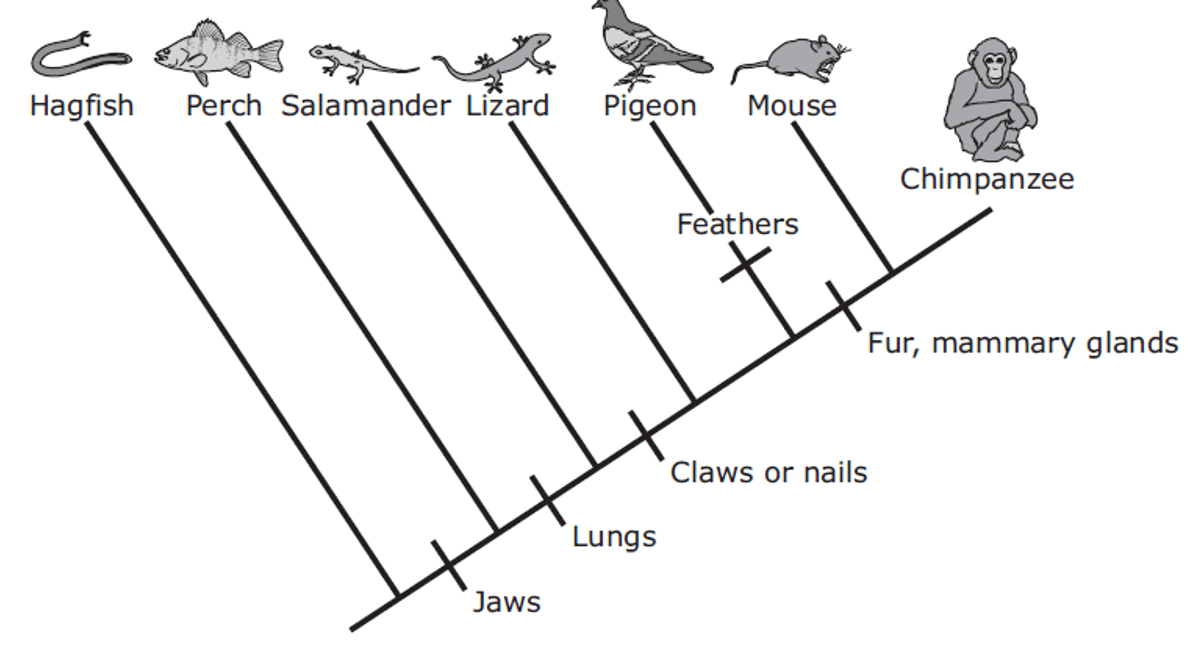
All the animals to the right of the salamander would have the common characteristic of...
Fur
Claws or nails
Lungs
Jaws

The lizard has all these derived characteristics EXCEPT
Jaws
Lungs
Bipedal

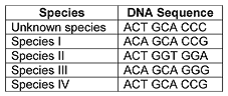
What is the common ancestor of Letters A, B, C, D, E?
1
2
3

Anatomical similarities and differences between various organisms allow us to reconstruct and infer evolutionary history and descent. The bones of the forelimbs (wing or arm) of three animals are shown in the illustration. Which of the following is NOT a reasonable conclusion that can be drawn from the similarities and differences found in this illustration?
Birds, bats, and humans have bones and structures that allow them to function.
Different structures allow for different functions.
Humans live in habitats that are very different from that of birds and bats.
Humans and bats share a closer evolutionary history with each other than with birds.

Which trait (adaptation) was developed most recently?
tetrapod limbs
feathers
amnion
They developed at the same time
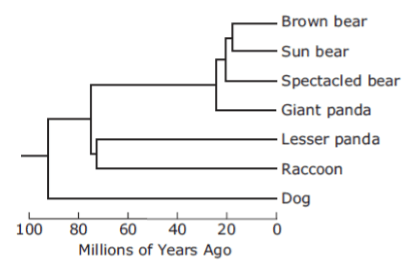
Who is the closest relative to the brown bear?
Giant panda
Dog
Lesser panda
Sun bear
The groups in a phylogenetic tree are called...
Taxa
Nodes
Roots
Branches
According to maximum parsimony...
The simpler your phylogenetic tree, the better
Phylogenetic trees should have many branches
All organisms in a phylogenetic tree must descend from a common ancestor
Phylogenetic trees must show all traits
Places on a phylogenetic tree where organisms share a common ancestor are called...
Nodes
Branches
Taxa
Species
Phylogenetic trees show...
Homologous structures through divergent evolution
Homologous structures through convergent evolution
Analogous structures through divergent evolution
Analogous structures through convergent evolution

Based on the figure, which organism is most closely related to the polar bear?
black bear
european brown bear
western north american brown bear
asian brown bear
Which evidence would be the most accurate when developing a cladogram?
morphological
molecular
ecological
fossil

