
 Worksheets
Chem 1050 Midterms
Total questions: 45
Worksheet time: 34mins
Each of the following objects were heated individually from 22 C to 41 C. Which required the most energy?
15 g of H2O (Cₛ = 4.18 J g⁻¹ C⁻¹)
60 g of Al (Cₛ = 0.902 J g⁻¹ C⁻¹)
20 g of Au (Cₛ = 0.128 J g⁻¹ C⁻¹)
10 g of Cu (Cₛ = 0.385 J g⁻¹ C⁻¹)
80 g of CCl₄ (Cₛ = 0.861 J g⁻¹ C⁻¹)
The molar enthalpy of combustion of sucrose (molar mass is 342 g mol⁻¹) is -5650 kJ mol⁻¹. What mass of sucrose has been burned when 210 kJ of heat is produced by its combustion?
3.72 g
16.5 g
9.20 g
12.7 g
26.9 g
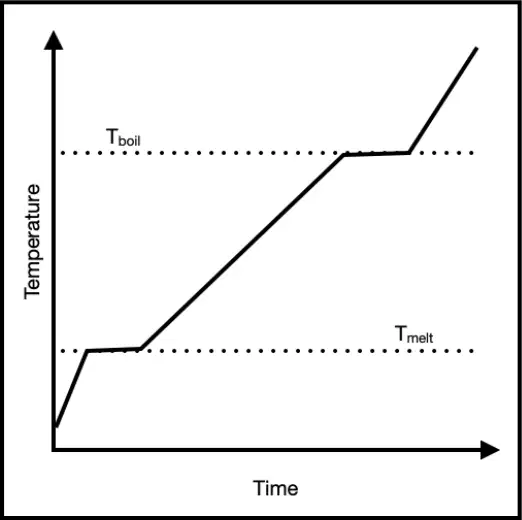
Shown is a graph of temperature vs. time for the heating of a substance we will call X. The rate of energy being supplied is constant. Which phase of X has the largest molar heat capacity?
X(s) solid.
Solid and liquid are about the same.
X(l) liquid.
Liquid and gas are about the same.
X(g) gas.
When ammonia, NH3, evaporates at constant pressure, the sign of the enthalpy change for the process
is negative
is positive
depends upon the external pressure
depends upon the temperature
cannot be predicted with this information as it can only be measured experimentally
An ideal gas expands isothermally (at constant temperature). In an isothermal process, the internal energy of an ideal gas is unchanged. From the perspective of the system, the heat exchanged in the process is +85 J. What is value for the work?
-85 J
+85 J
0 J
+170 J
-170 J
The reaction to form glutamine from glutamate and ammonia is glutamate + NH3 → glutamine ΔG°' = +14.1 kJ mol^-1 (1) There is an enzyme that can couple this reaction to the ATP/ADP reaction: ATP → ADP+ PO4^3-(aq) ΔG°' = -30.5 kJ mol^-1 (2) Coupling these two reactions favours the formation of glutamine because.
Reaction 1 favours reactants.
Reaction 2 favours reactants.
Reaction 2 is more exergonic than reaction 1 is endergonic.
The sum of reactions 1 and 2 give a reaction which favours reactants.
The sum of reaction 2 with the reverse of reaction 1 gives a reaction with a negative ΔG.
Which expression describes the heat evolved in a chemical reaction that is carried out at constant pressure?
ΔU – w
q + w
qH - ΔU
ΔU – q
ΔU + w
A model gas phase reaction, A(g) → B(g), has a Gibbs energy, ΔG, equal to 0 kJ mol^-1 under certain conditions. At the same time and under those same conditions, ΔG° = +30 kJ mol^-1. Which statement is true about this reaction at these conditions?
The reaction will proceed in the forward direction to produce more B.
The reaction will proceed in the reverse direction to produce more A.
The reaction is at equilibrium and [A] > [B].
The reaction is at equilibrium and [A] = [B].
The reaction is at equilibrium and [A] < [B].
Imagine two hypothetical elements, X and Y. At room temperature, the standard state for both is as a diatomic gas (X2 and Y2). They can react to form the gas XY, whose standard enthalpy of formation is -150 kJ mol^-1. The bond enthalpies for the two elements are BE(X2) = +200 kJ mol^-1 and BE(Y2) = +100 kJ mol^-1. What would be a correct estimate of the bond enthalpy of the X-Y bond?
+200 kJ mol^-1
+250 kJ mol^-1
+300 kJ mol^-1
+350 kJ mol^-1
-400 kJ mol^-1
The production of quicklime (calcium oxide) comes from heating calcium carbonate according to this reaction equation. CaCO3(s) → CaO(s) + CO2(g) With the values of ΔH° = +179 kJ mol^-1 and ΔS° = +160 J K^-1 mol^-1, under which temperature conditions will the equilibrium constant take on a value K < 1? At no temperature.
At all temperatures.
At temperatures below 1118 K.
At temperatures above 1120 K.
At temperatures greater than 500 C.
Of the following reactions, which one will have a positive ΔS?
2 CO(g) + O2(g) → 2 CO2(g)
H2(g) + I2(s) → 2 HI(g)
2 H2(g) + O2(g) → 2 H2O(g)
3 O2(g) → 2 O3(g)
2 Na(s) + Cl2(g) → 2 NaCl(s)
Ammonia can be produced from its elements according to the reaction N₂(g) + 3 H₂(g) → 2 NH₃(g). The standard molar Gibbs energy of formation of ammonia is -16.45 kJ mol⁻¹ at 298 K. Determine the change in Gibbs energy for the above reaction as written at 298 K when the pressure of each species is P(N₂) = 0.30 bar, P(H₂) = 0.80 bar, and P(NH₃) = 1.50 bar.
39.55 kJ mol⁻¹
-9.80 kJ mol⁻¹
-26.25 kJ mol⁻¹
-16.45 kJ mol⁻¹
-23.10 kJ mol⁻¹
Using the following bond enthalpy data (all in units of kJ mol⁻¹: H-H 436; O=O 495; O-H 463; O-O 146), determine an estimate of the molar formation enthalpy for hydrogen peroxide, H₂O₂ (g).
+322 kJ mol⁻¹
+5 kJ mol⁻¹
-322 kJ mol⁻¹
+141 kJ mol⁻¹
-141 kJ mol⁻¹
The vapour pressure of Br₂(ℓ) is 0.289 bar at 298 K. Calculate ΔG° for the vapourization of Br₂(ℓ) at 298 K.
-6.15 kJ mol⁻¹
-3.07 kJ mol⁻¹
0.00 kJ mol⁻¹
+3.07 kJ mol⁻¹
+6.15 kJ mol⁻¹
Hydrazine (N₂H₄(ℓ)) is a colourless liquid with many uses, including in power plants where it scavenges oxygen to prevent corrosion of the pressure tubes according to the following equation: N₂H₄(ℓ) + O₂(g) → N₂(g) + 2 H₂O(ℓ) ΔH° = -622.2 kJ mol⁻¹. Note that the standard molar enthalpy of formation of liquid water is -285.8 kJ mol⁻¹. What is the standard molar enthalpy of formation of liquid hydrazine?
+50.6 kJ mol⁻¹
-336.4 kJ mol⁻¹
+336.4 kJ mol⁻¹
-908.0 kJ mol⁻¹
+1194 kJ mol⁻¹
The steam reforming reaction of methane is given by this chemical reaction equation: CH₄(g) + H₂O(g) ⇌ CO(g) + 3 H₂(g) ΔH°= +195 kJ mol⁻¹. At 298 K the reaction lies far to the reactant side with a very small equilibrium constant of 5.10 x 10⁻²³. To obtain a significant amount of the desired hydrogen gas product, the reaction is operated at very high temperatures. What is the equilibrium constant at 1200 K?
3.01 x 10²¹
59.2
424
1.04 x 10⁴⁸
2510
6.00 g of ammonium nitrate (molar mass 80.0 g mol⁻¹) is dissolved in 1.00 L of water in a calorimeter with a heat capacity (including the water) of 2.10 kJ K⁻¹. The temperature decreases by 1.00 C. The molar enthalpy of solution of ammonium nitrate is
+28.0 kJ mol⁻¹
-28.0 kJ mol⁻¹
+0.35 kJ mol⁻¹
+15.7 kJ mol⁻¹
-15.7 kJ mol⁻¹
Which of the following statements is true for the combustion of butane, C₄H₁₀(g), to form carbon dioxide and water vapour in a bomb calorimeter?
ΔU = 0
ΔU = q
w = ΔU
q = 0
ΔU = ΔH
A reaction is carried out at constant pressure and the heat given off is measured to be 5.50 kJ. At the same time the system was found to have 1.25 kJ of work done on it. What is ΔU for this reaction?
-5.50 kJ
-4.25 kJ
-6.75 kJ
+5.50 kJ
+6.75 kJ

Use Hess's law to determine ΔH° for the reaction C₃H₄(g) + 2 H₂(g) → C₃H₈(g), the hydrogenation of propyne. Use the following data.
A. +567.9 kJ mol⁻¹
B. -853.7 kJ mol⁻¹
C. -567.9 kJ mol⁻¹
D. -289.5 kJ mol⁻¹
E. -3.7 kJ mol⁻¹
The standard enthalpy of formation of barium fluoride, BaF₂(s), is -1207 kJ mol⁻¹. All of the reactions below are found in the Born-Haber cycle for BaF₂(s). Which reaction has an enthalpy change that is exothermic?
A. Ba(g) → Ba⁺(g)
B. Ba(s) → Ba(g)
C. BaF₂(s) → Ba²⁺(g) + 2 F⁻(g)
D. Ba²⁺(g) + 2 F⁻(g) → BaF₂(s)
E. BaF₂(s) → Ba(s) + F₂(g)

Given the following reaction data for 25 C, calculate ΔG° at this temperature for the reaction A(g) + 2 B(g) → 3 C(g).
A. 614 kJ mol⁻¹
B. -230 kJ mol⁻¹
C. -416 kJ mol⁻¹
D. -9945 kJ mol⁻¹
E. -614 kJ mol⁻¹
The relevant standard reduction potentials are Ba/Ba2+ = -2.90 V; Ni/Ni2+ = -0.25 V. What is the standard cell potential and which metal is behaving as the cathode?
2.65 V ;Ni
3.15 V; Ni
-2.65 V ;Ni
-3.15 V; Ni
-2.65 V ;Ba

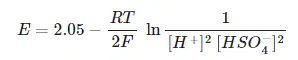
This is the reaction that is occurring during the discharge of a lead storage battery.
The standard cell potential is 2.05 V. What is the correct form of the Nernst Equation at temperature T?




There are two electrolytic cells, one containing magnesium (24.305 g/mol) as Mg2+ ions and the other containing aluminum (26.9815 g/mol) as Al3+ ions. They are connected in series (meaning one after the other, so that they both have the same current passing through them for the same length of time so that the same charge passes through both). Which cell has a larger mass of metal deposited after a certain time and why?
Since the charge being passed is the same for both cells, the mass being deposited is the same for both cells.
The deposited magnesium will have a greater mass because its lower valency will allow for more atoms to be deposited than for the aluminum with its greater valency.
The deposited aluminum will have a greater mass because the ion's charge is greater.
The deposited aluminum will have a greater mass because its molar mass is greater.
A chemical reaction system is represented by this equation.
Ag(s) + Br-(aq) + Fe3+(aq) → Fe2+(aq) + AgBr(s)
The standard reduction potentials at 298 K for AgBr/Ag = 0.328 V and for Fe3+/Fe2+ = 0.472 V. What is the value of the equilibrium constant K at this temperature?
(Some values have been changed from their actual value for the purpose of this exam.) Report your answer to three significant figures.
The probe used in a pH meter is used to …
measure the Zn2+ concentration.
measure the Hg2+ concentration in the calomel.
measure the concentration of H+ ions.
determine the direction of electron flow in the circuit.
determine the pressure of H2.
The following reactions are all observed to occur spontaneously as written.
Ti(s) + Pd2+(aq) → Ti2+(aq) + Pd(s)
Ti(s) + Fe2+(aq) → Ti2+(aq) + Fe(s)
Fe(s) + Sn2+(aq) → Fe2+(aq) + Sn(s)
Fe(s) + Pd2+(aq) → Fe2+(aq) + Pd(s)
Ti(s) + Sn2+(aq) → Ti2+(aq) + Sn(s)
Sn(s) + Pd2+(aq) → Sn2+(aq) + Pd(s)
Which of these metals is most easily oxidized (which one has the greatest tendency to react and end up in its oxidized form)?
Fe
Ti
Pd
Sn
Aluminum (molar mass = 26.9815 g/mol) is refined from its oxide ore, Al2O3. If the electrical current that is flowing is 750.00 A, how long will it take to deposit 377.52 grams of aluminum? Report your answer in hours with 1 decimal place precision.
An electroplating solution contains vanadium (50.9415 g/mol), which is a metallic element that can exist in solution in at least four oxidation states. A current of 1.50 A operates on the electrolysis cell for 30.0 minutes. During this time 0.475 g of V is deposited on the cathode. What is the oxidation state of the vanadium in solution?
+2
+3
+4
+5

Balance the following equation in acidic solution. As usual, the coefficients should be the smallest integers possible.
What is the coefficient for H+(aq)?
3
5
1
7
6
Select the pair of products formed in the electrolysis of a solution of GaBr3(aq) using inert electrodes. Assume that there are no overpotentials involved in any reactions. Standard reduction potentials are
O2(g) + 4 H+(aq) + 4 e- → 2 H2O(l) Eº = +1.23 V
Br2(l) + 2 e- → 2 Br-(aq) Eº = +1.07 V
Ga3+(aq) + 3 e- → Ga(s) Eº = -0.53 V
2 H2O(l) + 2 e- → H2(g) + 2 OH-(aq) Eº = -0.83 V
Br2 and H2
Ga and Br2
Ga and H2
O2 and H2
Ga and O2
For an electrochemical cell described as follows, what would be the balanced cell reaction indicated by this standard cell notation?
Ni(s) | Ni2+(aq) || Br2(l) | Br-(aq) | Pt(s)
Ni(s) + 2 Br–(aq) → Ni2+(aq) + Br2(l)
Ni2+(aq) + 2 Br–(aq) → Ni(s) + Br2(l)
Ni(s) + Br2(l) → Ni2+(aq) + 2 Br–(aq)
Ni2+(aq) + Br2(l) → Ni(s) + 2 Br–(aq)
Calculate ΔrG° for the following reaction at 298 K as written.
2 Ag(s) + Sn4+(aq) → 2 Ag+(aq) + Sn2+(aq)
The standard reduction potentials are Ag+/Ag = 0.886 V and Sn4+/Sn2+ = 0.141 V.
(Note that some of these numbers have been changed from their actual values for the purpose of this exam.)
Give answer in kJ/mol but do not include the units in your answer. Report your result to 1 decimal place.
When the half-cell represented by
Pb(s) | PbO(s) | OH-(aq)
is functioning as a cathode in a cell, identify the balanced half-reaction that is occurring.
PbO(s) + H2O(l) + 2 e– → Pb(s) + 2 OH–(aq)
PbO(s) + 2 OH–(aq) + 2 e– → Pb(s) + H2O(l)
PbO(s) + H2O(l) + 2 e– → Pb(s) + OH–(aq)
PbO(s) + H2O(l) → Pb(s) + 2 OH–(aq) + 2 e–
Pb(s) + 2 OH–(aq) → PbO(s) + H2O(l) + 2 e–
Consider the following electrochemical cell:
Pb(s) | Pb2+(aq) || Co3+(aq) , Co2+(aq) | Pt(s)
Which one of the following actions would tend to DECREASE the measured cell potential?
Increase the concentration of Co3+(aq).
Increase the surface area of the lead electrode.
Decrease the concentration of Pb2+(aq).
Increase the concentration of Co2+(aq).
Decrease the surface area of the platinum electrode.
A cell is set up based upon these iron and copper redox couples: Cu/Cu2+ and Fe/Fe2+. Copper behaves as the cathode and when properly connected to a voltmeter, the standard cell potential is E° = +0.789 V. The concentration of copper ion is 1.00 M. The Fe2+ concentration is not known but the measured voltage is +(8.41x10^-1) V. At 298 K, what is the [Fe2+] concentration in the anode compartment?
The cell voltage is given in scientific notation (for example +(8.45x10^-1) V means 8.45x10⁻¹ V). For this type of question, CourseLink requires that these numbers be in scientific notation. Your answer must also be expressed in scientific notation. Please watch the exponents carefully. We're not trying to be tricky. It is just necessary because the answers can cover a large range of values.
Report your answer in molarity with 3 significant digits. Do not include the units.
An electrochemical cell is constructed using a copper cell as the anode and the bromate/bromide cell as the cathode. The balanced chemical equation for the cell is
3 Cu(s) + BrO3–(aq) + 6 H+(aq) → 3 Cu2+(aq) + Br–(aq) + 3 H2O(l)
The standard cell potential is +1.10 V. What will be the measured cell potential under the following chemical conditions: [Br–] = 1.75 M; [Cu2+] = 0.560 M; [BrO3–] = 2.00 M; [H+] = 3.00 x 10⁻³ M?
Report your answer in volts with two decimal places. Do not include units.
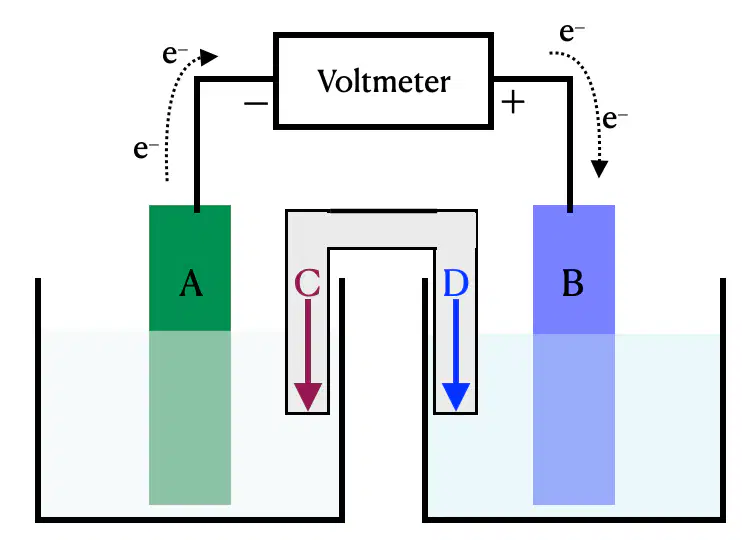
We construct a voltaic cell based on these two half-reactions:
Cr3+(aq) + 3 e– → Cr(s) E˚ = –0.74 V
Pt2+(aq) + 2 e– → Pt(s) E˚ = +1.20 V
The salt bridge consists of a solution of KNO3.
The voltmeter reads a positive voltage.
Identify the chemical species that are labelled in the figure.
A
NO3–
B
Pt
C
Cr
D
K+
A concentration cell is set up with two nickel electrodes and two solutions of Ni(NO3)2. One cell contains a solution that is 0.735 M and we connect that electrode to the positive terminal of a voltmeter. The other solution is 0.000280 M and is connected to the negative terminal. The measured voltage on the voltmeter is positive. At 298 K, what is that measured positive potential?
(Report your result in volts with 3 decimal places. Do not include units in your answer.

Balance the following redox equation in basic medium (using OH–). As usual, the coefficients should be the smallest integers possible.
What is the coefficient for H2O2(aq)?
1
2
3
4
5
What is the oxidation state of the As atom in the molecule Na3AsO3?
2+
3+
4+
5+
6+
A certain galvanic cell has a standard cell potential of 0.50 V. In the chemical reaction, 2 electrons (n=2) are transfered. What is the cell potential when the cell reaction has reached equilibrium?
E = 0.50 V
E = -0.50 V
E = 1.00 V
E = 0.00 V
E = -1.00 V
A mercury "button" battery is used when we need electrical energy in small spaces. Zinc metal forms one electrode while mercury oxide is dispersed in a carbon powder matrix to form the other. Using standard cell notation, the cell is represented by
Zn(s) | ZnO(s) || HgO(s) | Hg(l) | C(s)
Which one of the following statements is FALSE regarding the operation of the battery?
The mass of zinc metal is increasing.
HgO(s) is the oxidizing agent.
The carbon electrode is where the cathodic reaction is occurring.
ZnO is forming on the surface of the Zn electrode.
Liquid mercury is being formed at the cathode.
The electrolysis of a dilute sulfuric acid solution will produce the evolution of hydrogen gas at the cathode. With the right experimental arrangement, any water vapour can be removed and you can collect the dry hydrogen gas. The electrolysis experiment is carried out at a temperature of 25.0 °C. A current of 0.840 A flows for 13.00 minutes. The hydrogen gas is collected at a pressure of 1.00 bar. What is the volume of gas collected?

