
 Worksheets
APES Unit 1-3 Review
Total questions: 112
Worksheet time: 56mins
The concentration of carbon dioxide in the atmosphere
is increasing in part due to fossil fuel use.
has not significantly changed in the past 200 years.
is increasing in part due to deforestation.
has been decreasing since the 1800’s.
can not be reliably measured


Suppose that a new predator of the rabbit migrated to this ecosystem. What is the most likely initial effect on the other organisms?
More competition among the mice for food
More competition among the hawks for food
Less competition among snakes for food
Less grass available for food

In Stage 4, the Total Population is...
Growing Quickly
Leveling Out
Decreasing Quickly
The total amount of sun energy (light) that plants capture and convert to energy (glucose) through photosynthesis describes?
Gross Primary Productivity (GPP)
Net Primary Productivity (NPP)
Primary Productivity (PP)
The environment refers to
all conditions surrounding us on Earth.
species interactions that affect human life.
conditions that cause negative effects on our health.
interactions that harm the atmosphere.
the sum of all the conditions surrounding us that influence life.

What growth rate does this population pyramid represent?
Rapid Growth
Slow Growth
Negative Growth
Zero Growth
Evidence of biodiversity is seen in
genetic variation among human populations.
number of species in a region.
number of ecosystems and habitats in a region.
genetic variation among plants and animals in a region.
All of these answers are correct.
Which is NOT a non-renewable resources?
aluminum
oil
timber
copper
coal
The removal of which type of species will cause a trophic cascade?
Keystone Species
Invasive Species
Primary Consumer
Producer
An ecological footprint considers
per capita resource use of a nation.
how much an individual consumes in terms of land area.
average yearly consumption of resources.
resources that an entire nation consumes in and average year.
the ratio of resources consumed in developed nations to less developed nations.
An experiment is designed to determine if wheat grows better when it is planted alone or with clover. The design calls for 3 pans of each treatment. Pans A, B, and C contain only wheat. Pans D, E, and F contain clover and wheat planted in alternating rows. Each pan contains a total of
100 seeds. All treatments contain the same type of soil, are planted in the same size pan, are exposed to the same amount of sunlight, and are maintained at the same temperature throughout the course of the experiment.
The treatments planted with only wheat are the
sample size.
control.
environmental variable.
null hypothesis.
replication.
The goal of using resources to meet the needs of both current and future generations is referred
to as
NAFTA.
preservation
remediation
sustainability
environmental science
These organisms occupy stable environments, are larger in size and have longer life expectancies. They produce, during their life spans, fewer offspring, but place a greater investment in each.
k-strategist
r-strategist
m-strategist
s-strategist
What is ecological succession?
A set of environmental conditions within which an organism can best survive
An organism's ability to adapt to its environment
A peak community where the organisms are stable
The process of change in the species structure of an ecological community over time

Tracks organisms that tend to live long lives (low death rate and high survivorship rate); toward the end of their life expectancies, however, there is a dramatic increase in the death rate.
Type I
Type II
Type III
Type IV
where is sulfur stored?
sun
plants
deep sea
underground in rocks
An algal bloom is the rapid growth of a population of
fungi
protozoans
algae

In general, algal blooms occur when
toxins accumulate in shellfish.
nutrients decrease in the water.
nutrients increase in the water.


In Stage 4, the Population Pyramid looks like...


These organisms typically live in unstable, unpredictable environments & are able to reproduce rapidly (exponentially). They do not take care of their young & are subject to predation.
k-strategist
r-strategist
m-strategist
s-strategist

Hyenas and vultures both scavenge prey from apex predators. This is an example of...
Competition
Predation
Mutualism
Commensalism
Barnacles attach themselves to the skin of whales. This allows them to filter feed as the whale swims. The whale is unaffected. This is an example of...
Competition
Predation
Mutualism
Commensalism

Click on the image to enlarge it. Which biome is being shown in the climatogram?
Desert
Tundra
Tropical Rainforest
Temperate Seasonal Forest

In Stage 2, the Total Population is...
Growing Slowly
Growing Quickly
Not Growing

Click on the image to enlarge it. Which biome is being shown in the climatogram?
Desert
Tundra
Tropical Rainforest
Temperate Seasonal Forest
Similar biomes are often found along...
lines of latitude.
lines of longitude.
Which of the following is NOT an important factor for aquatic biomes?
Salinity
Flow
Temperature
Precipitation
_______ increases the amount of atmospheric CO2 while ______ decreases the amount of atmospheric CO2.
Cellular Respiration, Photosynthesis
Photosynthesis, Burning of Fossil Fuels
Burning of Fossil Fuels, Photosynthesis
Photosynthesis, Cellular Respiration
The process of atmospheric nitrogen being converted into a usable form is called...
nitrogen fixation
nitrification
ammonification
assimilation
Denitrification is...
the conversion of waste into ammonium
the conversion of atmospheric nitrogen into usable nitrogen
the conversion of soil nitrogen back into atmospheric nitrogen
the conversion of ammonium to nitrites
Which of the cycles is considered to be the SLOWEST?
Carbon
Water
Nitrogen
Phosphorus
An increase of which two molecules in water sources leads to eutrophication?
Carbon & Phosphorus
Nitrogen & Water
Phosphorus & Water
Nitrogen & Phosphorus
The two main processes that return water to the atmosphere are...
Evaporation & Transpiration
Precipitation & Transpiration
Precipitation & Evaporation
If the GPP of an area is 57 kcal/m2/yr and the amount of energy lost to respiration is 23 kcal/m2/yr, what is the NPP of the area?
80 kcal/m2/yr
57 kcal/m2/yr
23 kcal/m2/yr
34 kcal/m2/yr
If the GPP of an area is 25 kcal/m2/yr and the NPP of the same area is 15 kcal/m2/yr, what is the amount of energy that is lost to respiration?
25 kcal/m2/yr
15 kcal/m2/yr
10 kcal/m2/yr
40 kcal/m2/yr
Which of the following correctly lists the biomes in order from MOST productive to LEAST productive?
Desert > Grasslands > Seasonal Forest
Grasslands > Desert > Seasonal Forest
Seasonal Forest > Grasslands > Desert
Grasslands > Seasonal Forest > Desert
If producers capture 80,000 J of energy from the sun, how much will be passed on to the secondary consumers?
8,000 J
800 J
80 J
8 J
If producers capture 65,000 J of energy from the sun, how much will be passed on to the tertiary consumers?
6,500 J
650 J
65 J
6.5 J
What is an example of abiotic component?
A deer in the forest
A rock near a stream
A human
Bacteria in a river
What describes a symbiotic relationship?
Plants and animals that have migrated to places where they are not native
Humans using plants and animals for food.
A clownfish using an anemone as a shelter and the clownfish scaring away the anemone's predators
A species on which other species in an ecosystem depends on, if removed the ecosystem drastically changes
What are the correct descriptions of relationships?
Competition-/-
Predation+/-
Mutualism+/none
Commensalism+/+
Competition none/+
Predation-/+
Mutualism-/-
Commensalism+/+
Competition -/+
Predation+/+
Mutualism-/-
Commensalism-/
none
Competition -/-
Predation +/-
Mutualism+/+
Commensalism+/none
A key stone species is..
a species on which other species in an ecosystem largely depend, such that if it were removed the ecosystem would change drastically. (Ex. Ochre Sea Star, California Mussel)
species that are native to and found only within a limited area
a species that has a strong role in structuring a community. A foundation species can occupy any trophic level in a food web (i.e., they can be primary producers, herbivores or predators Ex. kelp).
Species with a broad ecological niche. They can live in many different places, eat a variety of foods, and tolerate a wide range of environmental conditions. (Ex. flies, human)
A biome is a large area with similar___ conditions that determine___ there
altitude/ species
climate/ plants and animals
Define Resource partitioning
Using different areas of a shared habitat
Using different resources based on different evolved body features
Different species using the same resources in different ways to reduce competition
Using resources at different times
Intertidal zones are narrow band of coastal between ----- and ------ -----
high and medium tide
low and high tide
high water and low tide
direct sunlight and high tide
A carbon sink
is a carbon reservoir that increases more carbon than it releases
Processes that adds carbon to the atmosphere
Movement of molecules that contain carbon, glucose, and methane
leads to imbalance in which reservoirs or sinks are storing carbon
What does photosynthesis do?
Removes CO2 from the atmosphere and converts it to glucose
Removes CH4 from the atmosphere and converts it to glucose
Removes CO2 from the atmosphere and it converts it to nectar
Removes NO2 from the atmosphere and it converts it to sugar
What is assimilation?
Conversion of soil NO3 into N20 gas which returns to the atmosphere
Converting NH3 into nitrite then into nitrate by soil bacteria
plants and animals taking nitrogen in and expelling it from their body
plants and animals taking nitrogen in and incorporating it into their body
The amount of energy (biomass) leftover for consumers after plants have used some for respiration describes?
Net Primary Productivity (NPP)
Primary Productivity (PP)
Gross Primary Productivity (GPP)
What is the 1st law of Thermodynamics?
Energy can be created or destroyed
Energy is never created or destroyed
The ___ rule. In trophic pyramids, only about energy of the energy from one level makes it to the next level; the other ____ is used by the organism and lost as heat
The 20% rule/ 80%
The 5% rule/ 95%
The 10% rule/ 90%
The 25% rule/ 75%
Exemplified by bees consuming nectar and carrying pollen from one flower to another
commensalism
mutualism
competition
predation

Two bird species coexist by feeding on the same type of insects in different parts of a tree. One bird species hunts insects near the top of the tree. The other bird species hunts insects near the base of the tree. Which of the following concepts is demonstrated between the two bird species?
predator/prey
mutualism
resource partitioning
parasitism
Which aquatic biome provides the benefits of flood control, protection from storms, water filtration, and groundwater recharge?
rivers and streams
wetlands
lakes
open ocean

In Stage 1, the birth rate is...
High
Falling
Low
Which of the following has the lowest productivity?
Lakes
Estuaries
Open Ocean
Coral Reef


What age groups does the bottom of a population pyramid represent?
The elderly
The working adults
The children
Males

Which of the following does not produce carbon dioxide?
Photosynthesis
Burning Fossil Fuels
Animal respiration
Plants decaying
The largest reservoir of nitrogen is the:
Oceans
Rivers
Rock, Lithosphere, & Land
Atmosphere
What is the role of decomposers in an Ecosystem?
They recycle matter and nutrients to form fossil fuels.
They are burning and releasing carbon dioxide into the environment.
Decomposers are responsible for turning oxygen into carbon dioxide.
They recycle energy back to the sun.


In Stage 1, the death rate is...
High
Falling
Low
If an island is closer to the mainland, how will this impact the biodiversity?
There will be a higher level of biodiversity here than an island that is further away.
There will be a lower level of biodiversity here than an island that is further away.
There will be no difference in biodiversity on islands based on distance to mainland.
Which of the following is NOT a factor that impacts ecological tolerance?
Temperature
pH
Humidity
Level of biodiversity

What stage of ecological succession is being shown?
Primary succession
Secondary succession
Tertiary succession
Climax community
When a community is stable with little to no change, what level of ecological succession is taking place?
Primary succession
Secondary succession
Tertiary succession
Climax community

A characteristic of stage one of the Demographic Transition Model shows
High birth and death rates
Low death and high birth rates
Low birth and death rates
High death and low birth rates
Which of the following is NOT a type of ecosystem service?
Cultural
Regulating
Recreational
Provisional
Which biogeochemical cycles are directly related to acid deposition?
Carbon and Nitrogen cycles
Carbon and Sulfur cycles
Phosphorus and Nitrogen cycles
Carbon, Sulfur and Nitrogen cycles
Sulfur and Water cycles
According to the law of conservation of matter,
I. matter can be created
II. matter can not be destroyed
III. after a chemical reaction, the original atoms remain
I only
II only
I and II
II and III
Most energy on Earth comes from
volcanoes
the sun
trees
water
fire
Extinctions of species can be the result of
natural systems changing
introduction of invasive species
systems that are not in steady state
human inputs
All of these are correct
Choose the correct sequence for energy flow within an ecosystem
Herbivores --> producers --> carnivores --> scavengers
Producers --> herbivores--> carnivores --> scavengers
Producers --> carnivores --> herbivores--> carnivores
Scavengers--> carnivores --> herbivores--> producers
An addition of a limiting nutrient to an ecosystem may lead to an algal bloom. What effect will this algal bloom have on the oxygen content of the water?
The algae bloom will cause the oxygen content in the water to increase overall
The algae bloom will cause the oxygen content in the water to decrease, leading to hypoxic conditions
The algae bloom will have no impact on the oxygen content of the water
The algae bloom will cause rapid fluctuations of oxygen in the water
A tapeworm lives in the small intestines where it feeds and grows, robbing the human of essential nutrients. This is a _____ type of relationship.
Commensalism
Parasitism
Symbiotic
Mutualism
Which biome is characterized by the presence of permafrost?
temperate seasonal forest
woodland/shrubland
tundra
boreal forest
The direction of an arrow in a food chain represents
the flow of energy from organism B to A
the movement of organisms
the directionality of the sun
the flow of energy from organism A to B
The temperature of your skin increases, which leads to an increase in perspiration. Perspiration evaporates from your skin, decreasing its temperature. This is an example of
a positive feedback loop
a negative feedback loop
the second law of thermodynamics
a tragedy of the commons

When a population has unlimited resources, and it continues to grow to its FULL LIVING POTENTIAL, it is called
Peak
Top shelf
Resource controlled limit
Biotic potential

In Stage 3, the Birth Rate is...
High
Dropping quickly
Low
factors that affect a population depending on its size
- these include food, predation, parasitism, and disease
Density-Dependent factor
Density-Independent factors
Which population has the greatest potential for rapid growth?
Populations with a large number of middle aged individuals
Older populations
Populations with large numbers of young offspring
None of these
Lower birth rate
More developed
Less developed

Is this country Developed or Developing?
Developed
Developing
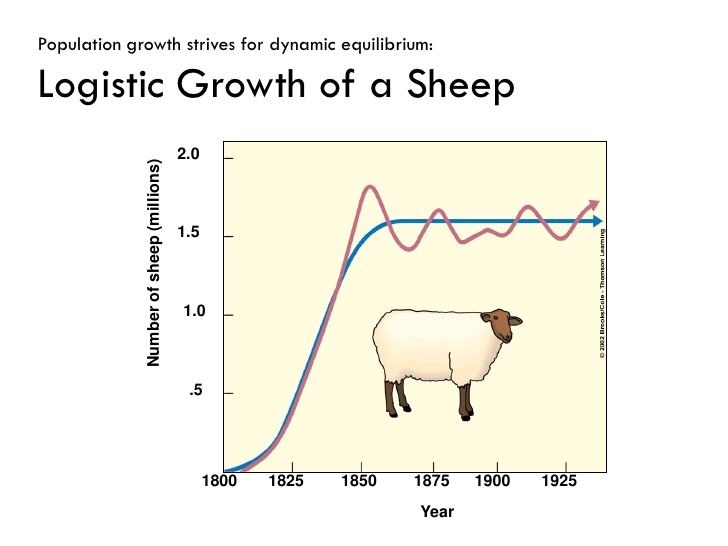
Describes organisms with a high death rate (or low survivorship rate) immediately following birth. Examples include bacteria, fishes, and invertebrates.
Type I
Type II
Type III
Type IV

In Stage 4, the Death rate is...
High
Rising
Low

Which correctly describes the term demographic transition?
The transition from low birth rates and death rates to high birth rates and death rates as a country develops.
The transition from high birth rates and death rates to low birth rates and death rates as a country develops.
The transition from high birth rates to low death rates as a country develops.
The transition from low birth rates to high death rates as a country develops.

