
 Worksheets
Natural Selection Review
Total questions: 25
Worksheet time: 13mins
Adaptations can be:
camouflage
ability to survive cold weather
hunting skills
all of the above

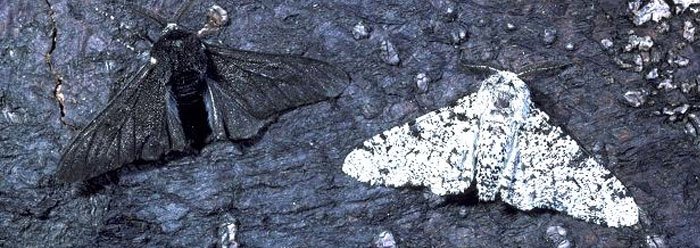
What is most likely to happen to moth populations in the picture shown?
Light moths--hunted easily, dark moths--population increase
Dark moths--hunted easily, dark moths--population increase
Light moths--hunted easily, light moths--population increase
Lights moths will change their color to match dark moths.

Due to pollution, a pond becomes darker over time. Which trait variation became more common?
light fish
dark fish
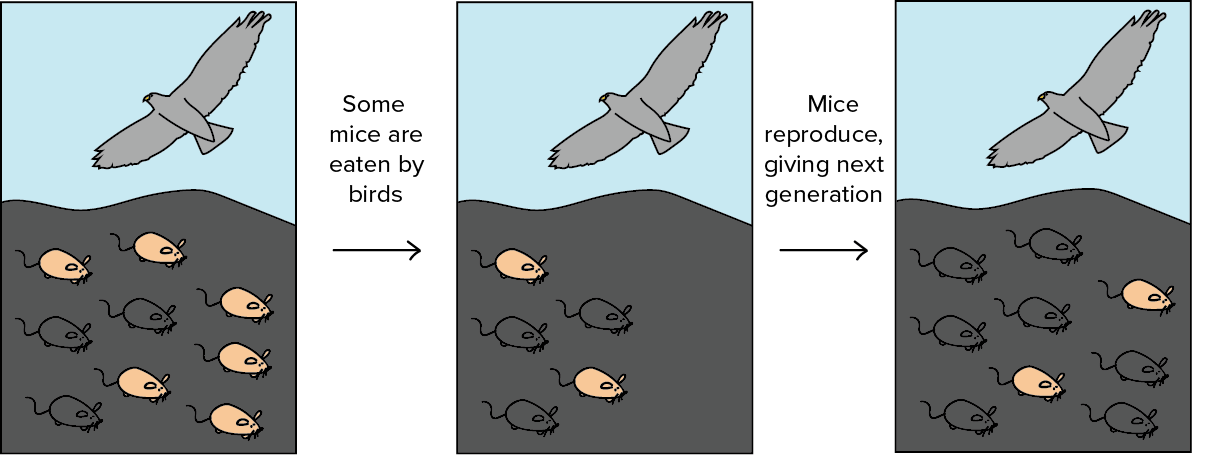
Natural Selection is driven by a change in the environment and survival of the
Earth
Fastest
Fittest
Biggest

The graphs below show the changes in crab color at one beach.
Which of the following is most likely to have caused the change in the distribution?
A new predator arrived that preferred dark-tan crabs.
A new predator arrived that preferred light-tan crabs.
A change in beach color made medium-tan crabs the least visible to predators.
A change in beach color made medium-tan crabs the most visible to predators.
Grass plants in a population range in height from 6 cm to 25 cm. The short plants receive little sunlight, and the tall plants are eaten by grazing animals. Which statement best describes the effect of natural selection on the grasses?
Because average height grass plants are favored, stabilizing natural selection is occurring.
Because average height grass plants are favored, disruptive natural selection is occurring.
Because tall grass plants are favored by the animals that eat grass, directional selection is occurring.
Because short and tall grass plants are favored, normal natural selection is occurring.
A variation is . . .
when organisms have camouflage like spots or stripes
an organism from a different dimension
when you order different food than your friend
differences between organisms in the same species
Which of the following is NOT an adaptation?

Quills

Speed

Camouflage

Fish
The spines on a hedgehog is considered to be _____________ adaptation.
Structural
Behavioral
Physiological
Learned
Running away from a predator is considered to be _____________ adaptation.
Structural
Behavioral
Physiological
Camouflage

A scientist measures the circumference of acorns in a population of oak trees and discovers that the most common circumference is 2 cm. There are very few acorns with circumferences of 3 cm or circumferences of 1 cm. Only the 2 cm circumference acorns survive.
Stabilizing
Directional
Disruptive

A population of Madagascar hissing cockroaches lives in a woodpile. The cockroaches are eaten by lizards. Because the lizards have small heads, the lizards are unable to eat the very largest adult cockroaches, and instead prey upon small and medium sized adults. Over time, only the large headed lizards survive.
Stabilizing
Directional
Disruptive

Black rabbits (BB) and white rabbits (bb) are both able to survive because they can camouflage into the white and black rocks in their environment. However, the intermediate gray rabbits (Bb) do not survive. This results in only white and black rabbits.
Stabilizing
Directional
Disruptive

Small lizards have difficulty defending territories so they end up dying out. Large lizards are more likely to be preyed upon by owls. Over time, only medium sized lizards end up surviving.
Stabilizing
Directional
Disruptional

Directional Selection
Stabilizing Selection
Disruptive Selection

