
 Worksheets
Capital Budgeting Quiz
Total questions: 66
Worksheet time: 48mins
Why is net present value considered the best measure for evaluating investments?
Because it takes into account the time value of money
Because it is the simplest method to calculate
Because it only considers the initial investment cost
Because it provides the highest rate of return
What is the first phase of the Typical Capital Budgeting Process?
The firm's management evaluates the company's financial statements.
The firm's management identifies promising investment opportunities.
The firm's management consults with stakeholders about investment opportunities.
The firm's management calculates the potential return on investment.
What is the goal of identifying promising opportunities in the capital budgeting process?
To minimize the risks associated with new investments.
To diversify the firm's investment portfolio.
To create the most value for the firm's common stockholders.
To ensure compliance with regulatory standards.
Where are good investments most likely to be found according to the text?
In markets with a high level of competition and low barriers to entry.
In markets that are less competitive with high barriers to new entrants.
In markets where the firm has the most market share.
In markets that are newly established and rapidly growing.
Which of the following is NOT a type of capital investment project mentioned in the material?
Revenue enhancing investments
Cost-reduction investments
Mandatory investments
Risk management investments
What is the primary goal before making an investment, according to the material?
To ensure it will create value
To comply with government mandates
To reduce operational costs
To enter a new market
What can be used to determine the desirability of investment proposals?
Government regulations
A single analytical tool
Customer feedback
One or a combination of several analytical tools
Which of the following is NOT one of the analytical tools used in Capital Appraisal?
Net Present Value (NPV)
Equivalent Annual Cost (EAC)
Discounted Payback Period
Return on Investment (ROI)
What does the Net Present Value (NPV) estimate in a project?
The total cost of the project
The amount of wealth that the project creates
The time it takes to pay back the initial investment
The annual return on the investment
According to the decision criteria for Net Present Value (NPV), when should an investment project be accepted?
When the NPV of the project is negative
When the NPV of the project is zero
When the NPV of the project is positive
When the NPV of the project equals the initial investment
What does NPV stand for in financial analysis?
Net Present Value
Net Profit Value
New Project Value
Net Percentage Value
What does CF₀ represent in the NPV formula?
According to the NPV formula, how are future cash flows adjusted?
What does the variable 'k' represent in the NPV formula?
What is the significance of a positive NPV?
How should projects with riskier cash flows be evaluated in terms of the discount rate 'k'?
What does 'n' represent in the NPV formula?
What is an independent investment project?
A project that must be undertaken with another project.
A project that cannot be undertaken due to external influences.
A project that stands alone and can be undertaken without influencing the acceptance or rejection of any other project.
A project that is dependent on the market conditions.
What does a mutually exclusive project do?
It allows multiple projects to be accepted simultaneously.
It prevents another project from being accepted.
It has no impact on the acceptance of other projects.
It requires at least one other project to be undertaken.
What is the first step in evaluating an independent investment opportunity according to the two steps approach?
Review the market conditions.
Calculate the project's internal rate of return (IRR).
Calculate Net Present Value (NPV).
Consult with stakeholders.
What should be done if the NPV of an independent investment project is negative?
The project should be accepted.
The project should be re-evaluated.
The project should be rejected.
The project should be accepted with modifications.
What is the initial investment required for Project Long?
$70,000
$30,000
$25,000
$100,000
What is the expected cash flow from Project Long in year three?
$70,000
$30,000
$25,000
$10,000
What is the discount rate used to calculate the NPV for Project Long?
17%
15%
20%
10%
What is the Net Present Value (NPV) of Project Long?
$18,378
$100,000
-$18,378
$0
What is the Net Present Value (NPV) of the project according to the given data in Checkpoint 11.1 (Alternatively)?
59,850
21,930
18,720
18,410
What is the discount factor (DF) for Year 2 in the table provided in Checkpoint 11.1 (Alternatively)?
0.855
0.731
0.624
0.456
According to the scenario in Checkpoint 11.1: Check Yourself, what discount rate does Saber Electronics use for projects of this type?
17%
20%
15%
10%
Based on the information in Checkpoint 11.1: Check Yourself, is this investment opportunity considered good by Saber Electronics?
Yes, because the NPV is positive.
No, because the NPV is negative.
Yes, because the discount rate is high.
No, because the cash flows are inconsistent.
When does a firm face mutually exclusive investment opportunities?
When it can undertake all positive NPV projects
When it must choose the best project from a set of negative NPV projects
When it must choose the best project or set of projects from the set of positive NPV investment opportunities
When it has unlimited resources to invest in all available projects
What are mutually exclusive opportunities in the context of investments?
Opportunities where the firm can undertake all positive NPV projects
Opportunities where the firm can choose any project without affecting the others
Opportunities where the firm must choose between projects that perform different functions
Opportunities where the firm cannot undertake all positive NPV projects
What is an example of a situation where a firm might face mutually exclusive projects?
When a firm needs to hire more employees than the number of available positions
When a firm is trying to pick between alternatives that perform the same function
When a firm is considering projects in completely different industries
When a firm is expanding into international markets
What may limit a firm's ability to invest in all the positive NPV opportunities?
Unlimited managerial time
Limited managerial time
High financial capital
No competition
When choosing between mutually exclusive investments, what is the criterion for selection?
The one with the lowest positive NPV
The one with the highest negative NPV
The one with the highest positive NPV
The one with the most managerial time required
What does the profitability index (PI) represent in financial analysis?
The difference between the present value of an investment's future cash flows and its initial cost
A cost-benefit ratio equal to the present value of an investment's future cash flows divided by its initial cost
The sum of all future cash flows of an investment
The interest rate at which the net present value of an investment is zero
What is the decision criterion for accepting an investment based on the profitability index (PI)?
The investment should be accepted if PI is equal to one
The investment should be accepted if PI is less than one
The investment should be accepted if PI is greater than one
The investment should be accepted if PI is zero
What is the implication for the net present value (NPV) if the profitability index (PI) is greater than one?
The NPV will be zero
The NPV will be negative
The NPV will be positive
The NPV will be unchanged
What should be done if the profitability index (PI) is less than one?
The project should be accepted unconditionally
The project should be reconsidered
The project should be rejected
The project should be accepted if the NPV is positive
What is the relationship between the profitability index (PI) and the net present value (NPV) when PI is less than one?
The NPV will be positive
The NPV will be zero
The NPV will be negative
The NPV will be unaffected
What does the profitability index indicate about an investment?
The amount of time it will take to recover the investment
Whether an investment should create or destroy company value
The number of years the investment will generate cash inflows
The percentage of profit compared to the investment
What does the profitability index take into consideration?
The company's overall financial health
The time value of money and the risk of future cash flows through the cost of capital
The market share of the company
The interest rate on the company's loans
What is the purpose of the profitability index when capital is rationed?
To determine the exact cash inflows from projects
To calculate the total investment required for all projects
To rank and choose between projects
To assess the liquidity of the company
Is Project Long considered a good investment opportunity if the profitability index (PI) is 17 percent?
Yes, because a PI of 17 percent indicates a high return on investment
No, because a PI of 17 percent indicates a low return on investment
Yes, but only if the PI is higher than the cost of capital
The image does not provide enough information to determine this
What is the initial investment required for the new automated materials handling system that PNG Pharmaceuticals is considering?
$25,000
$50,000
$75,000
$100,000
Over how many years is the new system expected to provide cash savings?
5 years
6 years
7 years
8 years
What is the profitability index of the project based on the present value of future cash flows and the initial cash outlay?
(a)
To what is the internal rate of return (IRR) of an investment analogous according to the learning material?
The current market value of a stock
The yield to maturity (YTM) of a bond
The dividend payout ratio of a company
The interest rate on a savings account
According to the decision criteria provided in the learning material, when should a project be accepted?
When the IRR is equal to the discount rate
When the IRR is less than the discount rate
When the IRR is greater than the discount rate
When the net present value (NPV) of the project is zero
What is the initial investment required for Project Long?
$50,000
$70,000
$100,000
$25,000
Over how many years is Project Long expected to provide cash inflows?
3 years
5 years
7 years
10 years
What is the required rate of return or discount rate for valuing the cash flows of Project Long?
10 percent
15 percent
17 percent
20 percent
What is the resulting NPV (Net Present Value) when the cash flows of Project Long are discounted using the IRR of 27.68%?
$0
$10,000
$50,000
$100,000
According to the information provided, is Project Long considered a good investment opportunity?
Yes, because the IRR is greater than the required rate of return.
No, because the IRR is less than the required rate of return.
Yes, because the NPV is greater than zero.
No, because the NPV is less than zero.
What is the result of the NPV when the IRR is greater than the discount rate used to calculate the NPV for a typical investment with an initial outlay followed by a period of cash inflows?
The NPV will be negative
The NPV will be zero
The NPV will be positive
The NPV cannot be determined
In the case of unconventional cash flows, such as a cash inflow followed by a series of cash outflows, what does an NPV greater than zero indicate about the IRR in relation to the discount rate used to calculate the NPV?
The IRR is equal to the discount rate
The IRR is greater than the discount rate
The IRR is less than the discount rate
The IRR cannot be determined
When calculating NPV using the mathematical formulas, what increment of discount rates is used in the example provided?
(a)
According to the NPV profile for project long, between which two discount rates does the NPV approach a value of zero?
Between 24% and 28%
Between 16% and 20%
Between 32% and 36%
Between 40% and 44%
Which method is recommended for evaluating projects with unconventional cash flow patterns?
IRR
NPV
ROI
Payback
Can a project have more than one IRR under certain circumstances?
No, it can never have more than one IRR.
Yes, but only if it has more than one NPV.
Yes, under certain circumstances.
No, it will always have a single NPV and a single IRR.
According to Descartes' Rule of Signs, how many Internal Rate of Returns (IRRs) can an investment project have if there are three changes in the sign of the cash flows over its n-year life?
One IRR
Two IRRs
Three IRRs
Four IRRs
What is the outflow at the end of year 2 for the project described in the example?
$235,000
$540,500
$310,200
$0
What is the inflow in year 1 for the project described in the example?
$235,000
$540,500
$310,200
$0
What is the correct equation for calculating the Net Present Value (NPV) at a 10% discount rate for the investment project described in the example?
NPV = CF0 + CF1/(1 + 0.1) + CF2/(1 + 0.1)^2
NPV = CF0 + CF1/(1 + 0.1)^2 + CF2/(1 + 0.1)
NPV = CF0/(1 + 0.1) + CF1 + CF2/(1 + 0.1)^2
NPV = CF0/(1 + 0.1) + CF1/(1 + 0.1) + CF2
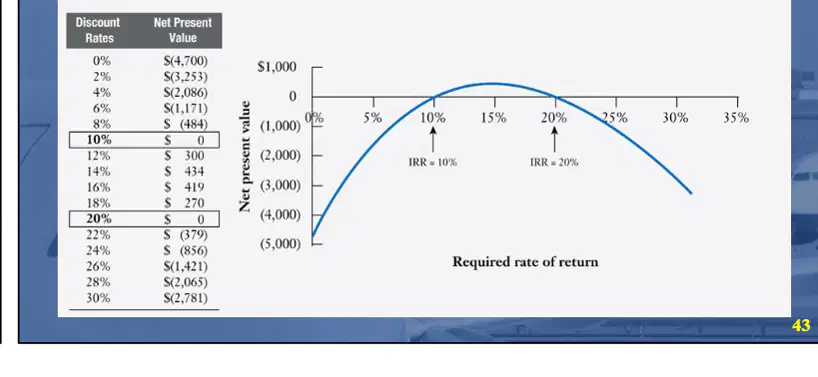
Based on the graph provided, which of the following statements is true regarding the IRR for the investment project?
There is only one IRR at 10%
There are two IRRs, one at 10% and one at 20%
There are three IRRs at different rates
The IRR is constant regardless of the discount rate
When comparing two mutually exclusive projects, why might IRR and NPV not lead to the same conclusion?
IRR and NPV always lead to the same conclusion.
IRR and NPV calculations do not consider the financial feasibility of projects.
The ranking of two projects may not be the same using NPV and IRR.
NPV is only used for non-exclusive projects.
According to Figure 11-2, which method should be used to get the correct ranking for mutually exclusive projects?
Use IRR as it is more reliable.
Use NPV as it will give the correct ranking for the projects.
Use both IRR and NPV and average the results.
The method does not matter as both will give the same result.

