Wayground logo

Free Printable Worksheets

Font size

S
M
L
XL
Worksheets

History STAAR review

Total questions: 161

Worksheet time: 4hrs 36mins

Name
Class
Date
1.

Southern states passed "Black Codes" in order to-

a)

limit the effects of Reconstruction amendments

b)

increase the labor supply for factories in the North

c)

decrease the number of northern representatives in Congress

d)

improve relations with the Democratic Party

2.

Which of the following reversed the Supreme Court ruling in Dred Scott v Sanford?

a)

The Dawes Act

b)

The 14th Amendment

c)

The Compromise of 1877

d)

The Kansas-Nebraska Act

3.

After General Robert E Lee's surrender at Appomattox Courthouse, the main priority of the United States was to-

a)

elect a new president and vice-president

b)

complete construction of the Capitol

c)

establish Union forts in the former Confederate states

d)

implement a plan to bring Confederate states back into the Union

4.

This painting of a Missouri scene (called The County Election) was completed in 1852. Such scenes would look dramatically different after the-

a)

ratification of the 15th Amendment

b)

Second Great Awakening

c)

emergence of Manifest Destiny

d)

expansion of the factory system in the South

5.

The 13th Amendment to the Constitution affected the lives of millions of African Americans by-

a)

providing them with voting rights

b)

guaranteeing their freedom of speech

c)

providing them with access to the Court system

d)

guaranteeing their permanent freedom from slavery

6.

What is the significance of the Civil Rights Act of 1866?

a)

It was the first time Congress overrode a presidential veto

b)

It represented a shift in federal power after the impeachment of President Johnson

c)

It was the first time Congress passed a law that protected racial minorities

d)

It represented the failure of northern abolitionists to influence Reconstruction policies

7.

A historian is writing an article for a history website. The article is divided into the following topics:


*The division of the South into military districts

*The impeachment of the president

*The ratification of the 14th and 15th amendments


Which era in US history is the focus of this article?

a)

The Jacksonian era

b)

The antebellum era

c)

The Federalist era

d)

The Reconstruction era

8.

*Establishment of the South's first state-funded school system

*Prohibition of racial discrimination


These reforms were instituted by:

a)

governors during the colonial era

b)

Reconstruction governments after the Civil War

c)

Patriots during the American Revolution

d)

revivalists after the Second Great Awakening

9.

"The powers not delegated to the United States by the Constitution, nor prohibited by it to the States, are reserved for the States respectively, or to the people." - 10th Amendment to the Constitution


Conflicting interpretations of this amendment played a major role in the-

a)

Bank War

b)

Nullification Crisis

c)

Corrupt Bargain

d)

XYZ Affair

10.

Which of the following was a job that the Freedmen's Bureau performed?

a)

Established Schools

b)

Certified applications for political office

c)

Granted small business loans

d)

Provided funds for farming supplies

11.

Poll taxes and Literacy tests are examples of ways Southern states weakened the effects of the-

a)

Compromise of 1850

b)

15th amendment

c)

The Treaty of Guadalupe Hidalgo

d)

Dred Scot v Sanford decision

12.

Which of these prompted Congress to pass the 14th amendment?

a)

The popular sovereignty provision in the Kansas-Nebraska Act

b)

The positions taken by the Know-Nothing Party

c)

The Black Codes enacted by the South after the Civil War

d)

The opposition of the South to the Emancipation Proclamation

13.

What was one long-term consequence of the sharecropping system?

a)

Agricultural workers organized labor unions

b)

Many former slaves became trapped in a cycle of debt

c)

Many agricultural workers moved to cities to start small businesses

d)

Land owners sold property to pay wages to former slaves

14.

The abolitionist movement achieved its goal with the passage of which amendment?

a)

12th amendment

b)

13th amendment

c)

14th amendment

d)

15th amendment

15.
a)

F

b)

G

c)

H

d)

J

16.
a)

F

b)

G

c)

H

d)

J

17.
a)

F

b)

G

c)

H

d)

J

18.
a)

F

b)

G

c)

H

d)

J

19.
a)

F

b)

G

c)

H

d)

J

20.
a)

F

b)

G

c)

H

d)

J

21.
a)

F

b)

G

c)

H

d)

J

22.
a)

A

b)

B

c)

C

d)

D

23.
a)

A

b)

B

c)

C

d)

D

24.
a)

F

b)

G

c)

H

d)

J

25.
a)

A

b)

B

c)

C

d)

D

26.
a)

A

b)

B

c)

C

d)

D

27.
a)

F

b)

G

c)

H

d)

J

28.
a)

A

b)

B

c)

C

d)

D

29.
a)

A

b)

B

c)

C

d)

D

30.

The Northwest Ordinance established a way for admitting new states. What is the key word for Northwest Ordinance?

a)

weak central government

b)

process

c)

representation

d)

representation and slavery

31.

The First Amendment is the most tested amendment. Which of the 5 freedoms is asked most often?

a)

cruel or unusual punishment

b)

trial by jury

c)

no unreasonable search or seizure

d)

religious

32.

Which group supported ratification of the Constitution for a stronger central government?

a)

Anti-Federalists

b)

Federalists

33.

Which group was against ratification of the Constitution because it didn't have a Bill of Rights?

a)

Anti-Federalists

b)

Federalists

34.

What had a weak central government?

a)

Articles of Confederation

b)

Constitution

c)

Fundamental Orders of Connecticut

d)

Parliament

35.

The Great Compromise was between large and small states. What is the key word for this compromise?

a)

process

b)

representation

c)

slavery

d)

weak central government

36.

The Three-Fifths Compromise was between Northern and Southern states. The key words are representation and...

a)

process

b)

slavery

c)

weak central government

37.

One principle of the Constitution is Checks and balances. What are the 2 keys words for this principle?

a)

3 branches

b)

representatives

c)

overrride

d)

veto

38.

Which amendment protects people from unreasonable searches and seizures?

a)

First Amendment

b)

Fourth Amendment

c)

Sixth Amendment

d)

Eighth Amendment

39.

Which amendment guarantees trial by jury?

a)

First Amendment

b)

Fourth Amendment

c)

Sixth Amendment

d)

Eighth Amendment

40.

The Federalists supported ratification of the Constitution. They included James Madison and...

a)

George Mason

b)

Alexander Hamilton

c)

Patrick Henry

41.

Which document influenced the Founding Fathers to include in the Bill of Rights that no citizen shall “be deprived of life, liberty, or property without due process of law?”

a)

Mayflower Compact

b)

Lincoln's Second Inaugural Address

c)

Magna Carta

d)

Declaration of Independence

42.

Which principle means the state governments and the federal government share power?

a)

federalism

b)

popular sovereignty

c)

limited government

d)

separation of powers

43.

Which amendment protects Americans from cruel and unusual punishment?

a)

First Amendment

b)

Fourth Amendment

c)

Sixth Amendment

d)

Eighth Amendment

44.

Which principle of the Constitution is reflected in the Tenth Amendment?

a)

Checks and balances

b)

Federalism

c)

Separation of powers

d)

Republicanism

45.

a)

F

b)

G

c)

H

d)

J

46.

a)

A

b)

B

c)

C

d)

D

47.

a)

F

b)

G

c)

H

d)

J

48.

a)

F

b)

G

c)

H

d)

J

49.

a)

A

b)

B

c)

C

d)

D

50.

a)

F

b)

G

c)

H

d)

J

51.

a)

A

b)

B

c)

C

d)

D

52.

a)

F

b)

G

c)

H

d)

J

53.

a)

A

b)

B

c)

C

d)

D

54.

a)

F

b)

G

c)

H

d)

J

55.

a)

A

b)

B

c)

C

d)

D

56.

a)

F

b)

G

c)

H

d)

J

57.

a)

F

b)

G

c)

H

d)

J

58.

a)

F

b)

G

c)

H

d)

J

59.

a)

F

b)

G

c)

H

d)

J

60.

a)

A

b)

B

c)

C

d)

D

61.

a)

A

b)

B

c)

C

d)

D

62.

a)

F

b)

G

c)

H

d)

J

63.

a)

F

b)

G

c)

H

d)

J

64.

a)

A

b)

B

c)

C

d)

D

65.

A historian is writing an article for a history website. The article is divided into the following topics below:

Which era in U.S. history is the focus of this article?

a)

The Jacksonian era.

b)

The antebellum era.

c)

The Federalist era.

d)

The Reconstruction era.

66.
What is the historical significance of this act below?
a)
It was the first time Congress voted to overrule a presidential veto.
b)
It represented a shift in federal power after the impeachment of President Johnson.
c)
It was the first time Congress passed a law that protected racial minorities.
d)
It represented the failure of northern abolitionists to influence Reconstruction policies.
67.
The election of Hiram Rhodes Revels in 1870 was significant because he was the first African American to?
a)
win an election as a member of the Democratic Party.
b)
win a majority of the popular vote in Mississippi.
c)
serve as a member of the U.S. Senate.
d)
run for public office in the South.
68.
After the Civil War, southern states adopted Black Codes to?
a)
punish plantation owners for the use of slavery.
b)
support Radical Reconstruction objectives in the South.
c)
promote the activities of the Freedmen’s Bureau.
d)
imit the impact of the Thirteenth Amendment.
69.
What was one long-term consequence of the sharecropping system?
a)
Agricultural workers organized labor unions.
b)
Many former slaves became trapped in a cycle of debt.
c)
Many agricultural workers moved to cities to start small businesses.
d)
Landowners sold property to pay wages to former slaves.
70.
This list below describes conditions found in —
a)
California following the Gold Rush.
b)
Washington, D.C., during the War of 1812.
c)
western territories after the U.S.-Mexican War.
d)
southern states at the beginning of Reconstruction.
71.
Southern states passed the codes described in this excerpt below in order to —
a)
limit the effects of the Reconstruction Amendments.
b)
increase the labor supply for factory jobs in the North.
c)
decrease the number of northern representatives in Congress.
d)
improve relations with the Democratic Party.
72.
One effect of the Dawes Act was that it?
a)
caused many American Indian tribes to create written constitutions.
b)
provided education to American Indians through locally run schools.
c)
limited the voting rights of American Indians.
d)
harmed the communal structure of American Indian society.
73.
Which of these prompted Congress to propose the Fourteenth Amendment?
a)
The popular sovereignty provision in the Kansas-Nebraska Act.
b)
The positions taken in the Know-Nothing Party platform.
c)
The Black Codes enacted by southern states after the Civil War.
d)
The opposition by southern states to the Emancipation Proclamation.
74.
Which of these occurred as a result of the Fifteenth Amendment?
a)
African American families divided by slavery were reunited. 
b)
Newly free men and women moved west to claim land.  
c)
African American men voted in the 1872 presidential election.  
d)
Newly free men and women were allowed to apply for U.S. citizenship.  
75.
The Fifteenth Amendment was ratified in order to?
a)
establish legal requirements for the education of former slaves.
b)
mandate fair labor contracts between African American workers and plantation owners.
c)
abolish the institution of slavery.
d)
protect the voting rights of African American men.
76.
The Thirteenth Amendment to the U.S. Constitution affected the lives of millions of African Americans by?
a)
providing them with voting rights.
b)
guaranteeing their freedom of speech.
c)
providing them with access to the court system.
d)
guaranteeing their permanent freedom from slavery.
77.
Which of these describes a result of the Thirteenth Amendment?
a)
African Americans in the North could vote.
b)
State governments were required to protect individual rights.
c)
Former Confederate officials were prohibited from holding elected office.
d)
African Americans in the South could move elsewhere.
78.
This painting of a Missouri scene was completed in 1852. Such scenes would look dramatically different after the?
a)
ratification of the Fifteenth Amendment.
b)
Second Great Awakening.
c)
emergence of Manifest Destiny.
d)
expansion of the factory system into the South.
79.

These reforms above were instituted by?

a)

Governors during the colonial era.

b)

Reconstruction governments after the Civil War.

c)

Patriots during the American Revolution.

d)

Revivalists after the Second Great Awakening.

80.

Which of the following best completes the list above?

a)

Established schools.

b)

Certified applications for political office.

c)

Granted small-business loans.

d)

Provided funds for farming supplies.

81.

In this excerpt above, President Hayes proposes a change in federal policy toward American Indians. Legislation based on this new policy did which of the following?

a)

Promoted individual land ownership among American Indians.

b)

Forced white settlers to leave reservation lands.

c)

Ended federal oversight of tribal governments.

d)

Granted American Indians the rights to attend public schools.

82.

The measures in the list above are examples of ways southern states weakened the effects of the?

a)

Compromise of 1850.

b)

Fifteenth Amendment.

c)

Treaty of Guadalupe Hidalgo.

d)

Dred Scott v. Sanford decision.

83.
a)

A

b)

B

c)

C

d)

D

84.
a)

A

b)

B

c)

C

d)

D

85.
a)

A

b)

B

c)

C

d)

D

86.
a)

F

b)

G

c)

H

d)

J

87.
a)

F

b)

G

c)

H

d)

J

88.
a)

F

b)

G

c)

H

d)

J

89.
a)

A

b)

B

c)

C

d)

D

90.
a)

F

b)

G

c)

H

d)

J

91.
a)

F

b)

G

c)

H

d)

J

92.
a)

F

b)

G

c)

H

d)

J

93.
a)

A

b)

B

c)

C

d)

D

94.
a)

F

b)

G

c)

H

d)

J

95.
a)

F

b)

G

c)

H

d)

J

96.
The _____________ foreign policy statement made by the 5th President stating that 1) the U.S. would not interfere in European affairs, and 2) that the western hemisphere was closed to colonization and/ or interference by European nations.
a)
Adam's Inaugural Address
b)
Washington's Farewell Address
c)
Jefferson's Embargo Act
d)
Monroe Doctrine
97.
__________ treaty ended the French and Indian War and effectively kicked the French out of North America.
a)
Treaty of Ghent
b)
Treaty of Guadalupe Hidalgo
c)
Treaty of Paris 1763
d)
Treaty of Paris 1783
98.

The _____________ Treaty ended the American Revolution and forced Britain to recognize the United States as an independent nation.

a)

Treaty of Ghent

b)

Treaty of Guadalupe Hidalgo

c)

Treaty of Paris 1763

d)

Treaty of Paris 1783

99.
________________- was a policy of establishing the principles and procedures for the orderly expansion of the United States.
a)
Judicial Review
b)
Northwest Ordinance
c)
Federalism
d)
Manifest Destiny
100.
___________ was the agreement signed in 1620 by the Pilgrims in Plymouth, to consult each other about laws for; the colony and a promise to work together to make it succeed.
a)
Mayflower Compact
b)
Representation
c)
Magna Carta
d)
Articles of Confederation
101.
___________ was a series of essays written by James Madison, John Jay, and Alexander Hamilton, defending the Constitution and the principles on which the government of the United States was founded.
a)
Anti-Federalist Writings
b)
Federalist Papers
102.
______________ was a pamphlet written by Thomas Paine to convince colonists that it was time to become independent from Britain.
a)
Federalist Papers
b)
Anti-Federalist Writing
c)
Give me Liberty or Give me Death
d)
Common Sense
103.
______________ the first ten amendments to the Constitution and detail the protection of individual liberties.
a)
Fixer Uppers
b)
Federalist Papers
c)
Bill of Rights
d)
Reconstruction Amendments
104.
_____________ is a short speech given by Abraham Lincoln to dedicate a cemetery for soldiers who died at the Battle of Gettysburg.  It is considered to be a profound statement of American ideals.
a)
Lincoln's Gettysburg Address
b)
Lincoln's First Inauguration
c)
Lincoln's Second Inaugural Address
d)
Lincoln's Farewell Address
105.
Abraham Lincoln issued the_________ on January 1, 1863, setting all slaves in the Confederate states free.
a)
Gettysburg Address
b)
Inaugural Address
c)
Emancipation Procalamation
d)
Farewell Address
106.
Lincoln's ____________ stated that, “no state…can lawfully get out of the Union”, but pledged there would be no war unless the South started it.
a)
Gettysburg Address
b)
Emancipation Proclamation
c)
First Inaugural Address
d)
Second Inaugural Address
107.
Lincoln's ___________ was meant to help heal and restore the country after four years of Civil War.
a)
Gettysburg Address
b)
Emancipation Proclamation
c)
First Inaugural Address
d)
Second Inaugural Address
108.
During the early 1800s many young women in New England were employed outside their homes as?
a)
crew members on cargo ships.
b)
cloth weavers in textile mills.
c)
H staff reporters for local newspapers.
d)
legal counselors in state courts.
109.
These innovations below in agriculture and industry resulted in?
a)
higher consumer costs.
b)
decreased profits for investors.
c)
less consumer choice.
d)
more efficient production of goods.
110.
Which factor accounts for this trend below?  
a)
The Second Great Awakening motivated people to join reform movements.
b)
Manifest Destiny inspired many people to become homesteaders.  
c)
Jacksonian Democracy allowed more people to vote in elections.  
d)
The Industrial Revolution encouraged people to pursue jobs in cities. 
111.
How did the development of the factory system encourage urbanization?
a)
Manufacturers produced goods to export overseas.
b)
Labor unions were formed to protect mill workers.
c)
Workers moved closer to manufacturing centers.
d)
Industrialists invested in cotton plantations.
112.
After the War of 1812, thousands of settlers and immigrants moved to the western frontiers of the United States in search of farming and business opportunities. In response, the government began building roads. This transportation network was intended to?
a)
promote the free-enterprise system.
b)
establish federal control over industry.
c)
discourage the organization of new territories.
d)
prevent border disputes between states.
113.
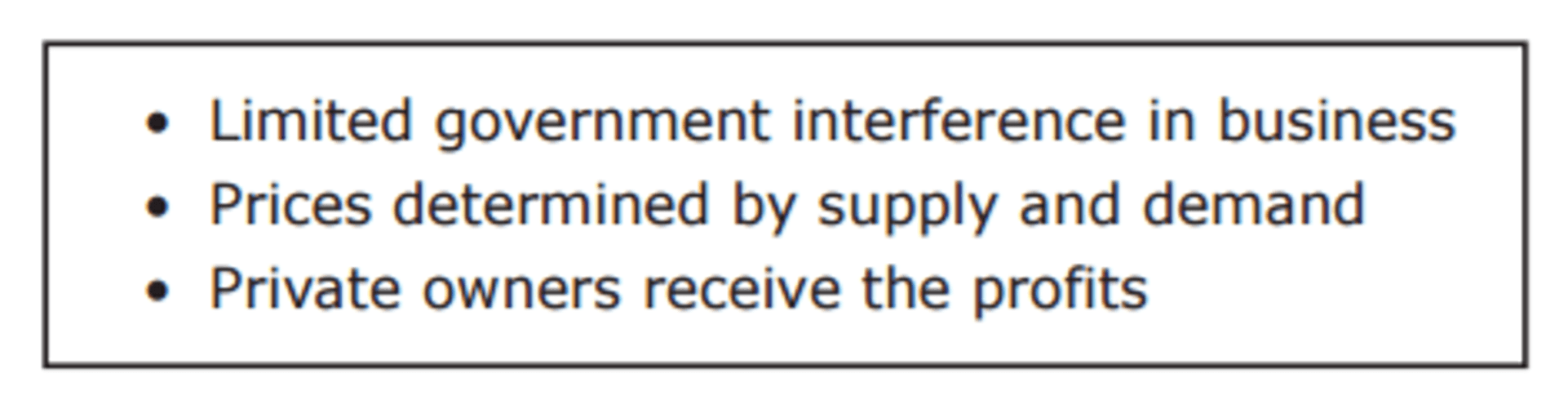
Which type of economy is best described by these characteristics below?
a)
Subsistence farming.
b)
Free enterprise.
c)
Mercantilism.
d)
Socialism.
114.
Which of these occurred during early U.S. industrialization?  
a)
Manufacturers instituted a five-day workweek.  
b)
Labor laws required factories to provide a safe working environment.  
c)
Workers were required to attend schools to develop technical skills.  
d)
Production of goods transitioned from homes to factories.  
115.
These developments below occurred as a result of increased —
a)
industrialization
b)
westward migration
c)
expansion of U.S. territory
d)
government regulation of business
116.
Which of these was an effect of the Industrial Revolution on U.S. women in the early nineteenth century?
a)
Women in unions gained bargaining power with employers.
b)
The government passed laws to improve safety for women in the workplace.
c)
Women seeking work migrated from rural communities to cities.
d)
State governments called conventions in support of women’s suffrage.
117.

Which sentence best completes this diagram?

a)

Cities grew rapidly.

b)

Demand for artisans increased.

c)

Farms experienced a shortage of labor.

d)

Government regulation of factories increased.

118.

What was one result of industrialization in the United States during the mid-1800’s?

a)

Sectional differences increased.

b)

The federal government prohibited immigration.

c)

Job opportunities.

d)

Fewer public lands were devoted to transportation.

119.

How did advancements in industrial technologies affect businesses during the late nineteenth century?

a)

By making handcrafted goods more affordable.

b)

By improving production methods and increasing competition.

c)

By forcing producers to manufacture multiple products.

d)

By causing an increase in wages for factory workers.

120.

How did new methods of mass production contribute to the Industrial Revolution?

a)

New products were all made by hand.

b)

Businesses used sharecropping to increase the production of goods.

c)

New products were made quickly and cheaply

d)

Cities became ghost towns because machines replaced manual labor.

121.
Which shaded state was the main destination of American Indians forced to relocate as part of the Trail of Tears?
a)
A
b)
B
c)
C
d)
D
122.
During the 1830s public servants and officials were widely perceived to be unqualified. What practice reinforced that perception?
a)
The public voting for candidates based on religious affiliations.
b)
The president rewarding political supporters with appointments to desirable positions.
c)
The federal government recruiting volunteers to serve abroad as ambassadors.
d)
Legislators awarding government contracts to the lowest bidders.
123.
What was one effect of these events below, on the 1828 presidential election?
a)
Votes were cast by secret ballot.
b)
Property qualifications for voting were strengthened.
c)
 Poll taxes were reduced.
d)
Voter participation increased.
124.
What was a major reason for the federal government’s involvement in the relocations depicted on this map below?
a)
To persuade American Indians to become farmers.
b)
To gain access to important rivers.
c)
To punish American Indians who were allies of the British.
d)
 To acquire valuable agricultural land and natural resources.
125.
Conflicting interpretations of this amendment below played a major role in the?
a)
Bank War
b)
Nullification Crisis
c)
Corrupt Bargain
d)
XYZ Affair
126.
The proclamation excerpted below was issued during which of these historical events?
a)
Shays’s Rebellion
b)
The War of 1812
c)
The Nullification Crisis
d)
The Civil War
127.
These speakers below are debating an issue that eventually became known as the —
a)
Monroe Doctrine
b)
Nullification Crisis
c)
Missouri Compromise
d)
Three-Fifths Compromise
128.
In 1832 the Supreme Court ruled that Georgia did not have legal authority over the Cherokees living in the state. President Andrew Jackson responded to this decision by?
a)
filing another petition against the Cherokee Nation.
b)
ignoring the ruling and allowing Georgia to evict the Cherokee Nation.
c)
ordering state officials in Georgia to negotiate with the Cherokee Nation.
d)
asking Congress to pay reparations to the Cherokee Nation.
129.
What led to the conflict referred to in this excerpt below?
a)
The passage of the Dawes Act.
b)
The Louisiana Purchase.
c)
The adoption of Indian removal policies.
d)
The Battle of Tippecanoe.
130.
One attempt to resolve this issue below without violence involved which action?
a)
The Cherokee Nation challenged Georgia’s anti-Cherokee laws before the U.S. Supreme Court.
b)
Georgia asked the federal government for funds to purchase Cherokee land.
c)
The Cherokee Nation asked President Andrew Jackson to negotiate with Georgia.
d)
Georgia offered to grant U.S. citizenship to the Cherokees.
131.

What was the primary question surrounding the 1832 Nullification Crisis?

a)

Can the federal government regulate interstate commerce.

b)

Can a state regulate a federal agency.

c)

Can a state overturn a federal law.

d)

Can the federal government levy taxes on states.

132.

The Trail of Tears refers to

a)

Jackson’s angry negotiations with the Five Civilized Tribes.

b)

the movement of Seminole Indians from the West to Florida.

c)

government workers who lost their jobs due to Jackson’s spoils system.

d)

the removal of Cherokee Indians from Georgia to Indian Territory.

133.
Andrew Jackson ran on the support of the "common man". Which is the best description of what this means?
a)
He made himself relatable to the average American.
b)
He limited the amount of voters by increasing property requirements
c)
He supported transportation growth
d)
He came from a wealthy family in the upper class
134.

The idea that America has the "God give" right to expand its territory west to the Pacific Ocean was known as --

a)

Nullification Crisis

b)

Trail of Tears

c)

Free Enterprise

d)

Manifest Destiny

135.

The 2 key words for the Nullification Crisis are federal law and...

a)

slavery

b)

state

c)

spoils system

d)

ignore

136.

Jackson ignored the Supreme Court ruling...

a)

Marbury v. Madison

b)

Worcester v. Georgia

137.

What was significant about the election of Andrew Jackson?

a)

only men with property could vote

b)

the House of Representatives handed Jackson his victory

c)

1st time men were allowed to vote who were not property owners

d)

wealthy elitists helped Jackson earn the Presdency

138.
Under the Articles of Confederation, the government consisted of _______________ branch of government.
a)
3
b)
2
c)
1
d)
4
139.
The New Jersey Plan was supported by _____ states and the Virginia Plan was supported by _____ states
a)
northern; southern
b)
large; small
c)
southern; northern
d)
small; large
140.

Why was "The Great Compromise" so important?

a)

It created the Senate and the House of Representatives.

b)

Smaller states seceded.

c)

Larger states had all the power in the government.

d)

People never argued again.

141.
The Federal government is also known as?
a)
Limited government
b)
Main Government
c)
National Government
d)
Official government
142.
Free Speech is found in which Amendment?
a)
First Amendment
b)
Second Amendment
c)
Third Amendment
d)
Fourth Amendment
143.
People gathering in groups protesting peacefully with the Black Lives Matter group is an example of what 1st Amendment freedom?
a)
speech
b)
assembly
c)
petition
d)
press
144.

Police must get a warrant to search citizens' property

a)

1st

b)

2nd

c)

8th

d)

4th

145.
What is federalism?
a)
The people vote for their leaders who then represent them. 
b)
The people have individual rights. 
c)
There are three branches of government. 
d)
The state and national government share power. 
146.
Which group of people wanted the Constitution to include a Bill of Rights?
a)
Federalists
b)
Anti-federalists
c)
Democrats
d)
Northerners
147.

The first Ten Amendments to the Constitution are called the _______.

a)

Bill of Rights

b)

Preamble

c)

Articles

d)

Naturalization

148.

What is the principle of republicanism?

a)

Government should be split into three branches.

b)

The people create the government.

c)

The power of government should be limited.

d)

The people elect representatives to make laws.

149.

The biggest issue between the Federalist and the Anti-Federalist was

a)

Expanding slavery

b)

Ratification of the Constitution

c)

Choosing a lead actor for the Hamilton musical

d)

Changing the boundary of the US

150.
The Intolerable Acts, First Continental Congress, and Thomas Paine's Common Sense all occurred during ...
a)
westward expansion
b)
Era of Good Feelings
c)
Revolutionary Era
d)
Jacksonian Era
151.
June 1776
*Continental Congress appoints a committee to prepare a document
*Thomas Jefferson is chosen to write the document
*Draft of document is reviewed and revised
July
* Congress debates and revises the document
*the document is approved
a)
Articles of Confederation
b)
Bill of Rights
c)
Treaty of Paris
d)
Declaration of Independence
152.
British colonists objected to the Proclamation of 1763 because they...
a)
feared it would provoke attacks from the Native Americans.
b)
did not want to share control of the fur trade with France.
c)
resented the limits it imposed on westward expansion.
d)
wanted to trade freely with foreign nations.
153.
It is essential to the freedom and security of a free people , that no taxes be imposed upon them but by their own consent, or their representatives.
---The Sons of Liberty, address to the public, New York, 1773
This excerpt reflects the dissatisfaction of American colonists with the---
a)
political debates that took place at the Albany Convention.
b)
interference of Britain with the slave trade.
c)
economic consequences of the Great Awakening.
d)
economic policies imposed by Great Britain following the French and Indian War.
154.
the Sugar Act, Quartering Act, and Stamp Act contributed to the start of the American Revolution by...
a)
restricting colonial trade with American Indians.
b)
imposing regulations on colonial agriculture.
c)
angering colonists who believed that their civil liberties were being violated.
d)
punishing colonists for resisting Parliament.
155.
The group responsible for answering these questions:
How do we finance a war?
Who has the power to negotiate treaties?
What prevents the executive from becoming too powerful
was the...
a)
settlers creating the Mayflower Compact.
b)
delegates writing the Articles of Confederation.
c)
representatives drafting the Fundamental Orders of Connecticut.
d)
colonists negotiating the Albany Plan of New York.
156.
America may boast that she has accomplished what no power before her ever did, contending with Britain--Capturing two of their celebrated generals and each an Army of thousands of veteran troops to support them.
---Abigail Adams, letter to John Adams, 1781
to which of the following is Abigail Adams referring to?
a)
The American victory at the Battle of Yorktown.
b)
The negotiation of the Treaty of Paris.
c)
The bravery of the soldiers at Valley Forge.
d)
The arrival of French aid after the Battle of Saratoga.
157.
The Battle of ______________ renewed patriots' hopes for independence and secured foreign recognition and support.
a)
Saratoga
b)
Concord
c)
Trenton
d)
Yorktown
158.
Which excerpt from the Declaration of Independence best explains why colonists were unhappy about their lack of representation in British Parliament?
a)
He has refused to pass other Laws for the accommodation of large districts of people.
b)
For imposing taxes on us without our consent.
c)
He has refused his assent to laws, the most wholesome and necessary for the public good.
d)
For transporting us beyond seas to be tried for pretended offences.
159.
The Continental Congress appointed/commissioned _________________ as General and Commander in chief of the Continental Army in 1775.
a)
Benedict Arnold
b)
Alexander Hamilton
c)
Thomas Paine
d)
George Washington
160.
Parliament passes the Tea Act of 1773---Colonists dump the tea into the Boston Harbor---?
Which of the following completes the events?

a)
Parliament repeals the Stamp and Sugar Acts
b)
King George III allows colonists to petition Parliament for relief
c)
Parliament passes the Intolerable Acts
d)
King George appoints colonial representatives to Parliament
161.
What was one result of the Treaty of Paris 1783?
a)
Great Britain recognized the United States as an independent country.
b)
Competing Seminole and Spanish claims in West Florida were resolved
c)
The British navy agreed to stop impressing American sailors
d)
British territory in eastern Canada was ceded to France