wayground logo

Free Printable Worksheets

NEW

Font size

S
M
L
XL
Worksheets

Revision Quiz

Total questions: 80

Worksheet time: 4hrs 38mins
Name
Class
Date
1.
What kind of triangles does the Pythagorean Theorem work with?
a)
Right
b)
Left
c)
Isosceles
d)
Equilateral
2.
What is the formula used to solve for the hypotenuse?
a)
a2+b2=c2
b)
a+b=c
c)
a2-b2=c2
d)
c-a=c
3.
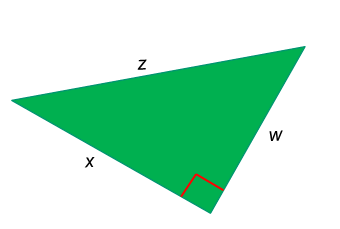
Identify the hypotenuse.
a)
x
b)
z
c)
w
4.
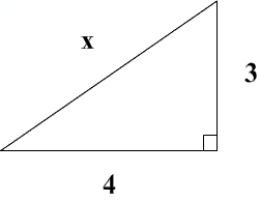
What is the length of x?
a)
5
b)
7
c)
8
d)
25
5.
What is the length of x?
a)
5.7
b)
10.6
c)
20
d)
400
6.
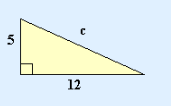
solve for c
a)
7
b)
9
c)
4
d)
13
7.
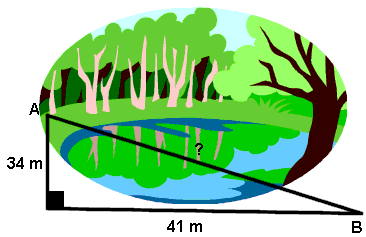
To get from point A to point B you must avoid walking through a pond.  To avoid the pond, you must walk 34 meters south and 41 meters east.  To the nearest meter, how many meters would be saved if it were possible to walk through the pond? 
a)
35
b)
22
c)
58
d)
75
8.
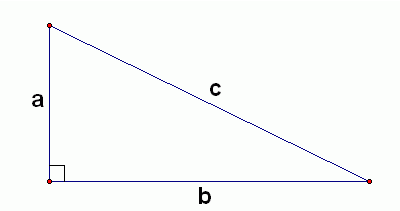
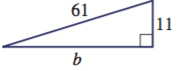
Find the length of b in this triangle.
a)
31
b)
36
c)
60
d)
62
9.
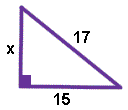
Find x.
a)
35
b)
20
c)
8
d)
12
10.
Find the length of b in this triangle.
a)
31
b)
36
c)
60
d)
62
11.

Osmosis is specifically.....

a)

diffusion of water molecules through a semi-permeable mebrane from an area of low concentration to an area of high concentration

b)

the diffusion of particles from an area of high concentration to an area of low concentration

c)

diffusion of water molecules through a semi-permeable membrane from an area of high concentration to an area of low concentration

d)

the diffusion of particles from an area of low concentration to an area of high concentration

12.
What is the diffusion of water only across a cell or semi-permeable membrane?
a)
Osmosis
b)
Diffusion
c)
Active Transport
d)
Passive Transport
13.
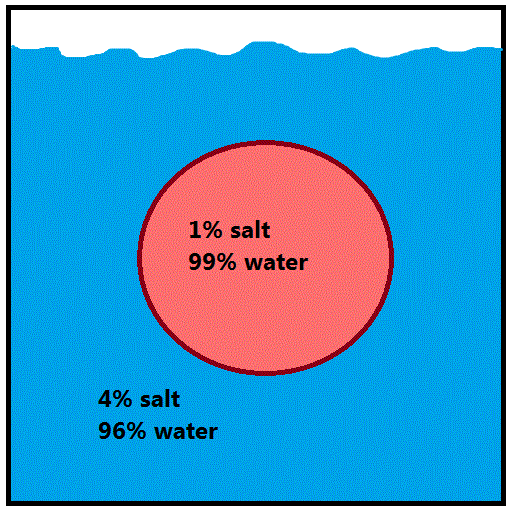
In which case would a cell most likely shrink?
a)
when placed in a solution containing a high salt concentration
b)
when placed in a isotonic solution
c)
when placed in a solution containing a low pH
d)
when placed in a solution containing distilled water
14.
Active transport requires energy because...
a)
The cell is moving something against a concentration gradient
b)
The cell is moving something with a concentration gradient
15.
A student noticed that placing wilted lettuce in a bowl of cool water caused the lettuce to become more crisp and firm. What is the best explanation for his observation?
a)
Water moved into the lettuce cells by active transport.
b)
Water moved into the lettuce cells by osmosis.
c)
Salt moved into the lettuce cells by diffusion.
d)
Water moved out of the lettuce cells by osmosis.
16.
_______ regulates what enters and leaves a cell.  
a)
Cell Membrane
b)
Nucleus
c)
Mitochondria
d)
Cytoplasm
17.
Where is there a low concentration of dye?
a)
at the bottom of cup
b)
in the color
c)
at the top of cup 
d)
no concenteraion gradient
18.
The picture below is an example of _________________.
a)
osmosis
b)
isotonic
c)
diffusion
d)
active transport
19.
Where will the water go?
a)
Into the cell
b)
Out of the cell
c)
Equally in & out - it's isotonic
d)
There is no water
20.

Nemo and other ocean dwelling fish cannot survive in freshwater because......

a)

freshwater is hypertonic to Nemo's cells and will result in water leaving them causing the cells to shrink

b)

freshwater is hypotonic to Nemo's cells and will result in water leaving them causing the cells to shrink

c)

freshwater is hypertonic to Nemo's cells and will result in water entering them causing the cells to swell and burst

d)

freshwater is hypotonic to Nemo's cells and will result in water enter them causing the cells to swell and burst

21.

In the cell pictured, which way would water move?

a)

Into the cell, causing the cell to swell

b)

Out of the cell, causing the cell to shrink

c)

In and out of the cell equally, keeping the shape the same

22.

In the cell pictured, where would water move? 

a)

Into the cell, causing it to swell

b)

Out of the cell, causing it to shrink

c)

In and out of the cell equally, causing the shape to stay the same

23.

In the cell pictured, which way would water move?

a)

Into the cell, causing the cell to swell

b)

Out of the cell, causing the cell to shrink

c)

In and out of the cell equally, keeping the shape the same

24.

In the cell pictured, which way would water move?

a)

Into the cell, causing the cell to swell

b)

Out of the cell, causing the cell to shrink

c)

In and out of the cell equally, keeping the shape the same

25.

In the cell pictured, which way would water move?

a)

Into the cell, causing the cell to swell

b)

Out of the cell, causing the cell to shrink

c)

In and out of the cell equally, keeping the shape the same

26.

A tree diagram is useful in determining the __________of a probability experiment.

a)

result

b)

possible outcomes

c)

event

d)

none of the above

27.

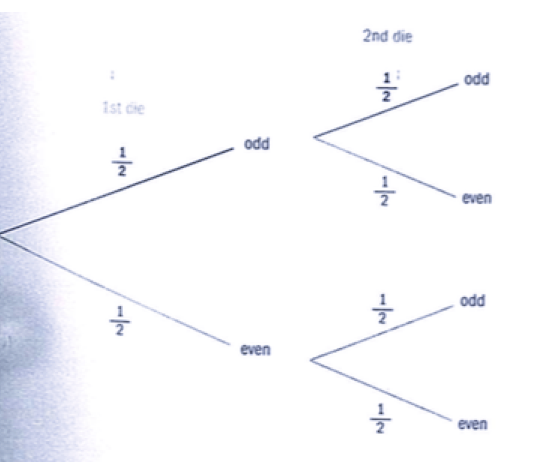
Two dice are rolled and it is recorded whether the result on each is odd or even. What is the probability both are odd?

a)

1/4

b)

1/2

c)

2/4

d)

3/4

28.

Two dice are rolled and it is recorded whether the result on each is odd or even. What is the probability that one is even and one is odd?

a)

1/2

b)

1/4

c)

3/4

d)

1/3

29.
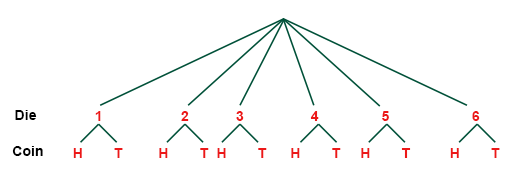
The tree diagram shows the outcomes of rolling a die and flipping a coin.  
How many total outcomes are there?  
a)
6
b)
12
c)
24
d)
36
30.
The tree diagram shows the outcomes of rolling a die and flipping a coin.  
What is the probability of rolling an even number and flipping a head?
a)
3/12
b)
1/2
c)
4/12
d)
0/12
31.
The tree diagram shows the outcomes of rolling a die and flipping a coin.  
What is the probability of rolling a less than 6 and flipping a head?
a)
2/12
b)
3/12
c)
4/12
d)
5/12
32.
A bag contains 3 white balls, 4 green balls. 2 balls are drawn from the bag without replacement.
Use a tree diagram to find the probability that the balls are white colors.
a)
5/13
b)
5/42
c)
6/42
d)
3/7
33.
A bag contains 3 white balls, 4 green balls. 3 balls are drawn from the bag without replacement.
Use a tree diagram to find the probability that the balls are white colors.
a)
5/18
b)
6/210
c)
6/18
d)
5/210
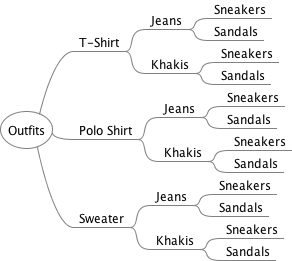
34.
How many total outfit options are represented?
a)
12
b)
22
c)
3
35.
The cafeteria is serving three kinds of sandwiches:  tuna (T), chicken, (C), and peanut butter (P).  They are also serving a choice of two drinks:  milk (M) or water (W).  Which shows the complete set of possible combinations?
a)
TW, CW, PW
b)
TW, TM, TC, CW, PW
c)
TW, TM, CW, CM, PW, PM
d)
TCP, MW
36.
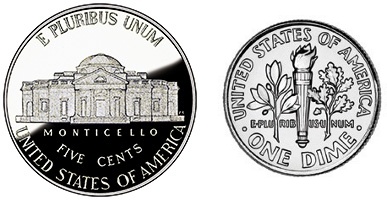
Which shows the sample space for flipping two coins?
a)
H, T
b)
HH, HT, TH, TT
c)
HH, TT
d)
Dime, Nickel
37.

You have a 3 tops, 2 pants and 2 shoes. How many total outfit options are represented?

a)

12 outfits

b)

22 outfits

c)

3 outfits

d)

7 outfits

38.

Use the tree diagram to find the probability of tossing a head first and then a tail when a coin is tossed twice.

a)

1

b)

1/2

c)

1/4

d)

1/8

39.

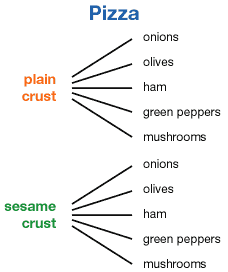
What is the probability that you will get plain crust with ham on your pizza?

a)

1/8

b)

1/2

c)

1/10

d)

2/10

40.

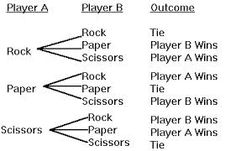
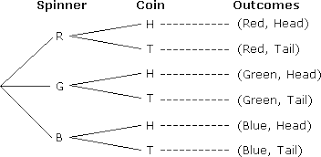
Which tree diagram has the most possible outcomes?
a)
b)
c)
41.
Simplify the algebraic fraction.
a)
2pq
b)
2/pq
c)
pq/2
d)
p/2q
42.
Simplify the algebraic fraction.
a)
-3/b
b)
-b/3
c)
3b
d)
-3b
43.

Simplify the following.

155(3a)\frac{15}{5\left(3-a\right)}  

a)

33a \frac{3}{3-a\ }  

b)

3a3-a  

c)

3a3\frac{3-a}{3}  

d)

3a3\frac{3}{a-3}  

44.

Simplify the following.

(x+2)(x+3)2(x+2)2\frac{\left(x+2\right)\left(x+3\right)}{2\left(x+2\right)^2}  

a)

(x+3)2(x+2)2\frac{\left(x+3\right)}{2\left(x+2\right)^2}  

b)

x+3(x+2)\frac{x+3}{\left(x+2\right)}  

c)

x+32\frac{x+3}{2}  

d)

x+32(x+2)\frac{x+3}{2\left(x+2\right)}  

45.
a)

10a/10b

b)

10a/5b

c)

2a/b

d)

a/b

46.
a)

a/2

b)

3a/6

c)

8a/6

d)

7a/6

47.
a)

8m2/8n2

b)

13m/4n

c)

13m2/4n2

d)

8m/8n

48.
a)

4/p

b)

5/p

c)

14/p2

d)

4/p2

49.
a)

6am/10a

b)

9

c)

9ma/3a

d)

6m

50.
a)

2by/c

b)

4xb/ac

c)

2xb/ac

d)

ac/dc

51.
a)

a2/6

b)

2a/3a

c)

3a/2a

d)

3/2

52.
a)

3c

b)

9b/4a

c)

4a

d)

2c/b

53.
Simplify the algebraic fraction.
a)
-m
b)
-1/m
c)
m/n
d)
1/mn
54.

Simplify the following.

6t5÷34t\frac{6t}{5}\div\frac{3}{4t}  

a)

8t25\frac{8t^2}{5}  

b)

18t20t\frac{18t}{20t}  

c)

9t10t\frac{9t}{10t}  

d)

10t8\frac{10t}{8}  

55.

Simplify the following.

5q7÷9q8\frac{5q}{7}\div\frac{9q}{8}  

a)

4063\frac{40}{63}  

b)

14q15\frac{14q}{15}  

c)

103q56\frac{103q}{56}  

d)

45q56\frac{45q}{56}  

56.

Simplify the following.

59e÷83e\frac{5}{9e}\div\frac{8}{3e}  

a)

87e27e2\frac{87e}{27e^2}  

b)

1312e\frac{13}{12e}  

c)

4027e2\frac{40}{27e^2}  

d)

524\frac{5}{24}  

57.
The SI unit of energy is _________________?
a)
Newton metre (Nm)
b)
Newton per metre  (N/m)
c)
Joule (J)
d)
Joule per metre (J/m)   
58.
When a ball accelerates down a slope, it _________________
a)
gains both kinetic energy and potential energy
b)
gains kinetic energy but loses potential energy
c)
gains potential energy but loses kinetic energy
d)
neither gains nor loses both kinetic energy and potential energy     
59.
A man of weight 900 N walks up a hill of height 10 m. What is the total work done?
a)
0 J       
b)
90 J
c)
900 J   
d)
9000 J             
60.
A boy lifted his school bag of mass 3 kg from the floor to his lap through a height of 0.5 m. What is the gravitational potential energy gained by the bag?
a)
1.5 J                 
b)
15 J     
c)
150 J
d)
1500 J
61.
What is mass?
a)
It is the amount of matter in a body
b)
It is the amount of force in a body
c)
it is the gravitational force acting on a body
d)
it is the kinetic force acting on a body
62.
What is weight?
a)
It is the amount of matter in a body
b)
It is the amount of force in a body
c)
it is the gravitational force acting on a body
d)
it is the kinetic force acting on a body
63.
What happen to the gravitational force on a body when u move away from earth's surface?
a)
it becomes stronger
b)
it becomes weaker
c)
it remains the same
d)
it become stronger first then it weakens
64.
Which of the following about mass and weight is true?
a)
weight is independent of gravity while mass is dependent of gravity
b)
mass is independent of gravity while weight is dependent of gravity
c)
Both are independent of gravity
d)
Both are dependent of gravity
65.
What is the formula for weight?
a)
W = m/g
b)
W = g/m
c)
W = mg
d)
W = mg2
66.
What is the formula for K.E.?
a)
(1/2)mv
b)
(1/2)m2v
c)
(1/2)mv2
d)
mv2
67.
What is the formula for G.P.E.?
a)
mgh
b)
mg/h
c)
m2gh
d)
mgh2
68.
What is the work done by the man?
a)
0 J
b)
65 J
c)
6500 J
d)
0.0065 J
69.

What net force is required to accelerate a car at a rate of 2 m/s2 if the car has a mass of 3,000 kg?

a)

2 m/s2

b)

6,000 N

c)

6,000 kg

d)

1,500 N

70.

What force does Mr. Demers need to produce in order to throw his 10 kg bowling ball down an alleyway with an acceleration rate of 3 m/s2?

a)

30 N

b)

30 m/s2

c)

3.33 N

d)

0.3 N

71.

What is the mass of a falling rock if it produces a force of 147 N? (assume acceleration of gravity is 9.8 m/s2)

a)

15 kg

b)

15 N

c)

0.067 kg

d)

1,440.6 kg

72.

What is the mass of Mr. Sullivan's truck if it produces a force of 14,000 N while accelerating at a rate of 5 m/s2?

a)

2,800 kg

b)

280 kg

c)

70,000 kg

d)

2,800 N

73.

What is the acceleration of a softball if it has a mass of 0.5 kg and hits the catcher's glove with a force of 25 N?

a)

50 m/s2

b)

12.5 m/s2

c)

50 N

d)

0.2 m/s2

74.

Karen's car has a mass of 2,000 kg. If her car exerts a force of 8,500 N, how fast will it accelerate?

a)

4.25 m/s2

b)

0.24 m/s2

c)

17,000,000 m/s2

d)

42.5 m/s2

75.

If a force of 26 N is exerted on two balls, one with a mass of 0.52 kg and the other with a mass of 0.78 kg, which ball will have the greater acceleration? (F=ma)

a)

The one with a mass of .78 kg will have the greatest acceleration.

b)

The one with a mass of .52 kg will have the greatest acceleration.

c)

They will both accelerate at the same rate.

76.
The masses of four objects are given in this table. If all objects are struck with the same amount of force, which one will have the greatest acceleration?
a)
Object 1
b)
Object 2
c)
Object 3
d)
Object 4
77.

A student pushes a box to right with a force of 10N while a young boy pushes the same box to the left with a force of 8N. If the box weighs 22 kg, what is the acceleration of the box?

a)

44 m/s2

b)

2N

c)

0.09 m/s2

d)

220 m/s2

78.

Your car has a mass of 2500 kg and a force of 5000 N. How fast will it accelerate?

a)

20 m/s2

b)

0.5 m/s2

c)

2 m/s2

d)

120 N

79.

How much force the man will need to exert to move the car.

a)

5000 N

b)

50 N

c)

20,000 N

d)

500 N

80.

If an object was accelerating at 5 m/s2, and a force of 10 newtons was required to accelerate it, what was the object's mass?

a)

50 kg

b)

2 kg

c)

0.5 kg

d)

5 kg