
 Worksheets
Chemistry paper 1 Revision
Total questions: 111
Worksheet time: 3hrs 37mins
C + O2 --> CO2
What amount (in moles) is present in 2.0 g of sodium hydroxide, NaOH?
0.050
0.10
20
80
Lithium hydroxide reacts with carbon dioxide as follows.
2LiOH + CO2 → Li2CO3 + H2O
What mass (in grams) of lithium hydroxide is needed to react with 11 g of carbon dioxide?
6
12
24
48
What is the law of conservation of mass?
Mass of products is more than mass of reactants
Mass of reactants is less than mass of products
Mass of reactants is equal to mass of products
1 dm3 is equal to how many cm3 ?
100
500
1000
2000
Choose a correct unit for concentration.
g
gdm
g/dm3
mol
A high mass of solute dissolved in a low volume of liquid would result in what type of solution?
Low Concentration
High Concentration
50g of sodium hydroxide is dissolved in water to make up 200cm3 . What is the concentration in dm3.
0.25 g/dm3
2.5 g/dm3
25 g/dm3
250 g/dm3
Give the equation for calculating concentration from the mass of substance and volume of solution.
Concentration = mass x volume
Concentration = mass ÷ volume

Which element is graphene made from?
Carbon
Copper
Hydrogen
Sodium

Which structure is a fullerene?
A
B
C
D

What type of forces act between the ions in an ionic compound?
Electrostatic
Frictional
Gravitational
Magnetic

What are TWO properties of ionic compounds?
Conducts electricity when molten
High melting point
Low melting point
Small molecules
Weak bonds between particles
Each carbon atoms in graphite is joined to _______ other carbon atoms
Two
Three
Four

What type of bonding holds together the atoms in graphite?
ionic
covalent
metallic

Why is graphite so soft and slippery?
It is made of layers of atoms
It is made of small molecules
It is an ionic compound
Diamond is made from what type of atoms?
Carbon
Nitrogen
Oxygen
Silicon

The atoms in diamond are joined together by which type of bonds?
Ionic
Covalent
Metallic
In diamond each atom is joined to _______ others
two
three
four

Diamond is suitable for the cutting end of a drill bit because it is
hard
shiny
soft

Which structure has a very low boiling point?
A
B
C
D
E

What type of bond is in a molecule of hydrogen chloride?
Ionic
Covalent
Metallic

Give TWO reasons why hydrogen chloride is a gas at room temperature
Hydrogen chloride has a low boiling point
Hydrogen chloride has a high melting point
Hydrogen chloride is made of simple molecules
Hydrogen chloride does not conduct electricity
Hydrogen chloride has a giant structure

What type of bonding is preset in calcium oxide?
Ionic
Covalent
Macromolecular
Metallic

What type of particle is this?
An ion
A lattice
A molecule
A polymer

What type of structure is C60?
Diatomic
Giant ionic
A Fullerene
Giant Metallic

What type of bond is labelled A?
Metallic
Double
Ionic
Covalent

This is propane. What type of bonding holds the atoms together?
Ionic
Covalent
Metallic

In silicon dioxide the bonds between atoms are
Easily broken
Very strong
Weak

What type of structure does this diagram represent?
Ionic
Metallic
Alloy
Covalent

Which term would NOT apply to a metallic structure?
High melting point
Good insulator
Delocalised electrons
Malleable

When can ionic substances conduct electricity?
Never
As a solid
As a liquid
As a solution
4. What usually forms the positive ion?
Metal
Nonmetals
None
6. What usually forms the negative ion?
Nonmetals
Metal
None

What does the image represent?
A ionic compound
A simple covalent compound
A polymer
A metallic structure
What type of structure is H20 ?
Simple Covalent
Giant Covalent
What are the limitations of using dot and cross diagrams to represent covalent bonds? Choose 2
Does not show the bond angles
Does not show the shape of the molecule
Is simple to draw
Represents the electrons as being shared
What is the arrangement of particles in a metal? Choose 2
Arranged in near rows
Electrons are shared between particles
Sea of delocalised electrons
Particles are arranged in a random pattern
What are the properties of giant covalent structures?
Low melting and boiling points
Can conduct electricity
Cannot Conduct electricity
High melting and boiling points
Why are metals malleable?
The particles are not able to slide over each other
The particles are able to slide over each other
Why are alloys harder than pure metals?
The different sized atoms distort the layers in the structure making it easier for them to slide over each other.
The different sized atoms distort the layers in the structure making to more difficult for them to slide over each other.
There is no difference in hardness.
Why do small molecules have low melting and boiling points?
Weak forces between molecules
Strong forces between molecules
The covalent bonds are broken more easily than giant molecules.
Weak ionic bonds
Which state of matter contains particles in fixed positions?
Liquid
Gas
Solid
What change of state can occur at the boiling point?
Freezing
Melting
Boiling
Condensing
Since covalent compounds do not have free charges, they are
good conductors
poor conductors
ionic
metallic

If an atom has no charge, which of the following must be true?
It has more neutrons than protons or electrons.
There are only neutrons inside the atom.
Its number of protons is equal to its number of electrons.
The neutrons in the atom outnumber the electrons and protons.

Why are dots and crosses used to show the electrons in the bonds?
To show which atoms the electrons belong to
Because this is what electrons looks like
To show if the electron came from a metal
To show if the electrons are gained or lost
Predict the bond between Mg and Cl
covalent
ionic
metallic
none of the above
Which of these are considered properties of metals? (choose ALL that apply)
brittleness
low melting point
luster (shininess)
malleability
ductility
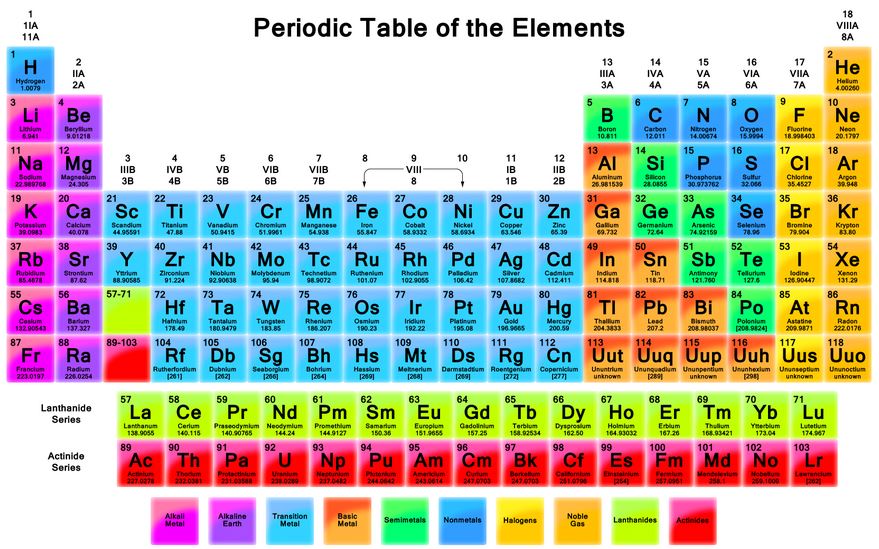
How are elements organized in the periodic table ?
Alphabetically
Based on physical and chemical properties
Increasing number of electrons
Most reactive to least reactive
Most elements on the periodic table are classified as ____________.
Gases
Metalloids
Metals
Nonmetals
Groups on the periodic table are arranged...
Vertically
Horizontally
Diagonally from bottom right corner
Diagonally from top right corner

Which accurately describes nonmetals?
Poor conductors of electricity
Often used in computer parts
Both malleable and ductile
Both dull and brittle

Which group on the periodic table is the most reactive?
Group 1
Group 2
Group 13
Group 18

What is the chemical symbol for Sodium?
S
So
Na
Ca

A neutral atom of _____________ has 52 electrons.
Chromium
Tellurium
Manganese
Antimony

Each horizontal row on the periodic table is called a what?
Group
Row
Period
Family

Who arranged the periodic table of elements by the atomic mass (or mass number)?
Democritus
John Dalton
Henry Moseley
Dmitri Mendeleev

Identify the unknown atom.
Flourine
Beryllium
Boron
Helium

Choose ALL of the alkali metals (group 1) from the list below:
lithium
copper
mercury
potassium
sodium
What ions do Metals form when they react?
Positive Ions
Negative Ions
Select all the properties of a Metal:
Strong
Malleable
Conductive
Brittle
Select the 3 things that describe Group 1 Elements as you go DOWN the group:
More Reactive
Lower Melting/Boiling Point
Higher relative atomic mass
Less Reactive
Higher Melting/Boiling Point
Select the 3 things that describe Group 7 Elements as you go DOWN the group:
More Reactive
Lower Melting/Boiling Point
Higher relative atomic mass
Less Reactive
Higher Melting/Boiling Point
Which one describes a reaction between a Group 1 metal and Water?
Vigorous Reaction to produce Hydrogen Gas and a Metal Hydroxide
Vigorous Reaction when Heated to form Metal Chloride Salts
Reacts to form a Metal Oxide
Which one describes a reaction between a Group 1 metal and Oxygen?
Vigorous Reaction to produce Hydrogen Gas and a Metal Hydroxide
Vigorous Reaction when Heated to form Metal Chloride Salts
Reacts to form a Metal Oxide
What happens to the Boiling point of Nobel Gases as you go Down the Group?
Increases
Decreases
As you move down the group, halogens' reactivity...
increases
decreases
doesn't change
shows no trend.
Which halogens can displace bromide ions to make bromine?
Fluorine and iodine.
Fluorine and bromine.
Fluorine and chlorine
Chlorine and iodine.

A displacement reaction involves...
a solution turning brown or yellow.
a less reactive element taking the place of a more reactive element.
a dislocated hip.
a more reactive element taking the place of a less reactive element.
Would a displacement reaction occur for Bromine + Potassium Iodide?
Yes
No
Maybe
How many electrons do the halogens all have in their outer shells?
1
2
7
8
Would a displacement reaction occur for Iodine + Potassium Bromide?
Yes
No
Maybe
As you go down the group, how does the boiling point of the halogen elements change?
Increases
Decreases
They're all about the same
6.15: Which of these is not a property of noble gases?
Colourless
Odourless
Flammable
Gas at room temperature

Which of the following has the lowest boiling point?
Argon
Krypton
Xenon
Helium
Neon
All noble gases have 8 electrons in their outer shell.
True
False
What is the trend in boiling point for noble gases?
There is no trend.
Boiling point decreases down the group.
Boiling point increases down the group.
All the boiling points are the same.

