
 Worksheets
CHAPTER 1 CN
Total questions: 54
Worksheet time: 31mins
Which of the following descriptions below correspond to a "nuts-and-bolts" view of the Internet? Select one or more of the answers below that are correct. [Hint: more than one of answers below are correct]
A place I go for information, entertainment, and to communicate with people.
A collection of hardware and software components executing protocols that define the format and the order of messages exchanged between two or more communicating entities, as well as the actions taken on the transmission and/or receipt of a message or other event.
A collection of billions of computing devices, and packet switches interconnected by links.
A platform for building network applications.
A "network of networks"
Which of the following descriptions below correspond to a "services" view of the Internet? Select one or more of the answers below below that are correct below that are correct. [Hint: more than one of answers below are correct].
A collection of hardware and software components executing protocols that define the format and the order of messages exchanged between two or more communicating entities, as well as the actions taken on the transmission and/or receipt of a message or other event.
A collection of billions of computing devices, and packet switches interconnected by links.
A place I go for information, entertainment, and to communicate with people.
A "network of networks".
A platform for building network applications.
Which of the following human scenarios involve a protocol (recall: "Protocols define the format, order of messages sent and received among network entities, and actions taken on message transmission, receipt")? Select one or more answers below that are correct. Hint: more than one of answers below are correct
A student raising her/his hand to ask a really insightful question, followed by the teaching acknowledging the student, listening carefully to the question, and responding with a clear, insightful answer. And then thanking the student for the question, since teachers love to get questions.
Two people introducing themselves to each other
A person reading a book.
A person sleeping.
One person asking, and getting, the time to/from another person
Ethernet
Wired. Up to 100's Gbps per link.
Wireless, up to 10's Kbps per device.
Wired. Up to 1 Tbps per link.
Wired. Up to 10’s to 100’s of Mbps downstream per user.
WiFi
Wired. Up to 10’s of Mbps downstream per user.
Wireless. 10’s to 100’s of Mbps per device.
Wireless, up to 10's Kbps per device.
Wired. Up to 1 Tbps per link.
Cable access network
Wired. Up to 10’s of Mbps downstream per user.
Wired. Up to 100's Gbps per link.
Wired. Up to 10’s to 100’s of Mbps downstream per user.
Wired. Up to 1 Tbps per link.
Digital Subscriber Line
Wired. Up to 10’s of Mbps downstream per user.
Wired. Up to 100's Gbps per link.
Wireless, up to 10's Kbps per device.
Wired. Up to 10’s to 100’s of Mbps downstream per user.
4G cellular LTE
Wireless. Up to 10’s Mbps per device.
Wired. Up to 10’s of Mbps downstream per user.
Wireless. 10’s to 100’s of Mbps per device.
Wired. Up to 10’s to 100’s of Mbps downstream per user.
Which of the following physical layer technologies has the highest transmission rate and lowest bit error rate in practice?
802.11 WiFi Channel
Twisted pair (e.g., CAT5, CAT6)
Fiber optic cable
Coaxial cable
Choose one the following two definitions that makes the correct distinction between routing versus forwarding.
Routing is the local action of moving arriving packets from router’s input link to appropriate router output link, while forwarding is the global action of determining the source-destination paths taken by packets.
Forwarding is the local action of moving arriving packets from router’s input link to appropriate router output link, while routing is the global action of determining the source-destination paths taken by packets.
Which of the characteristics below are associated with the technique of packet switching? Select all correct answers. [Hint: more than one of the answers is correct].
Resources are used on demand, not reserved in advance.
Data may be queued before being transmitted due to other user’s data that’s also queueing for transmission.
Congestion loss and variable end-end delays are possible with this technique.
This technique is used in the Internet.
This technique is used in the Internet.
Frequency Division Multiplexing (FDM) and Time Division Multiplexing (TDM) are two approaches for implementing this technique.
Which of the characteristics below are associated with the technique of circuit switching? Select all correct answers. [Hint: more than one of the answers is correct].
Frequency Division Multiplexing (FDM) and Time Division Multiplexing (TDM) are two approaches for implementing this technique
This technique was the basis for the telephone call switching during the 20th century and into the beginning of this current century.
Reserves resources needed for a call from source to destination.
Resources are used on demand, not reserved in advance.
Data may be queued before being transmitted due to other user’s data that’s also queueing for transmission.
Time needed to perform an integrity check, lookup packet information in a local table and move the packet from an input link to an output link in a router
Transmission delay
Queueing delay
Propagation delay
Processing delay
Time spent waiting in packet buffers for link transmission.
Transmission delay
Queueing delay
Propagation delay
Processing delay
Time spent transmitting packets bits into the link.
Transmission delay
Queueing delay
Propagation delay
Processing delay
Time need for bits to physically propagate through the transmission medium from end one of a link to the other.
Transmission delay
Queueing delay
Propagation delay
Processing delay
Protocols that are part of a distributed network application
Application Layer
Network layer
Physical layer
Link layer
Transport layer
Transfer of data between one process and another process (typically on different hosts).
Application Layer
Network layer
Physical layer
Link layer
Transport layer
Delivery of datagrams from a source host to a destination host (typically).
Application Layer
Network layer
Physical layer
Link layer
Transport layer
Transfer of data between neighboring network devices.
Application Layer
Network layer
Physical layer
Link layer
Transport layer
Transfer of a bit into and out of a transmission media.
Application Layer
Network layer
Physical layer
Link layer
Transport layer
Unit of Application
Frame
Datagram
Bit
Segment
Message
Unit of Transport Layer
Frame
Datagram
Bit
Segment
Message
Unit of Network Layer
Frame
Datagram
Bit
Segment
Message
Unit of Link Layer
Frame
Datagram
Bit
Segment
Message
Unit of Physical Layer
Frame
Datagram
Bit
Segment
Message
Which of the definitions below describe what is meant by the term "encapsulation"?
Taking data from the layer above, adding header fields appropriate for this layer, and then placing the data in the payload field of the “packet” for that layer.
Starting a transport layer timer for a transmitted segment, and then if an ACK segment isn’t received before the timeout, placing that segment in a retransmission queue.
Computing the sum of all of the bytes within a packet and placing that value in the packet header field.
Determining the name of the destination host, translating that name to an IP address and then placing that value in a packet header field.
Which of the characteristics below are associated with a client-server approach to structuring network applications (as opposed to a P2P approach)?
There is a server that is always on.
A process requests service from those it contacts and will provide service to processes that contact it.
There is not a server that is always on.
HTTP uses this application structure.
There is a server with a well known server IP address.
Which of the characteristics below are associated with a P2P approach to structuring network applications (as opposed to a client-server approach)?
There is a server that is always on.
A process requests service from those it contacts and will provide service to processes that contact it.
There is not a server that is always on.
HTTP uses this application structure.
There is a server with a well known server IP address.
When an application uses a UDP socket, what transport services are provided to the application by UDP? Check all that apply.
Throughput guarantee. The socket can be configured to provide a minimum throughput guarantee between sender and receiver.
Real-time delivery. The service will guarantee that data will be delivered to the receiver within a specified time bound.
Flow Control. The provided service will ensure that the sender does not send so fast as to overflow receiver buffers.
Best effort service. The service will make a best effort to deliver data to the destination but makes no guarantees that any particular segment of data will actually get there.
Congestion control. The service will control senders so that the senders do not collectively send more data than links in the network can handle.
When an application uses a UDP socket, what transport services are provided to the application by UDP? Check all that apply.
Throughput guarantee. The socket can be configured to provide a minimum throughput guarantee between sender and receiver.
Real-time delivery. The service will guarantee that data will be delivered to the receiver within a specified time bound.
Flow Control. The provided service will ensure that the sender does not send so fast as to overflow receiver buffers.
Congestion control. The service will control senders so that the senders do not collectively send more data than links in the network can handle.
Loss-free data transfer. The service will reliably transfer all data to the receiver, recovering from packets dropped in the network due to router buffer overflow.
When an application uses a TCP socket, what transport services are provided to the application by TCP? Check all that apply.
Throughput guarantee. The socket can be configured to provide a minimum throughput guarantee between sender and receiver.
Real-time delivery. The service will guarantee that data will be delivered to the receiver within a specified time bound.
Flow Control. The provided service will ensure that the sender does not send so fast as to overflow receiver buffers.
Congestion control. The service will control senders so that the senders do not collectively send more data than links in the network can handle.
Loss-free data transfer. The service will reliably transfer all data to the receiver, recovering from packets dropped in the network due to router buffer overflow.
What do we mean when we say “HTTP is stateless”? In answering this question, assume that cookies are not used. Check all answers that apply.
We say this when an HTTP server is not operational.
An HTTP server does not remember anything about what happened during earlier steps in interacting with this HTTP client.
The HTTP protocol is not licensed in any country.
An HTTP client does not remember the identities of the servers with which it has interacted.
An HTTP client does not remember anything about what happened during earlier steps in interacting with any HTTP server.
What is an HTTP cookie used for?
A cookies is a code used by a server, carried on a client’s HTTP request, to access information the server had earlier stored about an earlier interaction with this person.
A cookie is used to spoof client identity to an HTTP server.
A cookie is a code used by a server, carried on a client’s HTTP request, to access information the server had earlier stored about an earlier interaction with this Web browser.
A cookie is a code used by a client to authenticate a person’s identity to an HTTP server.
What is the purpose of the HTTP GET message?
The HTTP GET request message is sent by a web server to a web client to get the next request from the web client.
The HTTP GET request message is sent by a web server to a web client to get the identity of the web client.
The HTTP GET request message is used by a web client to post an object on a web server.
The HTTP GET request message is used by a web client to request a web server to send the requested object from the server to the client.
What is the purpose of the conditional HTTP GET request message?
To allow a server to only send the requested object to the client if this object has changed since the server last sent this object to the client.
To allow a server to only send the requested object to the client if the server is not overloaded.
To allow a server to only send the requested object to the client if the client has never requested that object before.
To allow a server to only send the requested object to the client if the client is authorized to received that object.
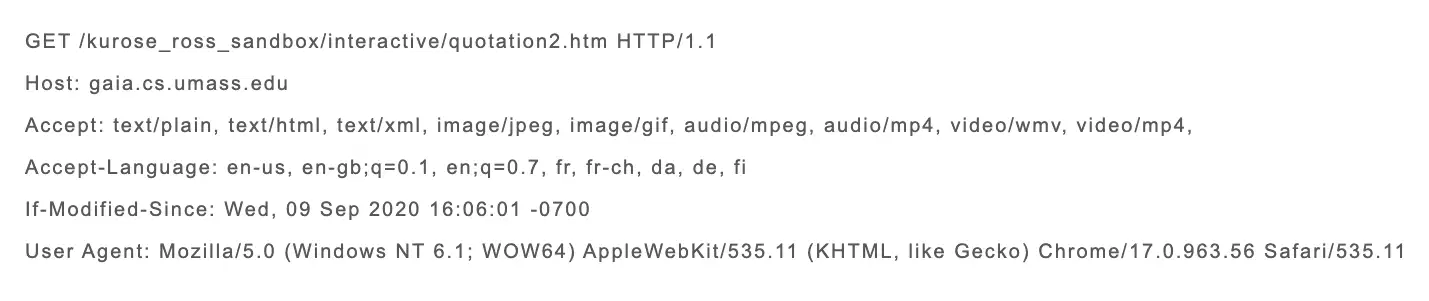
What version of HTTP is the client using?
1.1
2.1
1
2
Which of the following are advantages of using a web cache? Sselect one or more answers.
Caching uses less bandwidth coming into an institutional network where the client is located, if the cache is also located in that institutional network.
Caching allows an origin server to more carefully track which clients are requesting and receiving which web objects.
Overall, caching requires fewer devices/hosts to satisfy a web request, thus saving on server/cache costs.
Caching generally provides for a faster page load time at the client, if the web cache is in the client’s institutional network, because the page is loaded from the nearby cache rather than from the distant server.
Which of the following are changes between HTTP 1.1 and HTTP/2? Note: select one or more answers.
HTTP/2 allows objects in a persistent connection to be sent in a client-specified priority order.
HTTP/2 allows a large object to be broken down into smaller pieces, and the transmission of those pieces to be interleaved with transmission other smaller objects, thus preventing a large object from forcing many smaller objects to wait their turn for transmission.
HTTP/2 provides enhanced security by using transport layer security (TLS).
HTTP/2 has many new HTTP methods and status codes.
Which of the following pieces of information will appear in a server’s application-level HTTP reply message? (Check all that apply.)
A response code
A sequence number
A checksum
A response phrase associated with a response code
The server's IP address
What is the purpose of a cookie value in the HTTP GET request?
The cookie value indicates whether the user wants to use HTTP/1, HTTP/1.1, or HTTP/2 for this GET request.
The cookie value encodes the format of the reply preferred by the client in the response to this GET request.
The cookie value is an encoding of a user email address associated with the GET request.
The cookie value encodes a default set of preferences that the user has previously specified for this web site.
The cookie value itself doesn't mean anything. It is just a value that was returned by a web server to this client during an earlier interaction.
Responsible for a domain (e.g., .com, .edu); knows how to contact authoritative name servers.
DNS root servers
Authoritative DNS server
Top Level Domain (TLD) servers
Local DNS server
Provides authoritative hostname to IP mappings for organization’s named hosts.
DNS root servers
Authoritative DNS server
Top Level Domain (TLD) servers
Local DNS server
Replies to DNS query by local host, by contacting other DNS servers to answer the query.
DNS root servers
Authoritative DNS server
Top Level Domain (TLD) servers
Local DNS server
Highest level of the DNS hierarchy, knows how to reach servers responsible for a given domain (e.g., .com, .edu).
DNS root servers
Authoritative DNS server
Top Level Domain (TLD) servers
Local DNS server
What is the value of caching in the local DNS name server? Check all that apply.
DNS caching provides for faster replies, if the reply to the query is found in the cache.
DNS caching provides the ability to serve as authoritative name server for multiple organizations.
DNS caching provides prioritized access to the root servers, since the DNS request is from a local DNS cache.
DNS caching results in less load elsewhere in DNS, when the reply to a query is found in the local cache.
What information does the type “A” resource record hold in the DNS database? Check all that apply.
An alias name and a true name for a server.
A name and the name of the SMTP server associated with that name.
A domain name and the name of the authoritative name server for that domain.
A hostname and an IP address.
Which of the following characteristics below are associated with a UDP socket? Check one or more that apply.
socket(AF_INET, SOCK_DGRAM) creates this type of socket
provides unreliable transfer of a groups of bytes (“a datagram”), from client to server
data from different clients can be received on the same socket
the application must explicitly specify the IP destination address and port number for each group of bytes written into a socket
Which of the following characteristics below are associated with a TCP socket? Check one or more that apply.
when contacted, the server will create a new server-side socket to communicate with that client
a server can perform an accept() on this type of socket
provides reliable, in-order byte-stream transfer (a “pipe”), from client to server
socket(AF_INET, SOCK_STREAM) creates this type of socket
Where is transport-layer functionality primarily implemented?
Transport layer functions are implemented primarily at each end of a physical link connecting one host/router/switch to another one host/router/switch.
Transport layer functions are implemented primarily at the hosts at the “edge” of the network.
Transport layer functions are implemented primarily at the routers and switches in the network.
True or False: The transport layer provides for host-to-host delivery service?
TRUE
FALSE
Check all of the services below that are provided by the TCP protocol.
Reliable data delivery
In-order data delivery
A congestion control service
A flow-control service
A byte stream abstraction, that does not preserve boundaries between message data sent in different socket send calls at the sender.
True or False: When computing the Internet checksum for two numbers, a single flipped bit (i.e., in just one of the two numbers) will always result in a changed checksum.
True
False
True or False: When computing the Internet checksum for two numbers, a single flipped bit in each of the two numbers will always result in a changed checksum.
True
False

