
Font size
 Worksheets
KMT & IMF Quiz Review
Total questions: 55
Worksheet time: 1hrs 4mins

Which state of matter has both definite shape and definite volume?
solid
liquid
gas
plasma
In which state of matter are the particles vibrating in place and have a fixed volume?
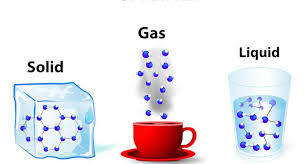

Which state of matter has no definite shape and no definite volume?
Gas
Liquid
Solid
As matter changes state from liquid to solid, the atoms move ______ .
CLOSER together
FARTHER apart
stay the SAME

Which state of matter has no definite shape but does have definite volume?
Gas
Solid
Liquid

As matter changes state from liquid to solid, the atoms have ____ kinetic energy.
more
less
the same
If I heat a liquid and its temperature increases, what change occurs to motion of the molecules?
The molecules move at the SAME rate.
The molecules move at a SLOWER rate.
The molecules move at a FASTER rate.

Which state of matter has tightly packed molecules?

Select the state(s) of matter have a definite volume.
Reorder from LOWEST (left) kinetic energy to HIGHEST (energy) kinetic energy
solid
liquid
gas
In the (a) state of a substance, the atoms collide frequently and move independently of one another.
If a gas has the same temperature throughout, which gas molecule has the highest average velocity?
O2
H2O
H2
Xe
Which of the following is not a physical property of gases?
absence of definite volume
large density
high compressibility
fluidity
The energy of movement is ___.
potential energy
kinetic energy
mechanical energy
The more energy that particles have, the ___ they move.
slower
faster

Which of the following statements is true?
Gases do not move in straight line
Gas particles are spaced so far apart that most of the volume of gas is empty space
Gas particles are not in constant motion
Gas particles attract each other
Adding heat to a solid makes the particles move...
Particles in a solid are not moving
Slower
At the same rate as before the heat was applied
Faster
Which among the following is NOT true regarding the Kinetic Molecular Theory of gases?
Gases particles move in straight lines.
Gas particles are closely packed and their motion is orderly.
Gas particles are in constant motion.
Gas particles do not attract or repel each other.

Which type of motion in the figure best represents the movement of gas particles?
Motion 1
Motion 2
Motion 3
Motion 4
What happens to matter as its temperature increases?
The average kinetic energy of its particles decreases
The average thermal energy of its particles decreases
The particles gain kinetic energy
The particles lose potential energy

Which of the following is not one of the assumptions of the kinetic molecular theory for ideal gases?
The particles attract and then repel each other.
The collisions between particles are elastic
The particles are in constant random motion.
The particle size is very small compared to the space between the particles.
Collisions in which particles transfer all their kinetic energy to other particles are called ___.
elastic
inelastic

All collisions between gas particles and between particles and container walls are what kind of collisions?
inelastic
kinetic
elastic
potential

There are no forces of __________ between gas particles.
attraction
repulsion
reactions
chemicals

What determines the temperature of a gas?
How hot or cold the gas is
The total kinetic energy of the gas particles
The average kinetic energy of the gas particles
The average potential energy of the gas particles
Type of intermolecular force present in I2, Br2, and Cl2.
dipole dipole
H-bond
London dispersion
metallic
Water has an unusually high boiling point for a molecular compound because it has
hydrogen bonding
ion-ion attractions
a high density
a large gram formula mass
The weaker the intermolecular forces of a substance the _____________ the boiling point
higher
lower
List the strongest to weakest IMFs.
Hydrogen Bond, London Dispersion, Dipole-dipole
London Dispersion, Dipole-dipole,
Hydrogen Bond
Hydrogen Bond, Dipole-dipole, London Dispersion
Dipole-dipole, Hydrogen Bond, London Dispersion
A strong IMF increases
boiling point
solubility
flammability
malleability
Viscosity is
the resistance to flow
the resistance to spread out
the ability to make sheets of metal
the ability to make wire
A weak IMF will result in a
high melting point
high viscosity
high surface tension
low surface tension
Which substance has the weakest intermolecular forces?
Substance A, boiling point of 75 °C
Substance B, boiling point of 105 °C
Substance C, boiling point of 25 °C
Substance d, boiling point of 45 °C
A weak IMF will result in a
high melting point
high viscosity
high surface tension
low surface tension
The measure of the resistance to the flow of a liquid is called:
vapor pressure.
sublimation.
viscosity.
condensation.
Which of the following forces are found between two NONPOLAR molecules?
London Dispersion Force
Dipole-dipole
Hydrogen bond
What intermolecular force is present between two molecules of HCl?
Dipole-Dipole
London Dispersion Force
Hydrogen bonds
Ionic
Liquids with very high viscosity flow very _______________________.
fast
not at all
slow
whenever it wants
The best example of high viscosity would be?
Honey
Soap
Marbles
Water
Surface tension is the property of water in which...
water molecules at the surface tend to stick together.
water spills easily.
water tends to be see-through.

Which type of IMF is responsible for the attraction pictured above?
Dipole-Dipole Interaction
Ion-Dipole Interaction
Hydrogen Bonds
Covalent Bond
Ionic Bond

Which type of IMF is responsible for the attraction pictured above?
Dipole-Dipole Interaction
Ion-Dipole Interaction
Hydrogen Bonds
Covalent Bond
Ionic Bond

Which type of IMF is responsible for the attraction pictured above?
Dipole-Dipole Interaction
Ion-Dipole Interaction
Hydrogen Bonds
Covalent Bond
Ionic Bond
Intermolecular forces are attractions between ______.
Cations and anions
Atoms within a molecule
Neighboring molecules
Protons and electrons
For which of the following would hydrogen bonding occur between molecules?



