
 Worksheets
5th grade Unit 7 Geometry and the Coordinate Plane review
Total questions: 47
Worksheet time: 2hrs 51mins

Classify the quadrilateral.
trapezoid
parallelogram
rhombus
kite
square

Classify the quadrilateral.
kite
rectangle
parallelogram
trapezoid
rhombus

A square, a rectangle, a trapezoid, and a rhombus all belong to which group of shapes?
squares
parallelograms
quadrilaterals
regular polygons
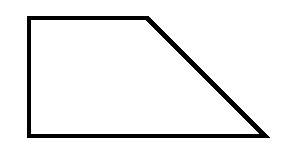


rhombus
parallelogram
rhombus
parallelogram
square

Use the angles to classify the triangles
all angles less than 90° - acute triangle
1 angle is equal to 90° - right triangle
1 angle is greater than 90° - obtuse triangle
(a)

Use the sides to identify the triangle
0 sides the same - scalene triangle
2 sides the same - isosceles triangle
3 sides the same - equilateral triangle
(a)

Use the sides to identify the triangle
0 sides the same - scalene triangle
2 sides the same - isosceles triangle
3 sides the same - equilateral triangle
(a)

Use the sides to identify the triangle
0 sides the same - scalene triangle
2 sides the same - isosceles triangle
3 sides the same - equilateral triangle
(a)

Use the sides to identify the triangle
0 sides the same - scalene triangle
2 sides the same - isosceles triangle
3 sides the same - equilateral triangle
(a)

Use the sides to identify the triangle
0 sides the same - scalene triangle
2 sides the same - isosceles triangle
3 sides the same - equilateral triangle
(a)

Use the sides to identify the triangle
0 sides the same - scalene triangle
2 sides the same - isosceles triangle
3 sides the same - equilateral triangle
(a)

Use the sides to identify the triangle
0 sides the same - scalene triangle
2 sides the same - isosceles triangle
3 sides the same - equilateral triangle
(a)

Use the angles to classify the triangles
all angles less than 90° - acute triangle
1 angle is equal to 90° - right triangle
1 angle is greater than 90° - obtuse triangle
(a)
Which ordered pair represents the point of origin?
(5,5)
(0,0)
(x,y)
(0,1)
A student graphs a point that is represented by the ordered pair (2,5). What does the number 5 represent?
Remember x you slide, y you fly
The point is 5 units to the right of 0 on the y-axis
The point is 5 units to the right of 0 on the x-axis
The point is 5 units above 0 on the x-axis
The point is 5 units above 0 on the y-axis

If you are trying to find the location of the ordered pair (4,8) what movement would you do first?
Move right along the x-axis to 4
Move up along the y-axis to 4
Move right along the y-axis to 8
Move up along the x-axis to 8
How do you write an ordered pair?
First you write the number for the y-axis and then the number for the x-axis
First you write the number for the x-axis and then the number for the y-axis

Which ordered pair represents the Ring Toss?
(4,7)
(3,1)
(7,4)
(2,6)

How can you move from Point P to Point Q?
Move 5 units up and 6 units to the right
Move 6 units up and 6 units to the right
Move 5 units to the right and 6 units up
Move 5 units to the right and 5 units up
When looking for an ordered pair you should always start at
the point of origin
the biggest number
the smallest number
the y-axis
Which axis runs vertically (up and down)?
x
Y
Which axis runs horizontally (side to side)?
x
y
What is the missing number in this pattern?
2, 4, 6, _, 10, 12
8
0
Do the rules add 3; subtract 1 work for this number pattern?
2, 5, 4, 7, 6, 9, 8
yes
no
65, 62, 59, 56, 53, 50
there are 5 numbers
6, 9, 12, 15, 18, 21
What is the rule?
x 6
+ 3
x 4
x 5
What number would come next if the pattern continued?


What is the missing number?
(a)

What is the rule?
Multiply by (a) ?

