
 Worksheets
Unit 6 Vietnam War & Cold War
Total questions: 162
Worksheet time: 3hrs 18mins
What European country controlled Vietnam until World War II?
France
Germany
Great Britain
Spain
John F. Kennedy
sent warships to bomb North Vietnam.
decreased the war equipment being sent to South Vietnam.
increased the number of military advisers in South Vietnam.
sent soldiers to fight in North Vietnam.
The Ho Chi Minh Trail was
a secret path which was used by the Viet Cong in Saigon.
a supply line for the Vietcong which ran through neutral countries.
the route that the Americans took when they left South Vietnam.
a supply line used by South Vietnam.
Which of the following was NOT used by the American military in Vietnam?
Aerial attacks (regular bombs)
Agent Orange
Napalm
Nuclear bombs
Where was the United States Navy allegedly attacked in 1964?
Gulf of Thailand
Gulf of Tonkin
Pearl Harbor
South China Sea
Which American president escalated the Vietnam War and did not run for re-election as a result of anti-war activities in the United States?
Kennedy
Nixon
Truman
Johnson
In the ____________________, United States soldiers killed at least 450 women, children, and elderly men, shocking the American public.
My Lai Massacre
Attack on Sai Pan
Tet Offensive
Attack on Khe Sanh
The sustained bombing of North Vietnamese and Viet Cong troops, ordered by Johnson in 1965
Domino Theory
Operation Rolling Thunder
Gulf of Tonkin Resolution
Tet Offensive
US troop reduction in Vietnam; transfer of combat operations from American to South Vietnamese troops
Domino Theory
Kent State University
Tet Offensive
Vietnamization
Leading Vietnamese nationalist figure, supporting the Communist party
Ngo Dinh Diem
Ho Chi Minh
Viet Cong
Kent State University
President of the Republic of Vietnam, had US support, eventually would be overthrown
Ngo Dinh Diem
Viet Cong
Democratic Republic of Vietnam
Ho Chi Minh
If one country falls to communism, the countries around would also fall to communism
Vietnamization
Domino Theory
Tet Offensive
Democratic Republic of Vietnam
Ho Chi Minh declared Vietnam’s independence and established this
Tet Offensive
Viet Cong
Kent State University
Democratic Republic of Vietnam
The Vietnamese who fought against the U.S. and South Vietnamese troops
Democratic Republic of Vietnam
Ngo Dinh Diem
Viet Cong
Ho Chi Minh
Gave the President expansive war powers
Operation Rolling Thunder
Domino Theory
Tet Offensive
Gulf of Tonkin Resolution
1968, massive attack by the Viet Cong on major cities in South Vietnam; caused American public support of war to plummet
Operation Rolling Thunder
Gulf of Tonkin Resolution
Tet Offensive
Kent State University
Protests over military missions in Cambodia resulted in confrontation between protestors and police, with four students killed on May 4, 1970
Kent State University
Vietnamization
Domino Theory
Viet Cong
President __________ is credited with the plan of Vietnamization
Ford
Reagan
Johnson
Nixon
What was Henry Kissinger's job?
He operated a very successful kissing booth at a fair.
National Security Advisor to Nixon
Vice President
He was the Iron Fist who protected all humanity from "The Hand"
What kind of government did Ho Chi Minh establish?
Communism
Democracy
Socialism
Monarchy


Which U.S. president escalated the conflict in Vietnam by sending in the first ground troops in 1964?
John F. Kennedy
Lyndon B. Johnson
Dwight D. Eisenhower
Richard M. Nixon
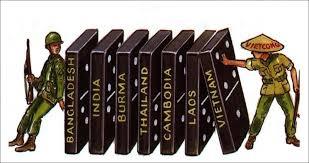
The idea that if South Vietnam fell to communism, other nations would soon follow...
Vietnamization
Communism
Domino Theory
Imperialism

The event described in this headline resulted in —
decreased federal funding of student loans
increased support for the antiwar movement
the reinstatement of the draft
an end to federal investigations of student organizations

Which of the following is the best title for this list?
Protests Against the Vietnam War
Opposition to the Arms Race
Support for Gender Equality
Demands to Stop Dumping Chemical Waste
As part of the Nixon administration’s policy of Vietnamization, the U.S. military —
trained South Vietnamese forces to take over combat responsibilities from U.S. troops
shared military technology with North Vietnam
shared military technology with North Vietnam
installed a puppet government in South Vietnam

How does this resolution demonstrate the principle of checks and balances?
It expands the power of judicial review to military courts.
It allows the executive to determine the length of military conflicts.
It allows Congress to limit the military authority of the executive branch.
It gives Congress oversight of military strategy and operations.

What happened as a direct result of these recommendations?
North Vietnamese leaders appealed for a ceasefire.
U.S military involvement in Vietnam escalated.
South Vietnamese leaders rejected military assistance.
Soviet ground troops were deployed to Vietnam.


John F. Kennedy
sent warships to bomb North Vietnam.
decreased the war equipment being sent to South Vietnam.
increased the number of military advisers in South Vietnam.
sent soldiers to fight in North Vietnam.
What year did the Vietnam War end?
1973
1974
1975
1976
How long did the Vietnam War span?
8 years
17 years
21 years
23 years
American Commander of the War in Vietnam
William Westmoreland
Robert McNamara
Napalm
Hawk
Dove
Chemical used to defoliate plants. It cause health problems and birth defects for those who came in contact with it
William Westmoreland
Agent Orange
Napalm
Hawk
Dove
Secretary of Defense under Kennedy and Johnson. He was in charge of the war in the States and change how we reported victories
William Westmoreland
Robert McNamara
Napalm
Hawk
Dove
Jellied gasoline dropped from canisters that exploded on impact and covered large areas in flames. It was dropped by US planes during the Vietnam War.
William Westmoreland
Agent Orange
Napalm
Hawk
Dove
A person who supported US involvement in the Vietnam War
William Westmoreland
Agent Orange
Napalm
Hawk
Dove
A person who opposed US involvement in the Vietnam War
William Westmoreland
Agent Orange
Napalm
Hawk
Dove
A young man forced into military service by the government during the Vietnam War
Draftee
SDS
Tet Offensive
Robert Kennedy
1973 peace agreement between the United States, South Vietnam, North Vietnam, and the Vietcong that effectively ended the Vietnam War
Vietnamization
My Lai
Pentagon Papers
Paris Peace Accords
War Powers Act
classified U.S. government study that revealed American leaders intentionally involved the United States in Vietnam without fully informing the American people; leaked to the New York Times in 1971
Vietnamization
My Lai
Pentagon Papers
Paris Peace Accords
War Powers Act
1973 law passed by Congress restricting the President's war-making powers; requires the President to consult with Congress before committing American forces to a foreign conflict
Vietnamization
My Lai
Pentagon Papers
Paris Peace Accords
War Powers Act
The Geneva Accords outlined that:
Vietnam would permanently split along the 17th Parallel
The French would gain control of all of Vietnam
Elections would be held to reunify Vietnam in the future
Ho hi Minh would gain all control of a unified Vietnam
The U.S. first became involved in the conflict in Vietnam.....
to help the North Vietnamese fight Communism
to unify North and South Vietnam
to support South Vietnam's government
The Tet Offensive was significant because.....
It ended the war in Vietnam
It resulted in a significant military win for the Vietcong
Media coverage of the event shifted public opinion in the USA against the war in Vietnam
It was igmored by the American public
TV was instrumental (important) in......
Promoting understanding between Americans and Vietnamese
Developing enthusiasm for the American war effort in Vietnam
Bringing the brutality of the war into people's living rooms
revealing the contents of classified military documents
An alternative lifestyle in the 1960's was called.....
Generation X
Panthers
Counterculture
VietCong
The Vietnam War finally ended in 1975 when.....
North Vietnam surrendered
U.S. forces invaded Cambodia
North Vietnam gained control over all of Vietnam
Nixon signed a peace treaty with North Vietnam
What was the lasting legacy of the Vietnam War?
Congress passed the War Powers Act
The devastation of the Vietnamese people
Many Americans felt a strong distrust in their government
All answers are correct
During the Vietnam War, the following people were presidents of the United States. Check all that apply.
Lyndon B. Johnson
John F. Kennedy
Richard Nixon
Franklin D. Roosevelt

How did the events in this cause-and-effect diagram affect the relationship between the executive and legislative branches of government?
By reducing the ability of the House of Representatives to approve military funding requested by the president
By giving the president the power to fight a war without getting a formal declaration from Congress
By allowing Congress to supersede the president’s role as commander in chief
By reducing the power of the president to bypass the Senate’s treaty-making powers

Which article would most likely quote this excerpt?
“Embedding Journalists in Combat during the Korean War”
“The Role of the Office of War Information during World War II”
“Improvements in Media Production during the Persian Gulf War”
“The Role of the Media during the Vietnam War”


When did the US military advisors begin to take a direct role in the war.
December 1960
November 1961
December 1961
November 1960
Who was the US President who pulled the troops out of the war?
Lydon Johnson
Richard Nixon
Henry Ford
Jimmy Carter
How many soldiers did the US Lose?
60, 200
70,000
55,000
58,220
What happened to Ho chi Minh during the war?
Nothing
He died
He fought in the war
He assissanated the South Vietnam president
A 1954 conference that divided Vietnam at the 17th parallel.
Paris Conference
Yalta Conference
Versailles Conference
Geneva Conference
A massive surprise attack by the Vietcong on South Vietnamese towns and cities in early 1968; caused American public support of war to plummet and showed that the communists had not lost the will to fight
.
Operation Rolling Thunder
Battle of Stalingrad
Tet Offensive
My Lai Massacre
Why did the United States aid France in its' attempt to regain control over Vietnam?
The US saw Vietnam as an economic opportunity
The US was coming to the aid of an ally
The US feared the spread of communism
The US wanted to expand its' control in Southeast Asia
President Johnson used his newly given authority, based on the Gulf of Tonkin Resolution, to do what?
Send in troops and order airstrikes
By declaring war
Send much needed supplies and weaponry
By creating a committee to negotiate a ceasefire
Martin Luther King stated "It {the US} was sending their sons and their brothers and their husbands to fight and die in extraordinarily high proportions relative to the rest of the population." What was he implying?
African Americans were being sent to Vietnam more than Whites
African Americans were made to serve in all black units
African Americans had the opportunity to get skills in the military
African Americans were a high percentage of draft dogers
What was the long term impact of the Vietnam conflict?
The US got a foothold in Southeast Asia
The Communist gained control of Cambodia, Laos, and Vietnam
Vietnam became united as one democratic country
Vietnam remained divided: the North as communist and the South as a republic
How did the Vietnam War impact American society longterm?
More people enlisted in the military
There was an increased sense of patriotism
Citizens did not trust their government and/or its officials
There was an increase in college admissions
"it is my duty to the American people to report that renewed hostile actions against United States ships on the high seas in the Gulf of Tonkin...the initial attack on the destroyer Maddox, on August 2, was repeated today by a number of hostile vessels attacking two U.S. destroyers with torpedoes." speech by PresidentJohnson
What action did President Johnson take as the result of this incident?
The US increased its military efforts
The US enacted an embargo against Vietnam
The US requested the UN to take action
The US withdrew all warships from the region

After WWII, U.S helped rebuild Western Europe's infrastructure, and stabilize their economies and governments through-
The Truman Doctrine
The Molotov Plan
The Marshall Plan
The Containment Plan

Investigated alleged disloyalty and rebel activities on the part of private citizens, public employees and organizations suspected of having Communist ties
Hollywood Ten
McCarthyism
House Un-American Activities Committee (HUAC)
North Atlantic Treaty Organization (NATO)

What benefits is this chart displaying?
G.I. bill coverage for school after 9/11
Rationing book
Medicaid assistance
Welfare benefits

What was the result of the Berlin blockade?
Military conflict escalated between the U.S & USSR
Germany fell to communism
The Cold War ended
The U.S airlifted supplies to West Berlin and avoided war with the Soviet Union

Movie producers, directors, & screenwriters accused of possible communists affiliations
Hollywood Trio
Hollywood 10
Cinema reds
Reds United

North Korea invading _____________ caused the start of the Korean War in 1950.
China
Cambodia
South Vietnam
South Korea

Gives soldier's money for college or training programs when they return to civilian life.
Containment Policy
Truman Doctrine
Marshall Plan
G.I. Bill

A competition between nations for superiority in the development and accumulation of weapons during the Cold War.
Space Race
Vietnamization
Arms Race
Domino Theory

What does this illustration display?
Soviet nuclear weapons in Cuba pointed at the U.S
Flights from Cuba to North American cities
Exportation of sugar to the U.S
Cuban Baseball Team's travel destinations

The practice of making accusations of subversion or treason, especially when related to communism, without any proper regard for evidence.
McCarthyism
Blitzkrieg
Hollywood 10
HUAC Act

A U.S policy to prevent the spread of communism abroad.
Marshall Plan
Molotov Plan
McCarthyism
Containment Policy

The U.S was seen by many nations as an imperialistic invader of less developed countries during-
WW2
The Vietnam War
WW1
The Civil War
Average family income, employment, and consumer spending all increased during which decade in the U.S.
1900's
1950's
1910's
1870's
Growth of suburbs, middle-class, and development of interstate highway system are effects of-
financial decline after WW1
economic success after Spanish American War
financial gain during the Gilded Age
economic prosperity after WW2
This held elected officials accountable to their actions
Referendum
Recall
22nd Amendment
Initiative

This allowed the US to get passed a Soviet blockade
Berlin Wall
Berlin Airlift
Tanks
Jeeps
What did Jonas Salk create that eradicated polio in America?
Mandatory quarantining
Cure for polio
Polio Vaccine
New ways to package food to stop the spread
The influence of African American music styles, such as rhythm & blues illustrated what?
Emergence of hip hop
Emergence of techno
Emergence of the Kardashians
Emergence of rock n' roll
The housing boom, new industries, and military spending all led to what in the 1950s?
Economic prosperity
Economic decline
Weaker military
More land for growth
Initiative, referendum, and recall all encouraged people to do what in the democratic process?
Participate
Stop caring
Buy war bonds
Support only one political view

Joseph McCarthy accused people of being what?
Communists
Democratic
Christians
Corrupt
In the late 1800s, what was the process of people claiming public land to convert it to their private property known as?
Homesteading
Sharecropping
Expansionism
Containment
Policy of providing economic and military aid to any country threatened by communism, mainly to help Greece and Turkey.
Truman Doctrine
Marshal Plan
Eisenhower Doctrine
Domino Theory
A military and defense alliance formed by 12 countries in Western Europe and North America. And the first peace time alliance in US History and the most important for the past 60 years.
NATO
WARSAW
Marshall Plan
Truman Doctrine


What war did the Cold War follow?
World War 1
World War 2
Spanish-American War
Civil War
A system where the government is run by a dictator with complete control of everything in the country.
democracy
totalitarian
command economy

When did the Space Race start?
1957
2019
1955
1800

The Berlin Blockade was a naval blockade of the Turkish Straights.
TRUE
FALSE

Super Powers
The United States and the U.S.S.R. during the Cold War
American policy of resisting further expansion of communism around the world
A 1949 defense alliance initiated by the US, Canada, and 10 Western European nations
An alliance between the Soviet Union and other Eastern European nations. This was in response to the NATO

Iron Curtain
A political barrier that isolated the peoples of Eastern Europe after WWII, restricting their ability to travel outside the region
A United States program of economic aid for the reconstruction of Europe (1948-1952)
A political system in which the supreme power lies in a body of citizens who can elect people to represent them
A theory or system of social organization based on the holding of all property in common, actual ownership being ascribed to the community as a whole or to the state.

Yalta Conference
1945 Meeting with US president FDR, British Prime Minister(PM) Winston Churchill, and and Soviet Leader Stalin during WWII to plan for post-war
July 26, 1945 - Allied leaders Truman, Stalin and Churchill met in Germany to set up zones of control and to inform the Japanese that if they refused to surrender at once, they would face total destruction.
1947, President Truman's policy of providing economic and military aid to any country threatened by communism or totalitarian ideology, mainly helped Greece and Turkey
A 1949 defense alliance initiated by the US, Canada, and 10 Western European nations

Potsdam Conference
July 26, 1945 - Allied leaders Truman, Stalin and Churchill met in Germany to set up zones of control and to inform the Japanese that if they refused to surrender at once, they would face total destruction.
1945 Meeting with US president FDR, British Prime Minister(PM) Winston Churchill, and and Soviet Leader Stalin during WWII to plan for post-war
A 1949 defense alliance initiated by the US, Canada, and 10 Western European nations
An alliance between the Soviet Union and other Eastern European nations. This was in response to the NATO

What were the defining characteristics of the Cold War?
Prohibition, Flappers, Jazz
Arms Race, Space Race, Red Scare
Holocaust, Nazi Germany, Pearl Harbor
Poverty, Unemployment, Dust Bowl

What individual/group contributed to the Red Scare and accused American citizens of being communists?
Martin Luther King & Black Panthers
Jane Addams & Settlement Houses
Joseph McCarthy & HUAC
Cesar Chavez & United Farmworkers Union

What happened as a result of the launch of Sputnik in 1957?
It started the space race.
U.S. began to invest more money into math & science education.
The U.S. started NASA.
All of the above
During the Cuban Missile Crisis, what did JFK do when he heard that the Soviet Union was construction a missile site in Cuba.
JFK gave into the Soviet demands.
JFK bombed the Soviet Union with an atomic bomb.
JFK ordered a naval blockade of Cuba.
JFK invaded Cuba from Guantanamo Bay.
After WWII what happened to the population of the U.S?
The population moved westward as a result of the railroad.
African Americans moved north as part of the Great Migration.
The population shifted from the Rust Belt to the Sun Belt.
The population grew due to the Baby Boom.
What wars were fought during the Cold War as a result of containment and the Domino Theory?
Korean & Vietnam War
WWI & WWII
Civil War & Spanish American War
Persian Gulf & War on Terror
Which choice best describes the Second Red Scare ?
the use of military force to put down civil unrest in American cities
the use of accusations, blacklisting, and investigations against suspected communists
the effort to expand civil rights protections to more groups of Americans
the use of unethical searches and unfounded proclamations of a planned communist revolution in America by Attorney General A Mitchell Palmer
Why did the United States not share the plan to develop the atomic bomb with the Soviet Union during World War II?
The Soviet Union already had an atomic bomb.
The United States did not trust the Soviet Union.
The Allies would have been against its development on moral grounds.
Scientists were unsure if they would be successful.
What is NATO?
A military alliance between Western European Countries, the U.S. and Canada.
A military alliance between Western European Countries, the Soviet Union and China.
A military alliance between Eastern European Countries, Including the Soviet Union and its satellite nations.
A military alliance between Eastern European Countries.
What is significant about the 38th parallel?
It divides Western and Eastern Europe, this line is also described as the Iron Curtain
The division between North and South Korea
The division between China and North Korea, also known as the Iron Curtain.
The 38th parallel was the location of all communist satellite nations.

Based on your knowledge of the cartoon, which of the following items most accurately describes the source
It is depicting the Cuban Missile Crisis
It is depicting the Berlin Crisis
It is depicting the Bay of Pigs
It is depicting the Berlin Blockade
Which reason explains why President Truman issued the Truman Doctrine?
The Soviet Union interfered in the domestic affairs of Greece and Turkey.
The Soviet Union refused to allow Greece and Turkey to join the United Nations.
The Soviet Union provided economic assistance to Greece and Turkey.
The Soviet Union prevented Greece and Turkey from accepting the Marshall Plan.
The Soviet Union and its allies formed this group.
United Nations
NATO
Warsaw Pact
NAFTA
What did Winston Churchill mean by an Iron Curtain?
The world was separated by competing alliances.
There were opportunities for nations to work together.
All-out war had broken out in Europe.
Europe could never recover from World War 2.
The purpose of the Marshall Plan was to provide Europe with
Defense military weapons
Economic aid
cultural exchange programs
political alliances
In the period following World War II, the US developed a policy of containment mainly in response to the
Perceived threat of Soviet expansion
Building of the Berlin Wall
Partition of Palestine
Spread of nuclear weapons

Which US program is most likely reflected in the amounts of nonmilitary foreign aid given from 1947 to 1950?
Peace Corps
Marshall Plan
Alliance for Progress
Lend Lease
Potsdam Conference
July 26, 1945 - Allied leaders Truman, Stalin and Churchill met in Germany to set up zones of control and to inform the Japanese that if they refused to surrender at once, they would face total destruction.
1945 Meeting with US president FDR, British Prime Minister(PM) Winston Churchill, and and Soviet Leader Stalin during WWII to plan for post-war
A 1949 defense alliance initiated by the US, Canada, and 10 Western European nations
An alliance between the Soviet Union and other Eastern European nations. This was in response to the NATO

NATO (North Atlantic Treaty Organization)
A 1949 defense alliance initiated by the US, Canada, and 10 Western European nations
airlift in 1948 that supplied food and fuel to citizens of west Berlin when the Russians closed off land access to Berlin
An alliance between the Soviet Union and other Eastern European nations. This was in response to the NATO
A conflict that was between the US and the Soviet Union. The nations never directly confronted each other on the battlefield but deadly threats went on for years.

Rosenbergs
Couple executed for giving military secrets to the Soviets in the 1950's
First artificial Earth satellite, it was launched by Moscow in 1957 and sparked U.S. fears of Soviet dominance in technology and outer space. It led to the creation of NASA and the space race.
A United States program of economic aid for the reconstruction of Europe (1948-1952)
A political barrier that isolated the peoples of Eastern Europe after WWII, restricting their ability to travel outside the region
1. Truman
2. Eisenhower
3. Nixon
4. Reagan
2. Containment
3. Domino Theory
4. Detente
2. Detente
3. Domino Theory
4. Reagan Doctrine
2. Domino Theory
3. Detente
4. Reagan Doctrine
2. Detente
3. Reagan Doctrine
4. Containment


Which United States foreign policy is being referred to in this cartoon?
Neutrality Act
Atlantic Charter
Truman Doctrine
Manhattan Project

The situation in Europe described by Secretary of State George Marshall was the result of the...
failure of the United Nations to help people in need
devastation caused by fighting in World War II
construction of the Berlin Wall by the Soviet Union
takeover of Greece and Turkey by communists
Which country was not included in the formation of NATO?
US
USSR
Great Britain
France
Which of the following was convicted and executed for espionage (stealing US secrets for USSR)?
Joseph McCarthy
Nikita Khrushchev
Julius Rosenberg
Alger Hiss
One important effect of President Eisenhower’s proposal for interstate highways was a significant increase in..
health-care spending
suburban communities
educational opportunities
sectional differences



