
 Worksheets
Aerospace Engineering
Total questions: 104
Worksheet time: 3hrs 48mins
The wheels of a plane are called the
landing gear
wheels
fuselage
The body of the plane is called the
flaps
fuselage
landing gear
The________________ are hinged on the wings and move downward to push the air down and make the wing tilt up.
flaps
fuselage
ailerons
The ______________ at the rear of the plane provides stability
tail
rudder
flaps
The __________ is the vertical part of the tail.
fin
tail
rudder
The _______________ moves left and right to control the left or right movement of the plane
rudder
tail
fin
The __________ can be raised or lowered to change the direction of the plane's nose
elevator
fin
fudder
The controlling surface that regulates an aircraft's roll.
Aileron
Rudder
Wing
Flaps
The major horizontal surface on an airplane that provides lift.
Aileron
rudder
wing
Flaps
An ____________is a vehicle for traveling through the air, and includes lighter-than-air vehicles such as balloons and also vehicles without fixed wings, such as helicopters.
Aircraft
Aerodynamic
Aerostatic
Airlift
The _______________ is the main body of an airplane.
cockpit
window
emmpennage
fuselage
The __________is a part of an airplane that produces much of an airplane’s total lift when air flows over it.
aileron
wing
elevator
rudder
The horizontal stabilizer, vertical stabilizer, rudder and elevator together are called the “_______________.”
flaps
empennage
wings
fuselage
The _____________ is used to make the nose of the airplane yaw left or right.
rudder
elevator
ailerons
flaps
compartment where the pilot sits while flying the aircraft
Elevators
propeller/turbine engine
cockpit
fuselage
An airfoil (usually at the back of an airplane) that resists up and down changes in motion.
Horizontal Stabilizer
cockpit
Vertical Stabilizer
fuselage
part on a plane's tail that makes the plane go up and down
Elevators
propeller/turbine engine
fuselage
cockpit
The ____________ is powered by an engine (usually just behind the propeller) and the propeller blades create __________to move an airplane forward.
thrust, propeller
lift,drag
propeller, thrust
thrust, drag
The four forces of flight considered in the design of airplane parts are lift, __________, thrust and __________.
gravity, drag
drag, gravity
lift, drag
The elevator controls “_____________,” or the up-and-down motion of the airplane’s nose.
flaps
lift
pitch
yaw
Generates thrust on an aircraft
Elevators
propeller/turbine engine
fuselage
cockpit
____________ are hinged control surfaces used to steer and control the airplane
flaps
ailerons
landing gear
What makes up most of the mass of a rocket before launch?
the payload
the rocket
the propellant
Where is the winglet located?
At the wing tip
On the horizontal stabilizer
On the vertical stabilizer
In front of the wing
What is the most commonly used aircraft material?
Alluminium Alloy
Titanium
Carbon Fibre Reinforced Polymer
Stainless Steel
What generates thrust?
Engines
Cockpit
Batteries
Landing gear
When are slats and flaps used?
During an emergency
During landing
During take-off
During landing and take-off
How many forces act on an aeroplane during flight?
2
3
4
5
6
Which are the four forces of flight?
Thrust, lift, drag and weight.
Thrust, hover, resistance and weight.
Jet, propeller, wind and sling.
Propel, hover, resistance and gravity.
Lift is the force that...
Pulls the aircraft to the Earth.
Moves the aircraft forward.
Keeps the aircraft in the air.
Slows the aircraft down.
Weight is the force that...
Pulls the aircraft to the Earth.
Moves the aircraft forward.
Keeps the aircraft in the air.
Slows the aircraft down.
Drag is the force that...
Pulls the aircraft to the Earth.
Moves the aircraft forward.
Keeps the aircraft in the air.
Slows the aircraft down.
Thrust is the force that...
Pulls the aircraft to the Earth.
Moves the aircraft forward.
Keeps the aircraft in the air.
Slows the aircraft down.
Drag is caused by...
Jets or propeller engines.
Wings and elevators.
Air resistance / Friction
Gravity
Lift is achieved with...
Jets or propeller engines.
Wings and elevators.
Air resistance / Friction
Gravity
Thrust is generated with...
Jets or propeller engines.
Wings and elevators.
Air resistance / Friction
Gravity
Weight pulls the aeroplane down because of...
Jets or propeller engines.
Wings and elevators.
Air resistance / Friction
Gravity
The force that works against thrust is...
Thrust
Lift
Drag
Weight
The force that works against lift is...
Thrust
Lift
Drag
Weight

The __________ is found on the tail of the plane. Moving it right and left controls the left and right movements of the plane.
Rudder
Slats
Roll
Spoilers

To________ the plane to the right or left, the ailerons are raised on one wing and lowered on the other. The wing with the lowered aileron rises while the wing with the raised aileron drops.
Rudder
Slats
Roll
Spoilers

When a plane travels faster than 760 a sound barrier forms in front of the plane. If a plane is going at the speed of sound it is traveling at Mach 1.
Speed of Sound
Subsonic
Supersonic
Transonic

Planes which travel faster than Mach 1 are traveling at ________________ speeds. An example of this speed regime is the Concorde. The speed range is 760 - 3500 MPH or Mach 1 - Mach 5.
Speed of Sound
Subsonic
Supersonic
Transonic
______________ is a speed of 100-350 MPH. Small planes such as crop dusters and seaplanes are examples of planes that travel at this speed.
Speed of Sound
Subsonic
Supersonic
Transonic
A measurement of speed based on comparisons to the speed of the sound.
propellant
thrust
Mach
velocity
The fuel used in engines of flying vehicles
propellant
thrust
Mach
velocity
To send something upwards.
propellant
thrust
Mach
launch
A measurement of how far something travels in a set amount of time.
propellant
thrust
Mach
velocity
The force exerted by an engine.
propellant
thrust
Mach
velocity
Paying a company for the right to use its design.
licensed production
thrust
Mach
velocity
The amount of fuel carried inside a vehicle.
internal fuel capacity
spacecraft
ramjet
flyaway value
Vehicles that fly beyond the Earth's atmosphere
spacecraft
ramjet
flyaway value
Mach
Engine that compresses air
spacecraft
ramjet
flyaway value
Mach
The cost of getting a vehicle to fly
spacecraft
ramjet
flyaway value
Mach
Traveling 5 times faster than the speed of sound is ___.
ultrasonic
supersonic
hypersonic
crazy
What is the opposite force of gravity
Drag
Lift
Thrust
Weight
Aerospace engineering involves.....
Science, Mathematics, Physics
Agriculture, Science, Math
Agriculture, Construction, Math
Physics and Science
The layers of gas surrounding some planets and moons
Fog
Smog
Atmosphere
States of matter
A plane or parachute is slowed down by ________, which is a force caused by gasses in the atmosphere pushing against something that is moving.
Weight
Drag
Load
Thrust
Type of spacecraft that orbits the earth because the centrifugal force created by its motion is in perfect balance with the earth’s gravitational pull.
Aileron
Propeller
Flap
Satellite
System that creates thrust for movement.
Aeronautics
Propulsion System
Lift
Propeller
Engine, also known as a jet engine, that pulls air into the front of the engine, increases the pressure of the air, and forces it out the back of the engine at great speed.
Rudder
Gas turbine engine
Aerospace engineering
Angle of attack
Type of windmill used to generate electricity from wind energy.
Wind turbine
Yaw
Aerodynamics
Pitch
_____ is the study of how air flows around solid objects.
Aeronautics
Aesthetics
Aerodynamics
Ailerons
The earth orbits satellites in much the same way the earth orbits the sun.
True
False
Design, building, analysis, and troubleshooting of components in aircraft, spacecraft, missiles, and high-altitude vehicles.
drag
astronautics
aerospace engineering
rudder
All of the electronic devices and systems which perform individualized functions, used on any aircraft are called …
Flight Control System
Avionics System
Aviation System
Navigation System
The most common type of pressure measurement is ______. This is the difference between the pressure to be measured and the atmospheric pressure.
Pressure Gauge
Pneumatic Pressure
Air Pressure
Oil Pressure

What's that?
Avionics equipment
Topographical surveying
Geological exploration
Why is it difficult to breathe at higher altitudes?
There is less oxygen as altitude increases.
There is a larger amount of carbon dioxide as altitude increases.
Gases in the atmosphere become thinner as altitude increases.
It is difficult to breathe cold air.
A gyroscope is a device used for measuring or maintaining orientation and angular velocity.
True
False
This device measures the height of the airplane.
Attitude indicator
Altimeter
gyroscope

Which kind of plane movement is being shown in this picture?
roll
pitch
yaw

Which kind of plane movement is being shown?
roll
pitch
yaw
Which part of the plane controls the pitch of the plane?
ailerons
elevators
rudders
A rapidly spinning wheel mounted on a set of swivels (gimbals) that allows it to rotate.
gyroscope
pitot-static tube
altimeter
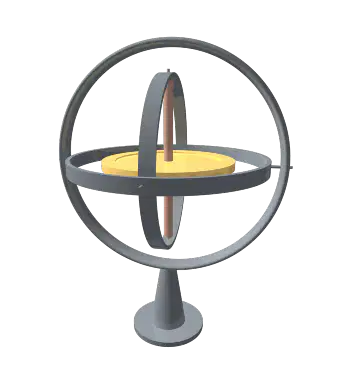
What is this?
A gyroscope
A barometer
A magnetometer

What is a fuselage on an airplane?
Where the luggage is stored.
Where the passengers sit.
Where the fuel is.

What is used to land and take off from the runway?
the wings
the landing gear
the throttle

What does the stabilizers do for the plane?
make it do loops
make it go higher
make it fly straight

The part of the plane that controls the speed is....
the wings.
the throttle
the fuselage

The yoke of the plane is like....
the steering wheel of a car.
the engine of a Dodge Charger.
the wheels on a bus.

There are many buttons and screens on this.
seats
wings
instrument panel

What is used to create "drag" on an airplane?
the throttle
the rudder
the flaps on the wings

When the rudder turns to the left the...
plane turns to the left
plane turns to the right
the plane will land

What do you use if you want the airplane to go up?
the throttle
the elevators
move all the passengers to the back

The wheels of a plane are called the
landing gear
landing wheels
fuselage
wheel rims
The __________ is the vertical part of the tail.
fin
tail
rudder
nose

FLAPS
AILERONS
SLATS
ELEVATORS

FLAPS
WINGTIPS
SLATS
SPOILERS
What is the main function of a piston engine in an airplane?
Generate the lift force
Propel the aircraft forward
Control the roll movement
Stabilize the aircraft
What is the main function of the empennage of an airplane?
Control the roll movement
Stabilize the aircraft
Generate lift force
Control the pitch movement
The fuel burned by the rocket creates a_______ which pushes the rocket upwards.
action
vacuum
thrust
frictrion
The ______of a rocket includes the cargo, passengers and equipment.
payroll
payload
propellant
chamber
The fuel and oxidizer used to propel a rocket.

