
 Worksheets
Mock EOG Review 23-24
Total questions: 102
Worksheet time: 1hrs 28mins
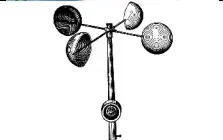
This weather instrument measures wind speed or how fast the wind is moving.
thermometer
wind vane
wind sock
anemometer
_______ is the combination of sunlight, wind, snow or rain, and temperatures in a particular region (area) at a particular time.
climate
forecast
temperature
Weather
During another part of Earth’s orbit around the Sun, Earth’s tilt causes the Northern Hemisphere to receive less direct sunlight than the Southern Hemisphere. When it is winter in the Northern Hemisphere, the Southern Hemisphere experiences the seasonal weather pattern of summer.
True
False
Meteorologists are scientists who study weather patterns.
True
False
Areas on Earth near the equator usually have warm temperatures throughout the year.
True
False
An imaginary line, called the ______, divides Earth into the Northern Hemisphere and the Southern Hemisphere.
latitude
equator
longitude
pole
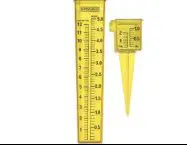
This rain gauge is a weather instrument that measures precipitation or water that falls to the ground in the form of rain or snow
True
False

Look at the pictures, descriptions and the type of predictable weather patterns on the image. Determine the correct order of each type of cloud.
A = cumulus
B = stratus
C = cirrus
A = cirrus
B = cumulus
C = stratus
A = cirrus
B = stratus
C = cumulus
During part of Earth’s orbit around the Sun, Earth’s tilt causes the Northern Hemisphere to receive more direct sunlight than the Southern Hemisphere. When it is summer in the Northern Hemisphere, the Southern Hemisphere experiences the seasonal weather pattern of fall.
True
False
Earth is _____ on its axis as it _____ (orbits) around the Sun.
placed, orbits
tilted, rotates
tilted, revolves
rotating, revolves
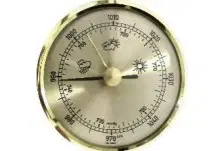
This weather instrument measures air pressure or the weight of air molecules pressing down on the Earth
anemometer
speedometer
thermometer
barometer
This weather instrument measures air pressure or the weight of air molecules pressing down on the Earth
anemometer
speedometer
thermometer
barometer
The difference in air pressure between the two air masses produces wind, or moving air. Air always moves from areas of Low pressure to areas of High pressure.
True
False
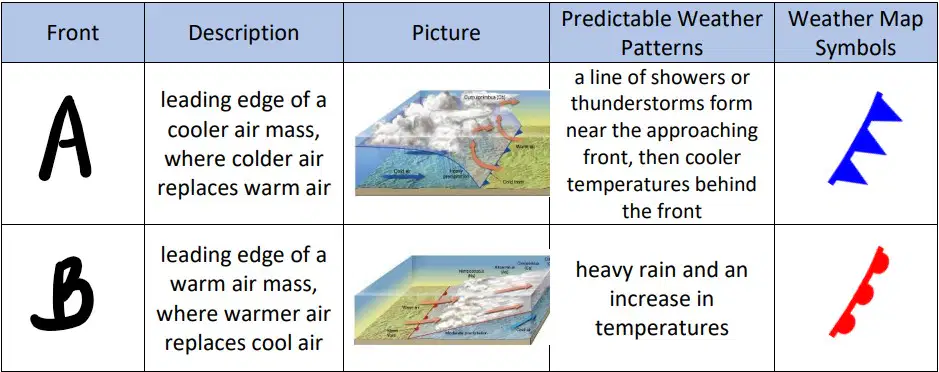
Using the image and the information provided, determine which type of front is being described for letter B.
hot front
warm front
cold front
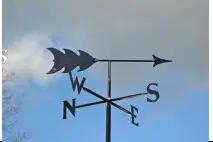
This weather instrument is a wind vane and it measures wind direction (North, South, East, West) from which the wind is blowing
True
False
Which type of pressure system produces clear, dry, fair “Happy Weather?"
Low pressure system
High pressure system
Air pressure system
El Niño is a water current or oscillation of unusually warm water temperatures in the Pacific Ocean. It causes many changes in weather conditions in other places, such as a lot of rain in areas that are usually dry.
True
False
The borderline between two air masses is called a(n) _____.
front
air mass
border
The ________ is a strong air current in the upper atmosphere. It is located over North America and flows from the West to the East. This flow helps move weather systems across North America in a West to East pattern.
current stream
Gulf stream
jet stream
Global weather patterns include air and water currents that have a powerful influence on weather conditions in the atmosphere. A current is a continuous movement of water or air in opposite directions.
True
False
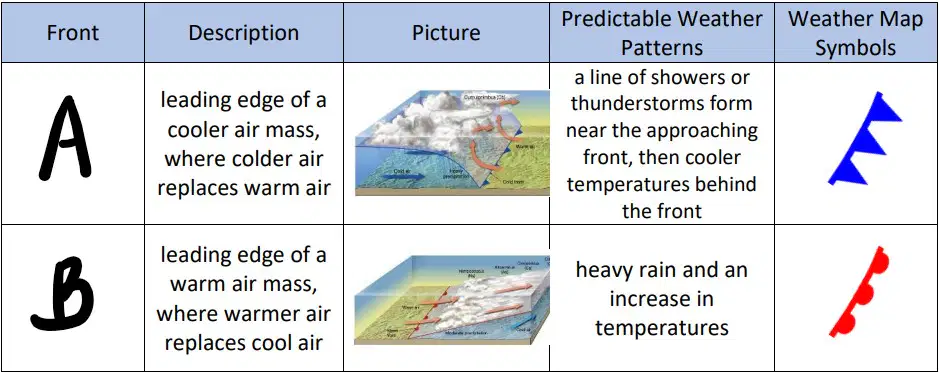
Using the image and the information provided, determine which type of front is being described for letter A.
hot front
warm front
cold front
The ________ is a strong, warm surface current in the North Atlantic Ocean. It moves from south of Florida up the eastern seaboard and then across the Atlantic.
current stream
Gulf stream
jet stream
_____ are major storms with very strong winds. They form over warm ocean water and are caused by global weather patterns. They occur especially in the western parts of the Atlantic Ocean.
tornadoes
thunderstorms
hurricanes
none of these
Which type of pressure system produces wet, precipitation, cloudy “Lousy Weather?"
Low pressure system
High pressure system
Air pressure system
La Niña is a water current or oscillation of unusually cooler water temperatures in the Pacific Ocean. It causes many changes in weather conditions in other places, such as winter temperatures that are warmer than normal in the Southeast region of the United States. The Northwest region of the United States will have winter temperatures that are cooler than normal.
True
False
A person rolls a ball on a flat surface that suddenly slopes downward. Which most likely describes the motion of the ball?
The ball stops when it reaches the downward slope.
. The ball speeds up as it travels on the downward slope.
The ball slows down as it travels on the downward slope.
The ball changes directions as it travels on the downward slope.
Which is the best example of friction?
applying brakes on a bicycle to slow down
getting wind in a sail to move forward
putting gas in a car to drive
falling apples from a tree to the ground
If a person pushes against a ball and the ball moves, which is true?
The person is applying force to the ball.
The person is changing the mass of the ball.
The force of gravity is less than the mass of the ball.
The force of friction is greater than the force of gravity.
Which has the greatest effect on a person who has jumped from a plane before opening their parachute?
lift
gravity
momentum
air resistance
A ball is rolled across a flat surface covered by carpet. Then, with same equal force, the ball is rolled on a flat, smooth surface. Which best explains why the ball rolls slower on the surface covered by carpet than on the smooth surface?
There is less gravity between the ball and the carpet.
There is less friction between the ball and the carpet.
There is more gravity between the ball and the carpet.
There is more friction between the ball and the carpet.
Which demonstrates a force being used to increase the speed of an object?
wind pushing the sails of a sailboat
a farmer pulling on the reins of a horse
a driver pressing on the brakes in a truck
a parachute opening during a person’s jump
A girl walked for 30 minutes. She noticed that she traveled farther in the first 15 minutes of her walk than in the second 15 minutes. What can she conclude about her walk?
She walked over many hills.
Her average speed was faster during the first half of her walk.
She walked in two different directions.
She was walking at a constant speed.
Which tool can best be used to measure the direction in which an object is moving?
a ruler
a watch
a compass
a barometer
A girl placed a leaf in a stream. After 5 minutes, the leaf had moved 100 yards away from the girl. Which best explains why the leaf changed its position?
the pulling force of the wind
the pushing force of the stream
the pulling force of the leaf against the water
the pushing force of the leaf against the water
Which best describes the distance an object moves in a given amount of time?
speed
gravity
momentum
friction
What information is needed to determine the speed of an object?
time and height
distance and time
distance and inertia
height and distance

The graph shows the motion of a soccer ball over time.
What most likely happened to the soccer ball at 20 meters?
The mass of the ball changed.
The shape of the ball changed.
The speed of the ball changed.
The direction of the ball changed.

The graph shows the movement of four horses around a track.
Which horse will most likely reach a distance of 12 miles after six minutes?
Horse E
Horse F
Horse G
Horse H

The graph below shows the motion of two objects, Object X and Object Y.
Which best describes the motion of objects X and Y at the point in time marked on the graph?
Object Y has been in motion longer than Object X.
Object X has been in motion longer than Object Y.
Object X has traveled more slowly than Object Y.
Object X has traveled farther than Object Y.

The graph below shows the motion of a bike over time.
Which statement is true?
The bike is speeding up.
The bike is slowing down.
The speed of the bike is constant.
The speed of the bike is constantly changing.

A force of the same strength is applied to each of the boxes shown in the diagrams.
Which best describes the motion of the boxes?
The boxes will move at the same speed.
The boxes will move in opposite directions.
The 10-lb box will move faster than the 20-lb box.
The 20-lb box will move faster than the 10-lb box.
Four balls of different masses are rolling down a hill at the same speed. Which ball will most likely take the least amount of force to stop?
40 gram ball
30 gram ball
20 gram ball
10 gram ball

Which statement is true about the seesaw?
The seesaw will be unaffected by the weight of the objects on each end.
The seesaw will remain balanced when objects of the same weight are positioned on each end.
The seesaw will remain balanced when objects of different weights are positioned on each end.
The seesaw will become unbalanced when objects of the same weight are positioned on each end.
If equal forces act in opposite directions on a resting object, what is the most likely result?
The object will remain at rest.
The object will move slowly in one direction.
The object will move quickly in one direction.
The object will move in one direction and then in the other direction.

Two teams play a game called “tug-of-war.” Each team wants to pull the flag, located in the middle of the rope, across the finish line. Which must happen for a team to win in a game of “tug-of-war”?
Both teams must pull with equal force.
One team must pull with greater force than the other team.
One team must push with greater force than the other team.
Both teams must have members that weigh exactly the same.

Use the diagram to answer the question that follows.
What process is shown by the X?
radiation
evaporation
precipitation
condensation
Which is the opposite of condensation
runoff
evaporation
precipitation
transpiration

The picture shows the water cycle on Earth.
In what part of the process does liquid water change to water vapor?
precipitation
evaporation
transpiration
condensation
Water evaporates mostly from
land
snow
clouds
oceans
The water cycle includes which processes?
evaporation, condensation, precipitation
metamorphosis, evaporation, respiration
precipitation, perspiration, mitosis
fixation, decomposition, respiration
Jacob made a table and recorded the events that happen on a rainy day.
Time / Rain Storm Event
8:00 AM / Clouds form in the sky.
9:30 AM / Rain begins falling.
10:00 AM / A puddle forms in the street.
12:00 PM / Rain stops falling.
12:30 PM / The sky becomes clear.
3:30 PM / The puddle dries up.
Which event BEST shows how the Sun powers the water cycle?
clouds form in the sky
a puddle forms in the street
rain stops falling
the puddle dries up
How does the Sun MOST affect the water cycle?
The Sun causes the ocean water to evaporate.
The Sun creates water droplets in the clouds.
The Sun forces water to drain back into the ocean.
The Sun makes the clouds produce precipitation.
Camilla put water in two flat, uncovered pans. She placed one pan in a sunny spot and put the other pan in a shady spot. She left the pans for 12 hours, then returned and measured the water in both pans. What MOST likely happened to the water in the pans?
More water evaporated from the pan exposed to sunshine.
More water evaporated from the pan left in the shade.
The same amount of water evaporated from both pans.
No water evaporated from either pan.
One morning, Jane notices drops of water on the outside of a window. Later in the day, she notices that the drops have disappeared. What most likely caused the drops to disappear?
The water condensed on the plants around the house.
Energy from the sun caused the water to evaporate.
The water cooled enough to turn into water vapor.
Wind blowing on the window turned the water into vapor.
Which best describes how the sun’s energy impacts the process of precipitation?
The sun’s energy causes water to collect into oceans, which evaporates into the atmosphere, then forms into clouds.
The sun’s energy causes water to evaporate into the atmosphere, which forms into clouds, then condenses into the oceans.
The sun’s energy changes liquid water into vapor, which condenses into clouds, then falls back to the earth as rain, sleet, or snow.
The sun’s energy changes liquid water into clouds, which condenses into vapor, then falls back to the earth as rain, sleet, or snow.
Evaporation, condensation, and precipitation are all processes which occur in the
water cycle
energy cycle
carbon cycle
nitrogen cycle

The diagram represents part of the water cycle.
Which form of water is represented by arrow 1?
water vapor
surface water
rainwater
groundwater
What happens when the Sun’s energy warms ocean water?
The water collects.
The water evaporates.
The water condenses.
The water precipitates.
Which would most likely increase on a hot, sunny day?
runoff
condensation
transpiration
Which is an example of condensation?
water boiling in a pot
water being absorbed by plants
salt being removed from water
moisture on mirror after hot shower
Rain, sleet, snow, and hail are examples of which process in the water cycle?
condensation
evaporation
precipitation
Mike observes solid ice pellets falling from the sky. Which type of precipitation is he most likely seeing?
fog
rain
sleet
snow
Which system functions to transport messages between the brain and other parts of the body?
respiratory system
nervous system
digestive system
skeletal system
Which of the following statements best describes unicellular organisms?
Unicellular organisms have transport systems between cells.
Unicellular organisms have many cells that must work together to perform life processes.
Unicellular organisms are a single cell that performs all life processes.
Unicellular organisms live only inside other living organisms.
Which of the following is an example of a multicellular organism?
human
flower
fish
all of the above
All of a human's organ systems interact with each other. How do a human's circulatory and respiratory systems interact?
The circulatory system pumps blood to the stomach to aid in digestion.
The respiratory system rids the circulatory system of extra fluids and cells.
The respiratory system provides the pump that helps the circulatory system move blood throughout the body.
The circulatory system transports the oxygen brought in by the respiratory system to other areas of the body.
Select the choice that best completes the following sentence:
The _______ system breaks down the food we eat, while the _______ system transports the nutrients to each cell in the body.
circulatory; digestive
digestive; respiratory
muscular; circulatory
digestive; circulatory
How does the circulatory system work with the digestive system?
Blood is used to build muscle strength.
Food is broken down in the bloodstream.
Blood transports nutrients throughout the body.
Food waste is filtered by the heart and blood vessels.
Which two human body systems are MOST responsible for getting oxygen to cells?
digestive and skeletal
skeletal and circulatory
circulatory and respiratory
respiratory and digestive
Which system produces red blood cells?
skeletal
nervous
digestive
circulatory
Which is responsible for providing oxygen to cells?
skeletal system
digestive system
muscular system
circulatory system
What are the three main parts of the circulatory system?
Blood, Heart, and Lungs
Blood, Blood Vessels, and Heart
Smooth muscles, Lungs, and Bones
Blood Vessels, Muscles, and Air Sacs
A class is modeling the differences between a unicellular organism and a multicellular organism. Which example is a model of a unicellular organism?
a student passing out water to a group
a student getting cereal from the cabinet
two students collecting trash from a group
four students working together to move a desk
Which BEST describes ALL unicellular organisms?
Every cell is round.
Every cell can make food.
Every cell can move on its own.
Every cell performs all life functions.
What is the main purpose of single-celled organisms?
to survive
to reproduce
to produce food for other organisms
to work with other single-celled organisms
Which statement would most likely be found in an article about multi-celled organisms like plants?
Plants have a simple structure.
Plants contain only one cell that performs all functions.
Plants do not need to eat, remove waste, or reproduce.
Plants contain many specialized cells that perform different functions.
Why does a human require specialized cells to live?
Specialized cells allow humans to adapt to changes in their environment.
Human bodies have systems that require cells with different functions.
Specialized cells allow for all life processes to occur in one cell.
Human bodies are simple and require few cells.
An organism can only be seen through a microscope. Which is most likely true of that organism?
It is a plant.
It is an animal.
It is multicellular.
It is single-celled.
A unicellular organism is BEST described as being
a complex organism.
a microorganism.
an organism with specialized cells.
an organism with different types of tissues.
How are single-celled organisms and multi-celled organisms similar?
Both need food for energy and growth.
Both have a skeletal system for support.
Both require the interaction of many cells to survive.
Both are able to carry out all life functions in only one cell.
Which best describes a snake?
A snake is made up of one cell that carries out one life process at a time.
A snake is made up of many cells that carry out one life process at a time.
A snake is made up of one cell that carries out many different life processes when needed.
A snake is made up of many cells that carry out many different life processes when needed.
In which way are multicellular organisms similar?
All of their cells transport food.
All of their cells have the same job.
All have cells that work together to keep the organism alive.
All have one cell that meets all the basic needs of the organism.
Max is comparing the characteristics of different types of organisms. Which best describes a difference between insects and bacteria?
Insects are made of one cell, while bacteria are made of many cells.
Bacteria are made of one cell, while insects are made of many cells.
Insects require energy to perform life functions while bacteria do not.
Bacteria require energy to perform life functions while insects do not.
Which two human body systems are MOST responsible for getting oxygen to cells?
digestive and skeletal
skeletal and circulatory
circulatory and respiratory
respiratory and digestive

The table describes some human body systems. Which row provides correct information?
1
2
3
4

The drawing shows the system that transports nutrients to cells in an insect. Which system in humans has a function MOST like the system shown?
circulatory
digestive
nervous
respiratory
Bone cells need nutrients. Which two systems get nutrients to bone cells?
the digestive system and the circulatory system
the circulatory system and the respiratory system
the respiratory system and the skeletal system
the skeletal system and the digestive system
How do the muscular and skeletal systems work together to help the body?
They provide blood to the body.
They provide nutrients to the body.
They provide structure and movement for the body.
They provide oxygen and carbon dioxide to the body.
Which is responsible for providing oxygen to cells?
skeletal system
digestive system
muscular system
circulatory system
Which best explains the effects of exercise on the respiratory system?
Exercise increases breathing rate which makes the lungs stronger.
Exercise increases breathing rate which makes the bones stronger.
Exercise decreases breathing rate which sends more oxygen to the brain.
Exercise decreases breathing rate which produces more wastes for the kidneys to process.
Which two human body systems work closely together to distribute nutrients from food throughout the body?
muscular and skeletal
digestive and circulatory
circulatory and respiratory
cardiovascular and digestive
Why is the digestive system so important for the human body?
It circulates blood to all of the organs.
It moves oxygen through the lungs and into the blood.
It carries away waste products from the place they are created.
It breaks food into nutrients and moves the nutrients into the blood.
Which task in the human body is accomplished through the combined efforts of the cardiovascular and muscular systems?
protecting major body organs
pumping blood throughout the body
releasing waste products from the body
moving water and nutrients from one organ to another
The circulatory system transports waste through the bloodstream. Which is the best example of another system working to remove waste from the body?
The respiratory system releases carbon dioxide.
The skeletal system produces new red blood cells.
The digestive system breaks down food into nutrients.
The nervous system send signals from the brain to the muscles.
Which best compares the respiratory system to the circulatory system?
The respiratory system transports oxygen to cells, while the circulatory system provides oxygen for cells.
The respiratory system provides oxygen for cells, while the circulatory system transports oxygen to cells.
The respiratory system breaks down food for cell energy, while the circulatory system rids the body of waste.
The respiratory system rids the body of waste, while the circulatory system breaks down food for cell energy.
Which best describes the circulatory system?
a system made up of the brain and nerves that delivers nutrients and removes waste from the body
a system made up of lymph and blood that delivers nutrients and removes waste from the body
a system made up of the brain and nerves that delivers messages throughout the body
a system made up of the heart and blood that delivers messages throughout the body
Which best describes the relationship between the skeletal system and the circulatory system?
The skeletal system transports red blood cells after the circulatory system produces them.
The skeletal system protects red blood cells and the circulatory system pumps those cells through veins and arteries.
The skeletal system produces red blood cells and the circulatory system transports those cells where they need to go.
The skeletal system helps put oxygen in red blood cells and the circulatory system helps those cells rid the body of carbon dioxide.

