
 Worksheets
Sound Review
Total questions: 12
Worksheet time: 24mins
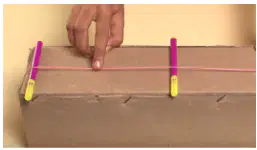
Ginny and Marshall are using a rubber band, 2 markers, and a box to learn about pitch. First, they stretch a rubber band around a box. Next, they place markers under the rubber band. They can move these markers to make the section of the rubber band that's being plucked shorter and longer.
Marshall makes a sound by placing the markers as seen in the picture below. He plucks the rubber band with his finger.
Ginny wants to make a higher pitch sound than the one that Marshall made. Which picture shows how she should place the markers so that when she plucks the rubber band, it will result in a higher pitch?


Ethan is investigating how to produce a sound. He taps a metal fork with a metal spoon. What will most likely happen?
The fork vibrates and makes a sound
The fork does not vibrate or make a sound.
The fork vibrates but does not make a sound.
Fourth grade students all created different ways to investigate sound.
Which of the following will both groups encounter when producing sound?
Only group 1 will hear sound because rubber bands are used to create vibrations when pulled on.
Both groups will move an object that will create a response with a sound and vibrating objects.
Only group 2 will hear sound because the ruler will vibrate and create a sound.
Three students wanted to investigate sound and vibrations with the same materials. One student flicked a string every 10 seconds, one student flicked a string every 5 seconds, and another student flicked a string every 2 seconds. What will the students observe?
Speed does not impact vibrations or sound.
The string was the highest pitched sound when vibrating the fastest.
The string was the highest pitched sound when vibrating the slowest.

A student fills different glasses of water with different amounts of water to investigate sound. What will happen when the student taps the glasses?
All of the glasses of water will produce different sounds, but there is no way of knowing what type of sound they will make until you hit all glasses and make observations.
The glass with the most water will have the lowest pitch sound since vibrations slow down to travel through the most water.
All glasses of water will produce the same sound since the vibrations are traveling through the same type of liquid.
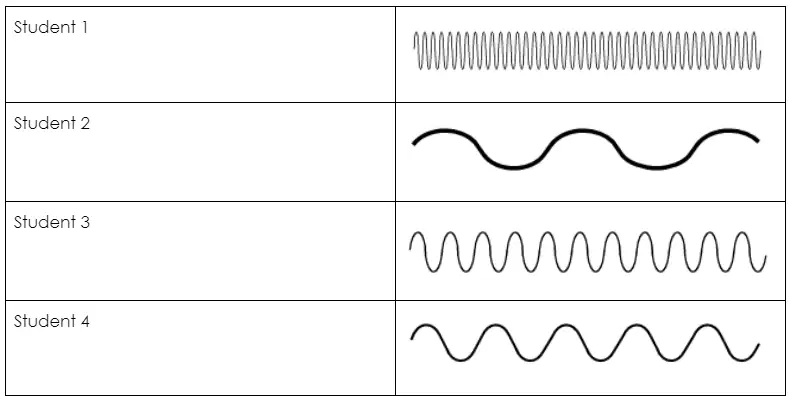
Four students investigated sound in the classroom. A visual of the four vibrations are documented.
Which student conducted an investigation that had the lowest pitch sound?
Student 1
Student 2
Student 3

Liz is working on her plan to create a device that will use sound waves to communicate yes or no answers to her friend's questions. She fills two glass bottles with the same amount of water. The picture shows her device.
She will tap each of the bottles once with a spoon to create two different sounds. One bottle will produce a high pitch sound when tapped with the spoon, and the other bottle will make a low pitch sound. She explains to her friend that the lower pitch means "no" and the higher pitch means "yes."
Will her device be able to communicate the yes or no messages using different pitches?
Yes, she will be able to create different pitches of sound because both bottles are filled with water all the way to the top.
No, she will not be able to produce any sound at all because the jars are filled with water.
No, she will not be able to produce different pitches. Both bottles will have the same pitch when tapped with the spoon because the water levels are the same.
Adam is playing outside. He wants his brother to come outside and play with him. Adam bangs on his drum to signal his brother inside the house. What did Adam's device use to communicate information?
sound
light
heat
A student is trying to get her friend's attention from across the room. The teacher left a whole set of supplies in the middle of the table. What can the student do to communicate with her friend using light?
The student should pick up a white piece of paper and wave it in the air until light reflects from the paper to the student.
The student should use a mirror and use the sun shining in from the window to reflect the sun to the student across the room.
The student should pick up a metal tin and hit it with a plastic spoon over and over.
Students are going camping and are creating a signal sound to use whenever they want their friends to come find them. Which of the following can the students do?
The student should use whistles made out of clay.
The students should use flashlights and point them at the sky.
The students should use mirrors to reflect light across the campsite.
The following students made devices to communicate with friends across the room.
What is similar about how all three of these devices will be used to communicate?
Student 1 Uses paper to make a megaphone
Student 2 Uses cups and strings to make a telephone
Student 3 Uses metal cans to build a drum
They are all created in order to speak to one person to another.
They are all created in order to communicate with light.
They will all produce vibrations, which will result in a sound.
Students were tasked with creating devices to communicate with either light or sound using common materials.
Student 1 Flashing lights on and off in a pattern
Student 2 Using pans and spoons in a pattern
What conclusion can be drawn from the devices created by the students?
Both students were able to communicate using common materials by using lights and sounds in patterns.
Both students were not able to communicate using common materials since there is no physical speaking.
Student 2 is successful in communicating using common materials by using light.

